Skip to content
Market Insights
MetalsChris Stadele2 min read

Will Iron Ore and Steel Fall Victim to the Australia-China Trade War?

Australia's intention to research the origins of the coronavirus ignited a trade war with China in late 2020, and Australia's alignment with the West ove...

Australia's intention to research the origins of the coronavirus ignited a trade war with China in late 2020, and Australia's alignment with the West over Chinese hacking allegations this month have added fuel to the fire. The two countries depend on each other for iron ore trade, and ore prices could fall if trade frictions increase.


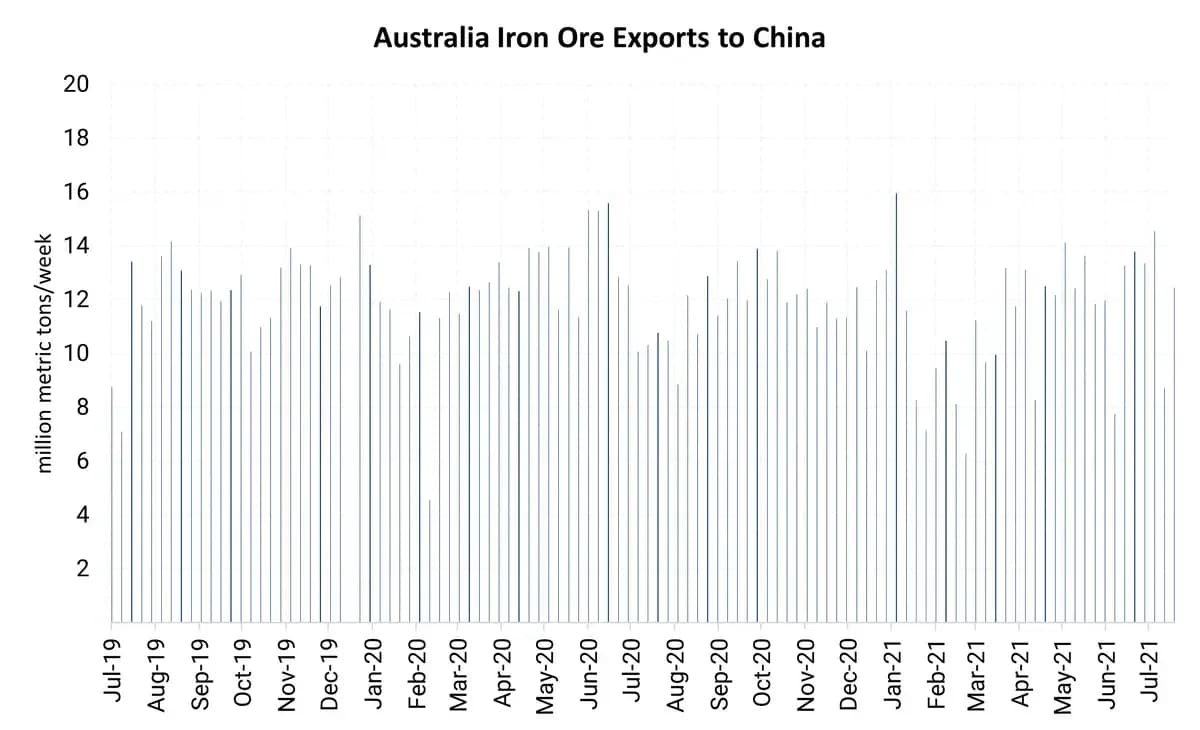
Summary: According to Metal Miner, "trade figures show that in the first five months of 2021, 69.3% of total Chinese iron ore imports came from Australia." Likewise, according the Minerals Council of Australia, approximately 80% of Australia's iron exports go to China. Despite the brewing trade war, Australia is still heavily dependent on China, as over 75% of Australia's iron ore shipments went to China in late June 2021, according to Argus Media. China is seeking its own alternative sources for iron ore, thus flexing its muscle over Australia. For instance, an Australian-domiciled company with ties to the Chinese government recently acquired rights to an iron-ore mining project on the border of Cameroon and the Congo.

Will Iron Ore and Steel Fall Victim to the Australia-China Trade War?: chart 1
Source: AEGIS Hedging
  • According to Metal Miner, "trade figures show that in the first five months of 2021, 69.3% of total Chinese iron ore imports came from Australia."
  • Likewise, according the Minerals Council of Australia, approximately 80% of Australia's iron exports go to China.
  • Despite the brewing trade war, Australia is still heavily dependent on China, as over 75% of Australia's iron ore shipments went to China in late June 2021, according to Argus Media.
  • China is seeking its own alternative sources for iron ore, thus flexing its muscle over Australia. For instance, an Australian-domiciled company with ties to the Chinese government recently acquired rights to an iron-ore mining project on the border of Cameroon and the Congo.

AEGIS Thoughts & Strategies: Both have benefited from the economic partnership, and likely neither economy will benefit from an ongoing trade war. As we have recently commented (here and here), China's economy has been slowing. Australia's Q1 GDP, released June 1, was 1.8% q/q, which was higher than trade estimates of 1.5%, yet lower than the 3.2% reported the previous quarter. Both economies are still growing, but are still off-pace of pre-pandemic levels. If China ceases imports of Australian iron ore, a knock-on effect might be a drop in both iron ore and steel prices. Australia could easily find a Western market for its iron ore; however, it is likely none will match the demand of the Chinese. Hence, with supply outweighing demand, prices could be pressured lower.

Want this in your inbox?

AEGIS market analysts publish research across crude, natural gas, NGLs, refined products, metals, and rates.

Subscribe to research

We use a few essential cookies to make our site work, including one that counts how many reports you have opened. Analytics cookies are used only with your permission, and you can change your mind at any time. Learn more about cookies in our privacy policy.