Skip to content
Market Insights
MetalsChris Stadele2 min read

Can China Both Jump Start Their Economy and Rein in Copper's Rally?

Copper has been red-hot this year, but the Hang Seng Index, which normally moves lockstep with the metal, has stalled. Efforts to jump start the ec...

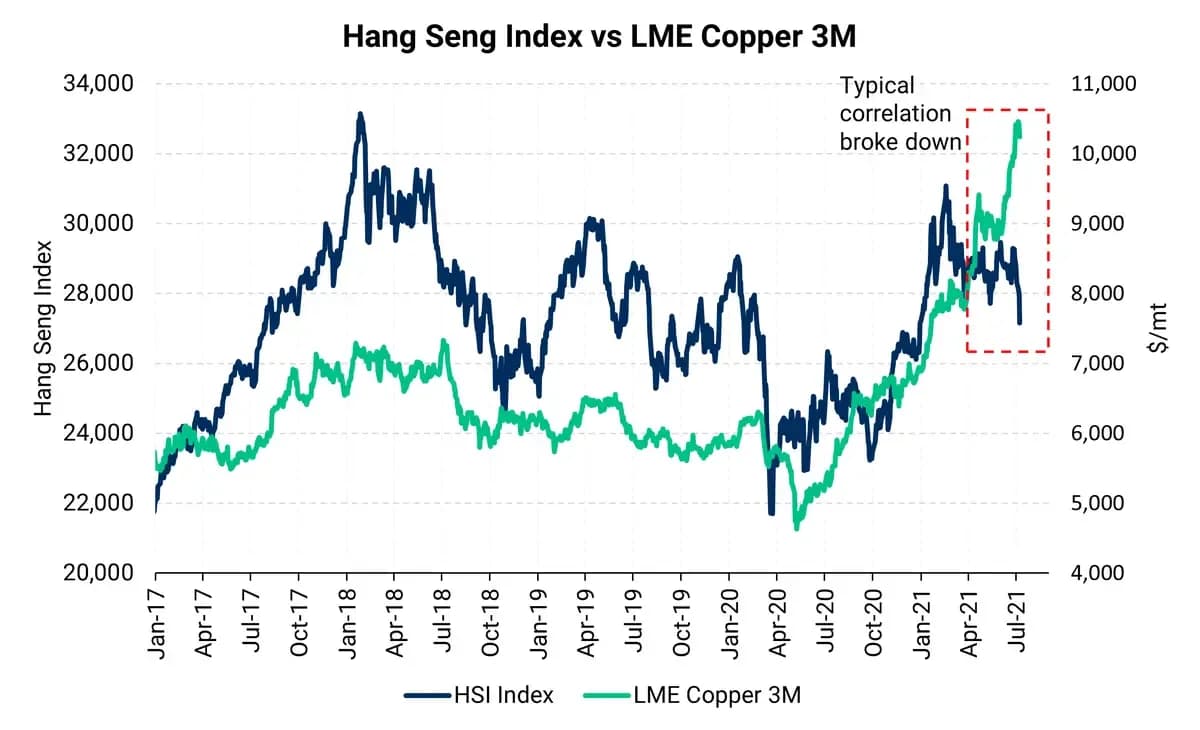
Copper has been red-hot this year, but the Hang Seng Index, which normally moves lockstep with the metal, has stalled. Efforts to jump start the economy might not bring this relationship back to normalcy.


Summary: The Hang Seng Index is the most watched stock index from China, and is considered to the most accurate representation of the country's economy. Copper is a staple of China's economy, so the Hang Seng Index and copper normally have a tight correlation. However, these markets have diverged this year as China's economy has stalled, yet copper has held strong. Will China's efforts to jump-start the economy keep copper marching higher, or will its deflationary efforts impede copper's rally? AEGIS investigates... .

Can China Both Jump Start Their Economy and Rein in Copper's Rally?: chart 1
Source: AEGIS Hedging
  • The Hang Seng Index is the most watched stock index from China, and is considered to the most accurate representation of the country's economy.
  • Copper is a staple of China's economy, so the Hang Seng Index and copper normally have a tight correlation.
  • However, these markets have diverged this year as China's economy has stalled, yet copper has held strong.
  • Will China's efforts to jump-start the economy keep copper marching higher, or will its deflationary efforts impede copper's rally? AEGIS investigates... .

AEGIS Thoughts & Strategies: In an effort to cool inflation, China has recently open its metals reserves, as the first auctions occured last Monday and Tuesday (July 5-6). To restimulate the economy, China’s cabinet announced on Wednesday (July 7) that it will implement a variety of monetary tools, including lowering the banking reserve requirement ratio (RRR). Wednesday's statements were followed on Friday by the announcement that they will lower the RRR by 50 basis points, effective July 15. To clarify, the RRR is portion of reserves that banks must keep “in the vault." By lowering this requirement, banks can do more lending and better support the larger economy. The government is also requesting that banks lower financing costs to smaller companies. However, their stimulus efforts have the potential of creating inflation, as lowering financing costs for borrowers and other monetary stimuli incentivizes producers to obtain lower interest rate loans to rebuild inventories of raw materials. This could potentially drive prices of raw materials and finished goods ever higher. So which effort will win out? For now, the bulls have the upperhand; however, slower economic growth from China is likely to limit copper demand, and sales of China's reserve metals puts pressure on prices. These would balance against the country's efforts to incentivize investment.

Want this in your inbox?

AEGIS market analysts publish research across crude, natural gas, NGLs, refined products, metals, and rates.

Subscribe to research

We use a few essential cookies to make our site work, including one that counts how many reports you have opened. Analytics cookies are used only with your permission, and you can change your mind at any time. Learn more about cookies in our privacy policy.