
Geopolitical swings push crude higher into the weekend as escalation risk builds
Crude markets spent the week oscillating between diplomacy and escalation as US-Iran negotiations progressed throughout the week even as military posturing intensified across the region. Early optimism around constructive exchanges gave way to renewed anxiety as traders reassessed the probability of confrontation heading into the weekend. On Friday prices rallied, with the WTI prompt-month contract settling at $67.02/Bbl, up $1.81 on the day, underscoring how quickly the risk sentiment shifted towards escalation.
Front-end volatility remains elevated and call skew continues to favor upside protection, a pattern consistent with prior geopolitical flashpoints. The market is assigning value to tail risk scenarios tied to potential disruption in the Strait of Hormuz, through which roughly one quarter of global seaborne crude flows.
Although Middle East tensions are driving near term pricing, the medium-term balance remains pointed toward surplus. Global inventories are projected to build materially in 2026 and remain elevated into 2027 as supply growth outpaces demand. Further additions are likely as OPEC+ delegates signaled another round of production quota increases for their upcoming meeting, potentially around 137 MBbl/d, consistent with prior increases.
At the same time, institutions have begun adjusting price expectations higher. Goldman Sachs recently lifted its late 2026 WTI forecast from $50 to $56/Bbl, citing smaller than expected inventory builds across developed economies. Sanctioned crude has increasingly built at sea as restrictions complicate discharge, particularly with India tapering purchases of Russian barrels. China has also acted as a key absorber of excess supply. Throughout 2025, Chinese buyers absorbed discounted crude to meet strategic petroleum reserve requirements, diverting barrels that might otherwise have flowed into OECD commercial inventories. If Chinese buying were to slow, incremental supply would likely appear more clearly in OECD balances, translating into renewed downside pressure absent the current geopolitical premium.
At present, US–Iran tensions are setting the tone. If diplomacy prevails, the geopolitical premium would likely fade, exposing a structurally loose forward balance characterized by rising supply and the risk of accelerating inventory builds. If escalation takes hold, the highly sensitive geopolitical backdrop could materially reprice crude higher. Until the situation resolves decisively in one direction or the other, crude will remain driven less by steady fundamentals and more by the evolving probability of conflict.
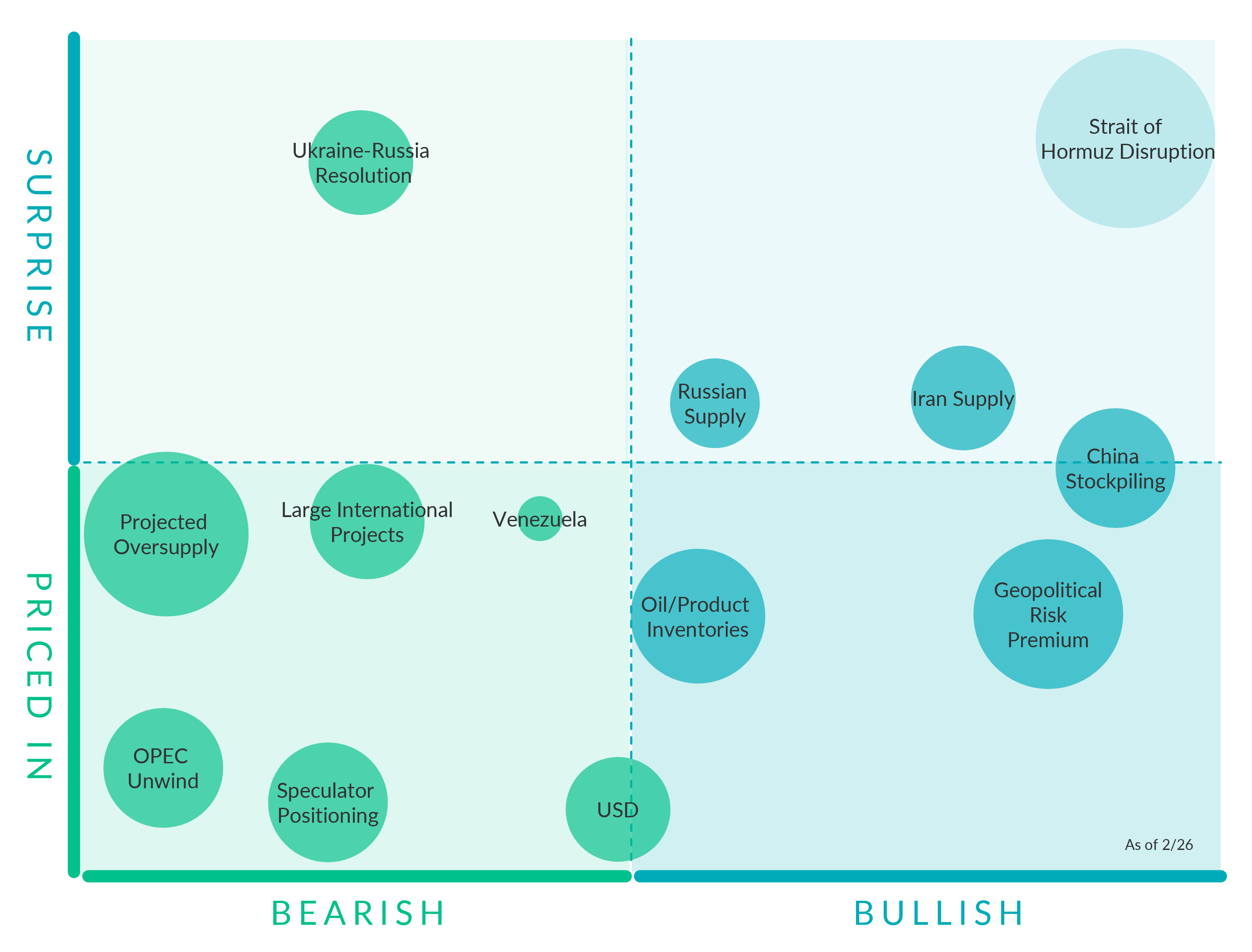
Crude Oil Factors
Geopolitical Risk Premium. (Bullish, Slightly Priced In) Crude futures rallied into the weekend as markets braced for potential escalation surrounding upcoming nuclear negotiations. Iranian Foreign Minister Abbas Araqchi said technical teams would meet in Vienna starting Monday and that political talks will resume next week. However, concerns about a potential US strike on Iran is supporting crude prices, with the US military buildup in the region now the largest since the 2003 Iraq invasion, reinforcing a geopolitical risk premium.
Speculator Positioning (Bearish, Priced In) Elevated geopolitical risk is increasingly reflected in oil market positioning. According to Bloomberg, upside-focused options have traded at sustained premiums to downside protection for much of the year.
Oil/Product Inventories. (Bullish, Priced In) The latest Oil Market Report from the IEA indicates global inventories are expanding at the fastest pace since the pandemic, with stockpiles rising sharply and OECD inventories returning above historical norms. Demand growth expectations have been revised lower and the agency now anticipates a surplus exceeding 3.7 MMBbl/d in 2026, underscoring the scale of the emerging imbalance.
OPEC Unwind. (Bearish, Mostly Priced in) Several OPEC+ delegates indicated the group is likely to move forward with a gradual return of curtailed barrels when it convenes this weekend to assess April production policy. Discussions have centered on a potential 137 MBbl/d increase, consistent with the incremental adjustments implemented late last year.
China Stockpiling. (Bullish, Surprise) A significant portion of recent global stock builds has been absorbed into Chinese strategic reserves, effectively converting what would otherwise appear as excess supply into incremental demand. The EIA expects this pattern to persist through 2026, with China continuing to add crude to storage at a pace near 1 MMBbl/d before moderating in 2027. This behavior helps cushion near-term price declines by tightening observable market balances, even as underlying global supply growth continues to exceed consumption. Once strategic stockpiling slows, however, the buffering effect diminishes, leaving prices more directly exposed to the broader surplus implied by rising non-OPEC production and moderating demand growth.
USD (Bearish, Priced In) The recent U.S. Supreme Court decision overturning former President Trump’s broad tariff authority led to a modest dip in the U.S. dollar as investor uncertainty eased and Treasury yields rose, reflecting a short-term softening in safe-haven demand. In oil markets, a weaker dollar can be slightly supportive for crude prices by making oil cheaper in foreign currency terms, but the ongoing geopolitical risk premium from Middle East tensions continues to be the dominant driver of crude strength at the moment.
Large International Projects (Bearish, Priced In) Major offshore developments in countries like Brazil and Guyana are now translating years of capital-intensive investment and long development timelines into meaningful production growth. These deepwater projects are finally ramping volumes into the global market, adding steady, non-OPEC supply that contributes to medium-term balance loosening and moderates structural upside pressure on crude prices.
Ukraine-Russia Resolution. (Bearish, Surprise) Talks between Russia and the Ukraine are ongoing and being mediated by the US, but no tangible results are yet to arise that would bring an end to the war in Ukraine. A peace deal, if followed by the elimination of sanctions on Russian oil over its invasion of Ukraine, could unleash supply from the world's third largest producer.
Trade War. (Bearish, Mostly Priced In)The US Supreme Court ruled 6–3 that former President Trump’s broad global tariffs imposed under emergency powers were unconstitutional, dealing a significant setback to his trade agenda. However, efforts to maintain or reimplement tariffs under alternative legal authorities have preserved uncertainty around US trade policy, keeping the risk of renewed trade tensions and demand headwinds in play for global markets.
Projected Oversupply. (Bearish, Mostly Surprise) The latest EIA STEO reinforces that these geopolitical episodes are occurring against a backdrop of persistent oversupply. The STEO forecasts global oil inventories will continue to build through 2026, with implied stock builds averaging roughly 2.8 MMBbl/d, as global production growth outpaces demand.
Iran Supply. (Bullish, Slight Surprise) Iran continues to supply roughly 3.2–3.3 mb/d, with exports near multi-year highs around 1.7–2.0 mb/d. With flows still intact, Iran’s impact on crude has been more about potential disruption than realized supply losses.
Russian Supply. (Bullish, Slight Surprise) Russian exports also faced growing logistical friction as US sanctions pushed more barrels into shadow-fleet channels. Strikes on refineries and export facilities have slowed transit and increased reliance on intermediaries, lifting Russian oil-on-water above 180 MMBbl.
Venezuela. (Bearish, Slight Priced In) Venezuela remains a constrained but potentially growing source of supply, producing roughly ~0.8–1.1 mb/d in recent months, far below historical capacity and less than 1% of global output.
Recent policy shifts and easing restrictions could allow incremental increases, with analysts suggesting output could rise by roughly 30% from current levels in the short to medium term, though structural limitations and infrastructure decay cap near-term upside.
Strait of Hormuz Disruption (Bullish, Surprise) The Strait of Hormuz is a critical oil chokepoint, with roughly one-fifth of global crude flows transiting the waterway, meaning any disruption immediately threatens global supply and forces prices higher via a rising risk premium. Escalation between the US and Iran increases the probability that shipping through the strait could be disrupted, putting a large volume of export barrels at risk and amplifying upside pressure on crude.
Commodity Interest Trading involves risk and, therefore, is not appropriate for all persons; failure to manage commercial risk by engaging in some form of hedging also involves risk. Past performance is not necessarily indicative of future results. There is no guarantee that hedge program objectives will be achieved. Certain information contained in this research may constitute forward-looking terminology, such as “edge,” “advantage,” ‘opportunity,” “believe,” or other variations thereon or comparable terminology. Such statements and opinions are not guarantees of future performance or activities. Neither this trading advisor nor any of its trading principals offer a trading program to clients, nor do they propose guiding or directing a commodity interest account for any client based on any such trading program.