
Natural gas falls on near-record warm March
The April Henry Hub contract fell 13c this week to settle at $2.87/MMbtu, as weather-driven losses continue. The Summer ’26 strip lost 11c to settle at $3.20/MMbtu and Winter ‘26/’27 fell 7c to $4.09/MMbtu. The March contract expired at $2.97/MMbtu this week, with Summer ’26 now the prompt season. A bearish weather outlook continues to be the primary driver of price weakness in the front of the curve.
Gas prices trended lower throughout the week as weather forecasts continued to show exceptionally warm temperatures for the first half of March. The Euro Ensemble forecast for the Lower-48 shows temperatures rising to nearly 10 ºF above the ten-year average over the next two weeks. Commodity Weather Group forecasts this March to be the fourth warmest of the past 25 years, which would be only slightly cooler than March 2025. While March is not a month of particularly strong weather-driven gas demand, a bearish weather pattern will still result in a loosening of the supply-demand balance. If weather materializes as forecast, it will likely result in a storage injection two weeks earlier than the five-year average rate. This could result in inventories starting summer around the five-year average rather than at a relatively steep deficit.
Inflows into the Golden Pass LNG export plant continued to climb as Train 1 starts up. Feedgas levels at Golden Pass reached nearly 300 MMcf/d, out of a total Train 1 capacity of 790 MMcf/d. The ramp up of Golden Pass and the remaining Corpus Christi Stage Three trains over the course of 2026 should drive continued strength in LNG feedgas demand.
While prices have softened in recent weeks, call-put skew remains elevated for the next few seasons. This can allow for producers to get a more favorable costless collar, especially for the winter seasons, where call skew is the norm.
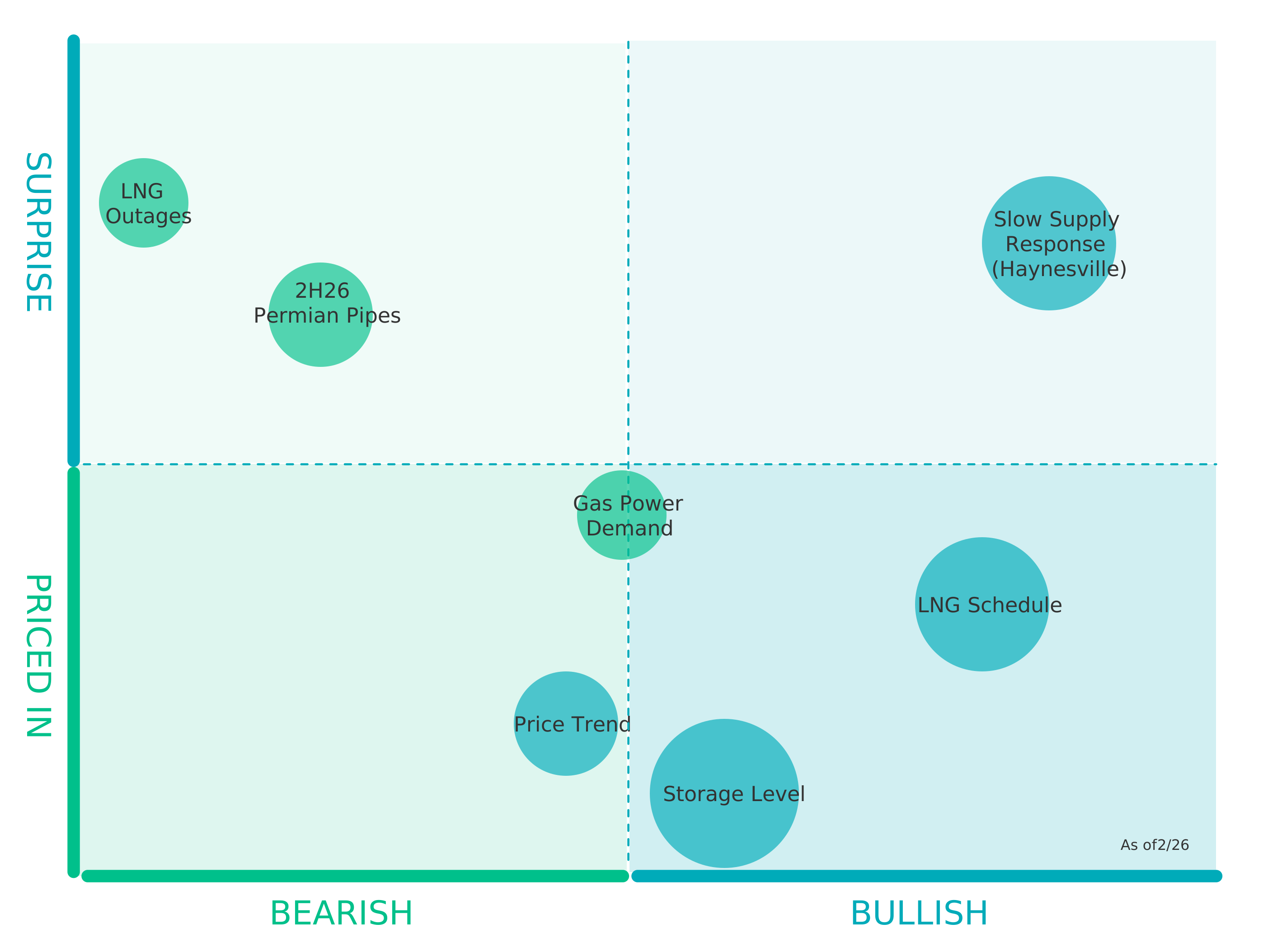
Natural Gas Factors
Price Trend. (Bearish, Priced In) The March Henry Hub contract has trended lower over the last few weeks as the near-term demand outlook turned less bullish. The contract fell below $3/MMbtu this week, down about $1.50 from the highs seen in late January.
Storage Level. (Bearish, Priced In) The storage level is a bearish priced-in factor due to the high levels of gas in inventories relative to the five-year average. According to the latest EIA weekly natural gas inventory report, Lower-48 storage is now at a deficit of -123 Bcf to the five-year average and 59 Bcf lower than last year.
Associated Gas Production.(Bearish, Priced In) Growth in associated gas production will be much slower than has beeen seen over the past few years, at least until the second half of 2026. Pipeline capacity out of the Permian Basin will begin to grow again next year, likely filling relatively quickly. These new Permian pipes should enter servicce around the same time as projects which will reroute gas around Houston, towards the border of Louisiana.
LNG Outages. (Bearish, Surprise) Feed-gas levels are at their near max capacity, and if there's any unplanned maintenance event or an outage, it may act as a surprise bearish factor for natural gas prices.
Slow Supply Response (Haynesville). (Bullish, Surprise) If production remains near where it is currently and does not grow into winter, this would be a bullish factor for gas prices. As production growth in the Permian and Northeast should be relatively constrained by pipeline capacity until the second half of 2026, the Haynesville will likely be the primary engine of production growth in the near-term. After being flat through most of 2025, Haynesville production and drilling activity has begun to increase this summer. Production is now up about 1.5 Bcf/d from the start of the year, but remains down from levels seen two years ago.
LNG Schedule. (Bullish, Mostly Priced In) With a significant amount of new LNG feedgas demand coming this year and the next few years, if these facilities startup sooner than anticipated it should be a bullish factor for gas prices. One example of this occuring is the recent startup of Plaquemines LNG, which saw feedgas levels reach more than 1 Bcf/d much sooner than anticipated.
2H26 Permian Pipes. Pipeline capacity out of the Permian is set to expand later this year, unlocking more gas supply. If the new Blackcomb pipeline fills quicker than expected, this could pose a bearish surprise to gas prices.
Commodity Interest Trading involves risk and, therefore, is not appropriate for all persons; failure to manage commercial risk by engaging in some form of hedging also involves risk. Past performance is not necessarily indicative of future results. There is no guarantee that hedge program objectives will be achieved. Certain information contained in this research may constitute forward-looking terminology, such as “edge,” “advantage,” ‘opportunity,” “believe,” or other variations thereon or comparable terminology. Such statements and opinions are not guarantees of future performance or activities. Neither this trading advisor nor any of its trading principals offer a trading program to clients, nor do they propose guiding or directing a commodity interest account for any client based on any such trading program.