
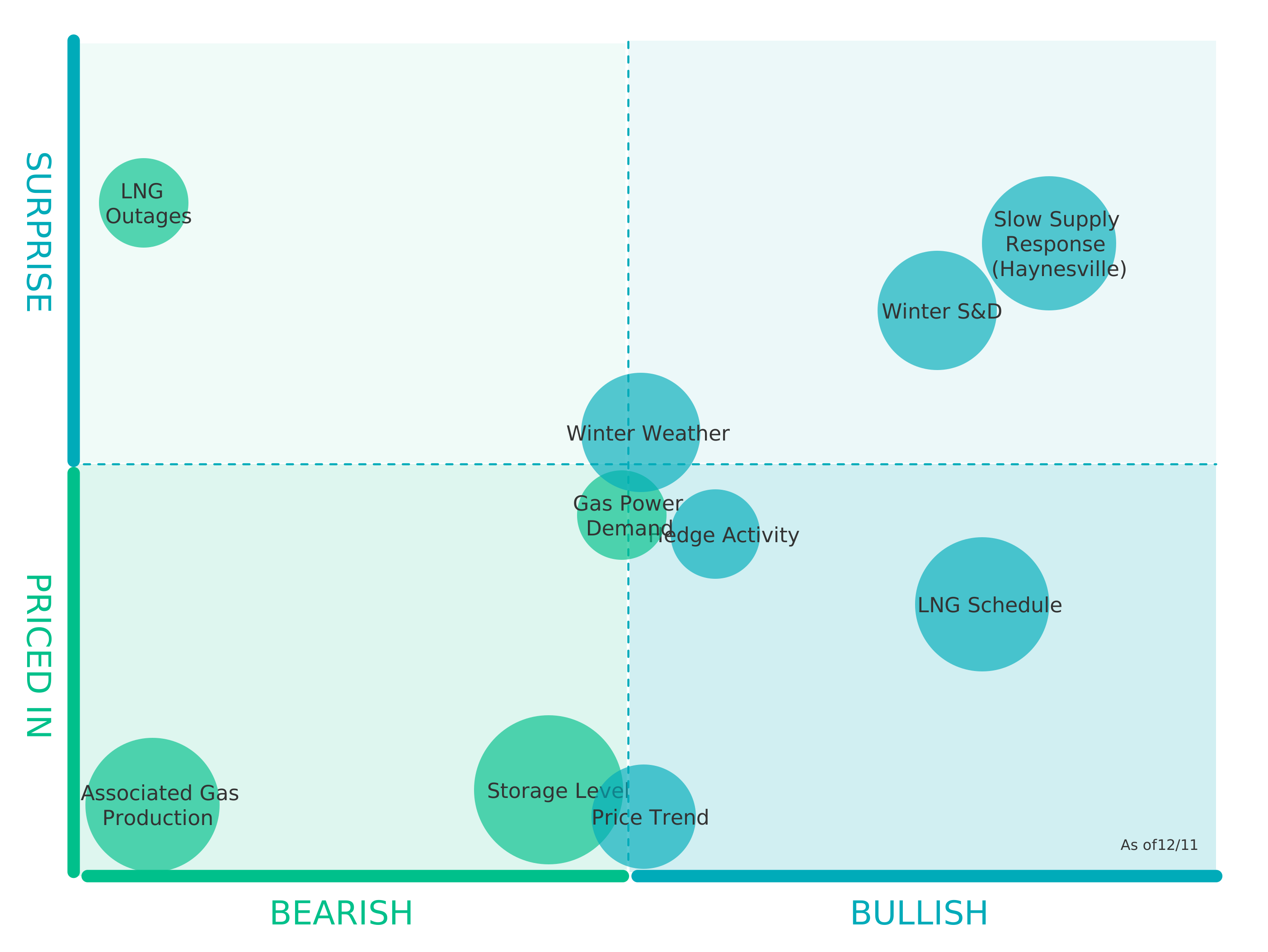
Natural Gas Factors
Price Trend. (Bearish, Priced In) Gas prices have turned sharply lower over the past week, after rallying to as high as $5.50/MMbtu at the start of the month. The Jannuary contract is down more than $1 over the past two weeks.
Winter S&D. (Bullish, Surprise)
Storage Level. (Bearish, Priced In) The storage level is a bearish priced-in factor due to the high levels of gas in inventories relative to the five-year average. According to the latest EIA weekly natural gas inventory report, the surplus to the five-year average stands at 32 Bcf above the five-year average but 61 Bcf below last year.
Associated Gas Production.(Bearish, Priced In) Growth in associated gas production will be much slower than has beeen seen over the past few years, at least until the second half of 2026. Pipeline capacity out of the Permian Basin will begin to grow again next year, likely filling relatively quickly. These new Permian pipes should enter servicce around the same time as projects which will reroute gas around Houston, towards the border of Louisiana.
LNG Outages. (Bearish, Surprise) Feed-gas levels are at their near max capacity, and if there's any unplanned maintenance event or an outage, it may act as a surprise bearish factor for natural gas prices.
Slow Supply Response (Haynesville). (Bullish, Surprise) If production remains near where it is currently and does not grow into winter, this would be a bullish factor for gas prices. As production growth in the Permian and Northeast should be relatively constrained by pipeline capacity until the second half of 2026, the Haynesville will likely be the primary engine of production growth in the near-term. After being flat through most of 2025, Haynesville production and drilling activity has begun to increase this summer. Production is now up about 1.5 Bcf/d from the start of the year, but remains down from levels seen two years ago.
LNG Schedule. (Bullish, Mostly Priced In) With a significant amount of new LNG feedgas demand coming this year and the next few years, if these facilities startup sooner than anticipated it should be a bullish factor for gas prices. One example of this occuring is the recent startup of Plaquemines LNG, which saw feedgas levels reach more than 1 Bcf/d much sooner than anticipated.
Hedge Activity. (Bearish, Priced in) With prices for next winter and beyond continuing to trend higher, producers have been hedging into the strength of forward prices.
Winter Weather. (Neutral, Surprise) While the first half of December came in significantly colder than average, the second half of the month is forecast to be warmer than average. Based on our modeling, if weather comes in equivalent to the ten-year average, inventories would tighten to the five-year average. Therefore, anything colder than the ten-year average would be particularly bullish.
Commodity Interest Trading involves risk and, therefore, is not appropriate for all persons; failure to manage commercial risk by engaging in some form of hedging also involves risk. Past performance is not necessarily indicative of future results. There is no guarantee that hedge program objectives will be achieved. Certain information contained in this research may constitute forward-looking terminology, such as “edge,” “advantage,” ‘opportunity,” “believe,” or other variations thereon or comparable terminology. Such statements and opinions are not guarantees of future performance or activities. Neither this trading advisor nor any of its trading principals offer a trading program to clients, nor do they propose guiding or directing a commodity interest account for any client based on any such trading program.