OPEC and allies struggled to come to an agreement over oil production quotas. However, OPEC, with its participating guest countries (collectively, OPEC+), ...
OPEC and allies struggled to come to an agreement over oil production quotas. However, OPEC, with its participating guest countries (collectively, OPEC+), remains a major force in determining oil prices.
Below, we keep a running list of OPEC developments and online resources. This effort began in September 2022, so items before that date may not be included, even if they are relevant for understanding the current situation.
OPEC+ announced its extension of 3.66 MMBbl/d cuts through December 2025. (June 2, 2024) Additionally, the 2.2 MMBbl/d voluntary cuts from eight member countries will continue into Q3 2024 but will start to be reversed in October at a rate of 0.18 MMBbl/d per month However, OPEC+ indicated that these monthly production increases could be "paused or reversed subject to market conditions"
Additionally, the 2.2 MMBbl/d voluntary cuts from eight member countries will continue into Q3 2024 but will start to be reversed in October at a rate of 0.18 MMBbl/d per month
However, OPEC+ indicated that these monthly production increases could be "paused or reversed subject to market conditions"
Iraq's oil minister has stated that Iraq will not agree to further OPEC supply cuts, asserting that the country has already reduced enough. (May 13, 2024) Despite overproducing its OPEC quota, exporting 3.4 MMBbl/d this month, Iraq remains firm ahead of the June 1 OPEC meeting to discuss future production cuts.
Despite overproducing its OPEC quota, exporting 3.4 MMBbl/d this month, Iraq remains firm ahead of the June 1 OPEC meeting to discuss future production cuts.
OPEC has decided to keep their current production cuts of approximately 2 MMBbl/d in place until at least the end of June, with a potential extension through the end of the year (April 3, 2024) Despite these cuts tightening the market, Iraq and Kazakhstan have not fully implemented their agreed-upon output reductions
Despite these cuts tightening the market, Iraq and Kazakhstan have not fully implemented their agreed-upon output reductions
The OPEC+ alliance will extend its supply cuts through the end of June, meeting traders' and analysts' expectations (March 4, 2024) Russia announced it would strengthen its role by focusing more on production cuts rather than exports, while OPEC indicated that the latest output curbs would be "returned gradually subject to market conditions" after the second quarter.
Russia announced it would strengthen its role by focusing more on production cuts rather than exports, while OPEC indicated that the latest output curbs would be "returned gradually subject to market conditions" after the second quarter.
Angola has announced its decision to exit OPEC after disputes with the organization's leadership (December 21, 2023)
OPEC had requested Angola to accept a lower production rate for 2024 due to its declining output, which has dropped 40% over the past eight years to 1.14 MMBbl/d, and recently further lowered Angola's quota to 1.1 MMBbl/d after a review by external consultants.
OPEC+ agreed to cut an extra 0.88 MMBbl/d in the first quarter of 2024, adding to Saudi Arabia's existing 1 MMBbl/d reduction. (November 30, 2023) Russia is deepening its voluntary oil export cuts from 0.3 MMBbl/d to 0.5 MMBbl/d. The combined voluntary cuts for the first quarter of 2024, excluding Saudi and Russia, are about 0.68 MMBbl/d, amounting to over 2 MMBbl/d in total. The UAE, Kuwait, Iraq, Kazakhstan, and Algeria, announced their respective production cuts following the meeting. Brazil will join the OPEC+ alliance in January 2024, in a move that adds South America's largest oil producer to the group's market influence. However, skepticism among market participants due to the voluntary nature of the cut and Angola's non-compliance led to a decline in oil prices following the announcement
Russia is deepening its voluntary oil export cuts from 0.3 MMBbl/d to 0.5 MMBbl/d.
The combined voluntary cuts for the first quarter of 2024, excluding Saudi and Russia, are about 0.68 MMBbl/d, amounting to over 2 MMBbl/d in total.
The UAE, Kuwait, Iraq, Kazakhstan, and Algeria, announced their respective production cuts following the meeting.
Brazil will join the OPEC+ alliance in January 2024, in a move that adds South America's largest oil producer to the group's market influence.
However, skepticism among market participants due to the voluntary nature of the cut and Angola's non-compliance led to a decline in oil prices following the announcement
Saudi Arabia will carry forward its July production cut of 1 MMBbl/d production cut into August, according to a statement from the state-run Saudi Press Agency (July 3, 2023) In a concurrent move, Russian Deputy PM Noval said that the nation will slash its oil exports by 0.5 MMBbl/d in August
In a concurrent move, Russian Deputy PM Noval said that the nation will slash its oil exports by 0.5 MMBbl/d in August
Saudi Arabia announced an additional voluntary cut of 1 MMBbl/d for July; OPEC+ extended their current cuts (3.66 MMBbl/d) until the end of 2024 (June 5, 2023) Oil surged by about $2/Bbl to nearly $74/Bbl before finishing lower following the announcement
Oil surged by about $2/Bbl to nearly $74/Bbl before finishing lower following the announcement
Oil surges back above $80/Bbl after a surprise announcement by OPEC+ to cut more production (April 3, 2023)(CNBC) OPEC+ made a surprise cut of 1.66 MMBbl/d on Sunday, which raised the overall cut to 3.66 MMBbl/d (Including October's 2 MMBbl/d cut)
OPEC+ made a surprise cut of 1.66 MMBbl/d on Sunday, which raised the overall cut to 3.66 MMBbl/d (Including October's 2 MMBbl/d cut)
Saudi Arabia and U.A.E. Clash Over Oil, Yemen as Rift Grows (March 3, 2023)(WSJ) The oil markets fell $2/Bbl intraday as a result of the WSJ exclusive story UAE responded by denying the report that they were thinking about leaving OPEC, and the oil market quickly recovered all of its losses
The oil markets fell $2/Bbl intraday as a result of the WSJ exclusive story
UAE responded by denying the report that they were thinking about leaving OPEC, and the oil market quickly recovered all of its losses
OPEC+ Eyes Output Increase Ahead of Restrictions on Russian Oil (November 21, 2022) (WSJ) The WSJ exclusive piece moved the oil markets $4/Bbl lower intraday In response, Saudi Arabia claimed the allegations of a production increase were false; the oil market recovered all losses intraday
The WSJ exclusive piece moved the oil markets $4/Bbl lower intraday
In response, Saudi Arabia claimed the allegations of a production increase were false; the oil market recovered all losses intraday
OPEC+ agreed to cut production by 2 MMBbl/d for November (October 5, 2022) (WSJ)
The coalition has also agreed to extend its production cooperation agreement until the end of 2023
OPEC+ spare capacity is still an unknown number, but the group has struggled to meet its announced quotas in the last year
Additionally, the 2.2 MMBbl/d voluntary cuts from eight member countries will continue into Q3 2024 but will start to be reversed in October at a rate of 0.18 MMBbl/d per month
However, OPEC+ indicated that these monthly production increases could be "paused or reversed subject to market conditions"
Despite overproducing its OPEC quota, exporting 3.4 MMBbl/d this month, Iraq remains firm ahead of the June 1 OPEC meeting to discuss future production cuts.
Despite these cuts tightening the market, Iraq and Kazakhstan have not fully implemented their agreed-upon output reductions
Russia announced it would strengthen its role by focusing more on production cuts rather than exports, while OPEC indicated that the latest output curbs would be "returned gradually subject to market conditions" after the second quarter.
Russia is deepening its voluntary oil export cuts from 0.3 MMBbl/d to 0.5 MMBbl/d.
The combined voluntary cuts for the first quarter of 2024, excluding Saudi and Russia, are about 0.68 MMBbl/d, amounting to over 2 MMBbl/d in total.
The UAE, Kuwait, Iraq, Kazakhstan, and Algeria, announced their respective production cuts following the meeting.
Brazil will join the OPEC+ alliance in January 2024, in a move that adds South America's largest oil producer to the group's market influence.
However, skepticism among market participants due to the voluntary nature of the cut and Angola's non-compliance led to a decline in oil prices following the announcement
In a concurrent move, Russian Deputy PM Noval said that the nation will slash its oil exports by 0.5 MMBbl/d in August
Oil surged by about $2/Bbl to nearly $74/Bbl before finishing lower following the announcement
OPEC+ made a surprise cut of 1.66 MMBbl/d on Sunday, which raised the overall cut to 3.66 MMBbl/d (Including October's 2 MMBbl/d cut)
The oil markets fell $2/Bbl intraday as a result of the WSJ exclusive story
UAE responded by denying the report that they were thinking about leaving OPEC, and the oil market quickly recovered all of its losses
The WSJ exclusive piece moved the oil markets $4/Bbl lower intraday
In response, Saudi Arabia claimed the allegations of a production increase were false; the oil market recovered all losses intraday
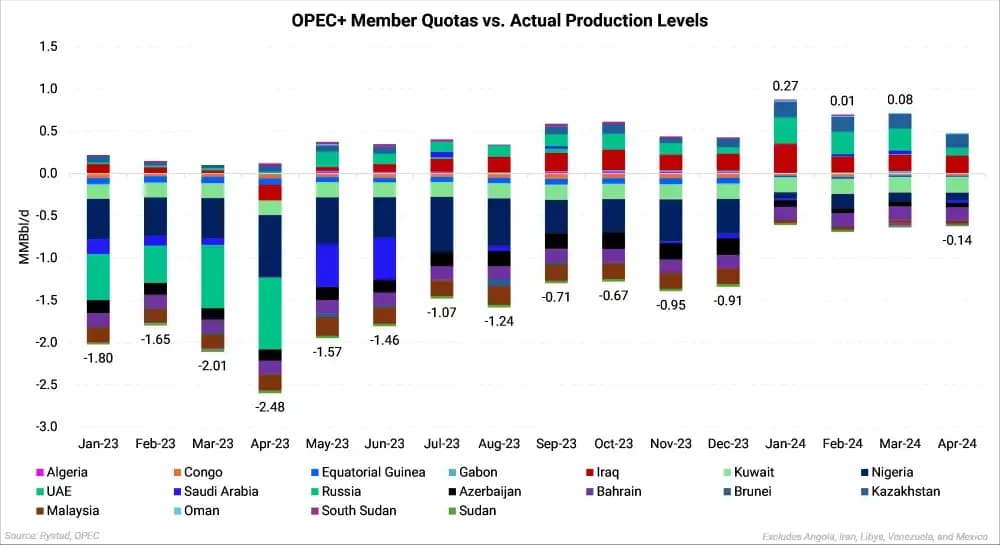
June 3, 2024 - OPEC+ is a loosely affiliated entity consisting of thirteen OPEC members and ten of the world's major non-OPEC oil-exporting nations. The group produces about 40% of the world's crude oil. The cartel is struggling to meet its quota, and the group's undersupply continues to worsen each month.
The chart below shows the OPEC nations' cumulative historical production volumes and their respective quotas.
Source: AEGIS Hedging
On June 2, OPEC+ announced its extension of 3.66 MMBbl/d cuts through December 2025. Additionally, the 2.2 MMBbl/d voluntary cuts from eight member countries will continue into Q3 2024 but will start to be reversed in October at a rate of 0.18 MMBbl/d per month. However, OPEC+ indicated that these monthly production increases could be "paused or reversed subject to market conditions." Furthermore, the Saudi Energy Minister led ministers this week in reiterating that the production increase can be paused or reversed based on market conditions.
AEGIS notes that the global crude market would quickly build inventories without OPEC's support in reducing supply. Furthermore, IEA now projects a deficit of 0.33 MMBbl/d,starkly contrastingo its previous forecast of a 0.8 MMBbl/d oversupply and consequent inventory builds. This adjustment stems from the first-time inclusion of expected OPEC+ production cuts extending through the year's end, a view that diverges from OPEC's own announcement of cuts lasting until 2Q 2024.
Recent developments and items to watch:
Because of its dominant market position (40% of global oil production), OPEC+ often behaved as a cartel, coordinating production levels among members to control global oil prices. The bloc led by Saudi Arabia signaled the possibility of output cuts in August to address what the group sees as exaggerated oil price declines in the market.
(September 5, 2023) The Saudis announced they would extend 1 MMBbl/d voluntary cuts through December on top of a 3.7 MMBbl/d reduction already agreed by OPEC+, including a 2 mb/d cut to its production ceiling in November 2022 and 1.7 MMBbl/d of extra curbs from some members starting in May Russia said it would also extend its 300 MBbl/d export cuts through December
Russia said it would also extend its 300 MBbl/d export cuts through December
(August 3, 2023) Saudi Arabia will extend a voluntary oil output cut of 1 MMBbl/d for another month to include September, adding it could be extended beyond that or deepened Russia will also cut oil exports by 300 MBbl/d in September, Deputy Prime Minister Alexander Novak said shortly after the Saudi announcement.
Russia will also cut oil exports by 300 MBbl/d in September, Deputy Prime Minister Alexander Novak said shortly after the Saudi announcement.
(July 3, 2023) Saudi Arabia on Monday announced it would extend its voluntary cut of 1 MMBbl/d into August. Additionally, Russia will reduce its oil exports by 0.5 MMBbl/d in August, aiming to tighten global supplies Furthermore, Saudi Arabia has hinted that it may extend its production cut beyond August, and its energy minister Prince Abdulaziz, who will be speaking at an OPEC conference on Wednesday, has said that he will keep traders guessing about future plans
Furthermore, Saudi Arabia has hinted that it may extend its production cut beyond August, and its energy minister Prince Abdulaziz, who will be speaking at an OPEC conference on Wednesday, has said that he will keep traders guessing about future plans
(June 5, 2023) WTI gained $1.79 this morning to trade around $73/Bbl after Saudi Arabia unilaterally cut its oil production by 1 MMBbl/d for July Saudi Energy Minister Salman said he would do “whatever is necessary to bring stability to this market” following Sunday’s meeting Some of the OPEC+ members’ quotas were redistributed based on actual production, allowing UAE an additional 0.2 MMBbl/d quota from January 2024
Saudi Energy Minister Salman said he would do “whatever is necessary to bring stability to this market” following Sunday’s meeting
Some of the OPEC+ members’ quotas were redistributed based on actual production, allowing UAE an additional 0.2 MMBbl/d quota from January 2024
(April 3, 2023) Oil soared to above $80/Bbl after nine OPEC+ members announced a surprise voluntary cut in production of 1.66 MMBbl/d set to begin in May and last until the end of 2023 The Saudi Arabian Ministry of Energy said that “this is a precautionary measure aimed at supporting the stability of the oil market” AEGIS notes that the reduction in production could cause long-term price increases in a delicately balanced oil market. This could result in inflation and create a dilemma for Central banks, which are trying to control inflation while supporting the banking crisis
The Saudi Arabian Ministry of Energy said that “this is a precautionary measure aimed at supporting the stability of the oil market”
AEGIS notes that the reduction in production could cause long-term price increases in a delicately balanced oil market. This could result in inflation and create a dilemma for Central banks, which are trying to control inflation while supporting the banking crisis
(March 3, 2023) Oil prices fell by $2/Bbl on the back of a report that the UAE is internally discussing leaving OPEC, the powerful 13-member oil producer alliance. However, UAE officials denied that report.
(February 1, 2023) OPEC+ recommends no change to current output levels amid uncertainties about demand in China and the impact of sanctions on Russian crude supplies
(November 14, 2022) OPEC has lowered its forecast for oil demand growth for the fifth time since April The group said that demand would increase by 2.55 MMBbl/d this year, down 0.100 MMBbl/d from its previous forecast It reduced the outlook for next year by the same amount, saying demand in 2023 will only rise by 2.24 MMBbl/d
The group said that demand would increase by 2.55 MMBbl/d this year, down 0.100 MMBbl/d from its previous forecast It reduced the outlook for next year by the same amount, saying demand in 2023 will only rise by 2.24 MMBbl/d
The group said that demand would increase by 2.55 MMBbl/d this year, down 0.100 MMBbl/d from its previous forecast
It reduced the outlook for next year by the same amount, saying demand in 2023 will only rise by 2.24 MMBbl/d
(October 17, 2022) OPEC+ member states endorsed the group's decision to cut output after the White House accused Saudi Arabia of coercing other member nations into supporting the decision The UAE's energy minister said in a tweet that the decision was "unanimously approved" and a "pure technical decision, with no political intentions whatsoever"
The UAE's energy minister said in a tweet that the decision was "unanimously approved" and a "pure technical decision, with no political intentions whatsoever"
The UAE's energy minister said in a tweet that the decision was "unanimously approved" and a "pure technical decision, with no political intentions whatsoever"
(October 5, 2022) The OPEC+ coalition agreed to cut their cumulative production by 2 MMBbl/d for November The bloc cited "the uncertainty that surrounds the global economic and oil market outlooks, and the need to enhance the long-term guidance for the oil market" as its rationale for the move The cut comes despite aggressive lobbying by the Biden administration for the group to continue production at current or higher levels The quota system is extended until the end of 2023 "OPEC wants prices around $90," said Nigerian Minister of State for Petroleum Resource Sylva after the ministerial meeting The cutbacks of 2 MMBbl/d will be measured against the member nations' current baselines Shared pro-rata among members would only require eight countries to reduce actual output, resulting in a real reduction of 1 to 1.1 MMBbl/d
The bloc cited "the uncertainty that surrounds the global economic and oil market outlooks, and the need to enhance the long-term guidance for the oil market" as its rationale for the move The cut comes despite aggressive lobbying by the Biden administration for the group to continue production at current or higher levels The quota system is extended until the end of 2023 "OPEC wants prices around $90," said Nigerian Minister of State for Petroleum Resource Sylva after the ministerial meeting The cutbacks of 2 MMBbl/d will be measured against the member nations' current baselines Shared pro-rata among members would only require eight countries to reduce actual output, resulting in a real reduction of 1 to 1.1 MMBbl/d
The bloc cited "the uncertainty that surrounds the global economic and oil market outlooks, and the need to enhance the long-term guidance for the oil market" as its rationale for the move
The cut comes despite aggressive lobbying by the Biden administration for the group to continue production at current or higher levels
The quota system is extended until the end of 2023
"OPEC wants prices around $90," said Nigerian Minister of State for Petroleum Resource Sylva after the ministerial meeting
The cutbacks of 2 MMBbl/d will be measured against the member nations' current baselines
Shared pro-rata among members would only require eight countries to reduce actual output, resulting in a real reduction of 1 to 1.1 MMBbl/d
(September 29, 2022) Several members of OPEC+ have started talks about a potential production cut ahead of the regular monthly OPEC+ meeting on October 5
(September 27, 2022) Russia is likely to suggest that OPEC+ cut oil production by about 1 MMBbl/d at its next meeting in October, according to Reuters
(September 23, 2022) Nigeria's oil minister Sylva indicated that OPEC would increase output cuts if prices continued to drop below present levels after prices fell by almost $6/bbl last week Additionally, Sylva's stated that current prices are "affecting budgets of certain member countries," but the group does not "exactly know "how to address the issue, and the only solution could be to cut production
Additionally, Sylva's stated that current prices are "affecting budgets of certain member countries," but the group does not "exactly know "how to address the issue, and the only solution could be to cut production
(September 18, 2022) Production from the OPEC+ alliance fell far short of its goal level in August by a record 3.58 MMBbl/d, according to a report published by Argus, one of the producer group's official 'secondary sources.'
(September 13, 2022) The coalition's ten participating core OPEC members accounted for 1.399 MMBbl/d of the August shortfall, while their non-OPEC allies underproduced by 2.185 MMBbl/d, according to OPEC data
(September 5, 2022) OPEC+ agreed to lower its daily production target for October by 0.100 MMBbl/d; this marginal cut could be a symbolic move to show that OPEC+ is keeping an eye on prices and is prepared to act preventively
(September 1, 2022) OPEC+ coalition's committee of technical experts cut forecasts for this year's global supply to 0.400 MMBbl/d (vs. previously 0.800 MMBbl/d). They also changed forecasts for 2023 from a surplus of 0.900 MMBbl/d to a deficit of 0.300 MMBbl/d
(August 25, 2022) Iraq, Algeria, Kuwait, Equatorial Guinea, and Venezuela made statements supporting Saudi's idea of market intervention, along with backing from Libya and Congo. Additionally, OPEC's president supports Saudi Arabia's suggestion that the group might pump less oil due to market volatility. He added that the proposal was "in line with our views and objectives."
(August 22, 2022) Saudi Oil Minister Prince Abdulaziz bin Salman said that "extreme" volatility and a lack of liquidity in the futures market are creating a gap between crude pricing and fundamentals. He added that OPEC+ may be compelled to interfere and may need to consider production cuts while discussing output targets at their meeting next month
Russia said it would also extend its 300 MBbl/d export cuts through December
Russia will also cut oil exports by 300 MBbl/d in September, Deputy Prime Minister Alexander Novak said shortly after the Saudi announcement.
Furthermore, Saudi Arabia has hinted that it may extend its production cut beyond August, and its energy minister Prince Abdulaziz, who will be speaking at an OPEC conference on Wednesday, has said that he will keep traders guessing about future plans
Saudi Energy Minister Salman said he would do “whatever is necessary to bring stability to this market” following Sunday’s meeting
Some of the OPEC+ members’ quotas were redistributed based on actual production, allowing UAE an additional 0.2 MMBbl/d quota from January 2024
The Saudi Arabian Ministry of Energy said that “this is a precautionary measure aimed at supporting the stability of the oil market”
AEGIS notes that the reduction in production could cause long-term price increases in a delicately balanced oil market. This could result in inflation and create a dilemma for Central banks, which are trying to control inflation while supporting the banking crisis
The group said that demand would increase by 2.55 MMBbl/d this year, down 0.100 MMBbl/d from its previous forecast It reduced the outlook for next year by the same amount, saying demand in 2023 will only rise by 2.24 MMBbl/d
The group said that demand would increase by 2.55 MMBbl/d this year, down 0.100 MMBbl/d from its previous forecast
It reduced the outlook for next year by the same amount, saying demand in 2023 will only rise by 2.24 MMBbl/d
The group said that demand would increase by 2.55 MMBbl/d this year, down 0.100 MMBbl/d from its previous forecast
It reduced the outlook for next year by the same amount, saying demand in 2023 will only rise by 2.24 MMBbl/d
The UAE's energy minister said in a tweet that the decision was "unanimously approved" and a "pure technical decision, with no political intentions whatsoever"
The UAE's energy minister said in a tweet that the decision was "unanimously approved" and a "pure technical decision, with no political intentions whatsoever"
The UAE's energy minister said in a tweet that the decision was "unanimously approved" and a "pure technical decision, with no political intentions whatsoever"
The bloc cited "the uncertainty that surrounds the global economic and oil market outlooks, and the need to enhance the long-term guidance for the oil market" as its rationale for the move The cut comes despite aggressive lobbying by the Biden administration for the group to continue production at current or higher levels The quota system is extended until the end of 2023 "OPEC wants prices around $90," said Nigerian Minister of State for Petroleum Resource Sylva after the ministerial meeting The cutbacks of 2 MMBbl/d will be measured against the member nations' current baselines Shared pro-rata among members would only require eight countries to reduce actual output, resulting in a real reduction of 1 to 1.1 MMBbl/d
The bloc cited "the uncertainty that surrounds the global economic and oil market outlooks, and the need to enhance the long-term guidance for the oil market" as its rationale for the move
The cut comes despite aggressive lobbying by the Biden administration for the group to continue production at current or higher levels
The quota system is extended until the end of 2023
"OPEC wants prices around $90," said Nigerian Minister of State for Petroleum Resource Sylva after the ministerial meeting
The cutbacks of 2 MMBbl/d will be measured against the member nations' current baselines
Shared pro-rata among members would only require eight countries to reduce actual output, resulting in a real reduction of 1 to 1.1 MMBbl/d
Additionally, Sylva's stated that current prices are "affecting budgets of certain member countries," but the group does not "exactly know "how to address the issue, and the only solution could be to cut production
Source: AEGIS Hedging
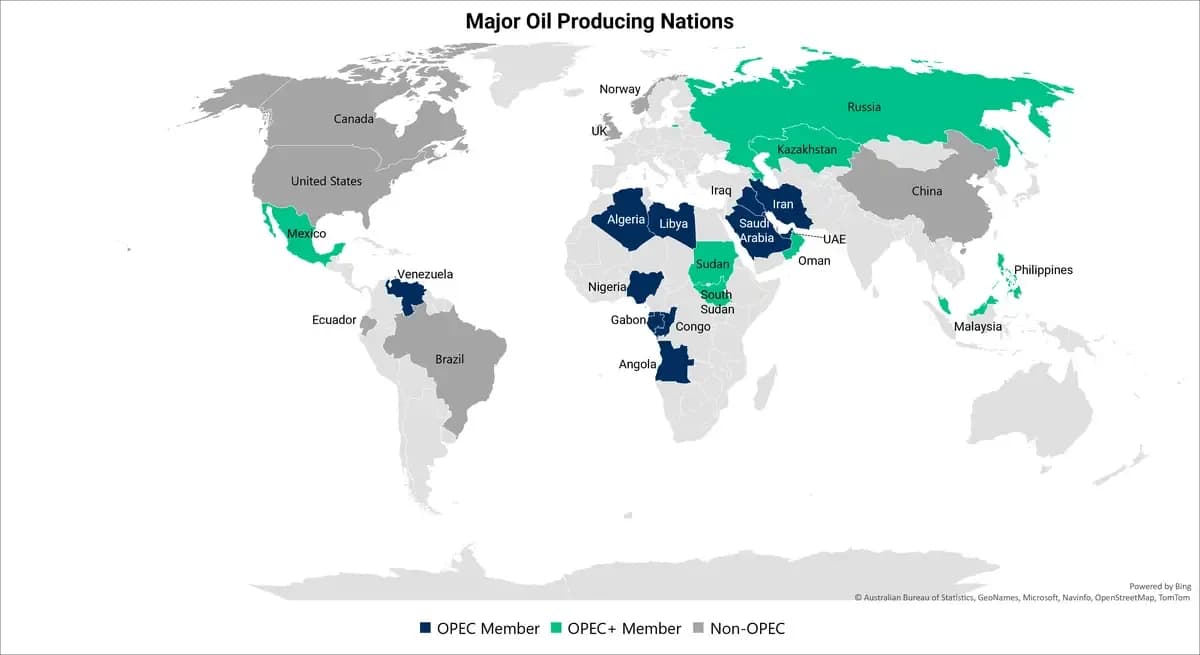
Core OPEC is a bloc of thirteen oil-rich countries concentrated in the Middle East and Africa. The majority of OPEC nations' production is controlled by their respective national oil companies (NOCs), which make production decisions in accordance with central coordination. In contrast to OPEC, producers in non-OPEC nations (U.S., Brazil, Canada, etc) are investor-owned companies (IOCs) that primarily operate on increasing shareholder value and make investment decisions based on economic factors.
Thirteen non-OPEC nations (Russia, Mexico, Oman, etc.) joined OPEC in 2001 to form the OPEC+ alliance. Since then, the group has produced with the aim of managing the oil supply in an effort to steer the price of oil on the global market. Some of the key OPEC producers' current state of production are explained below.
Production
Source: AEGIS Hedging
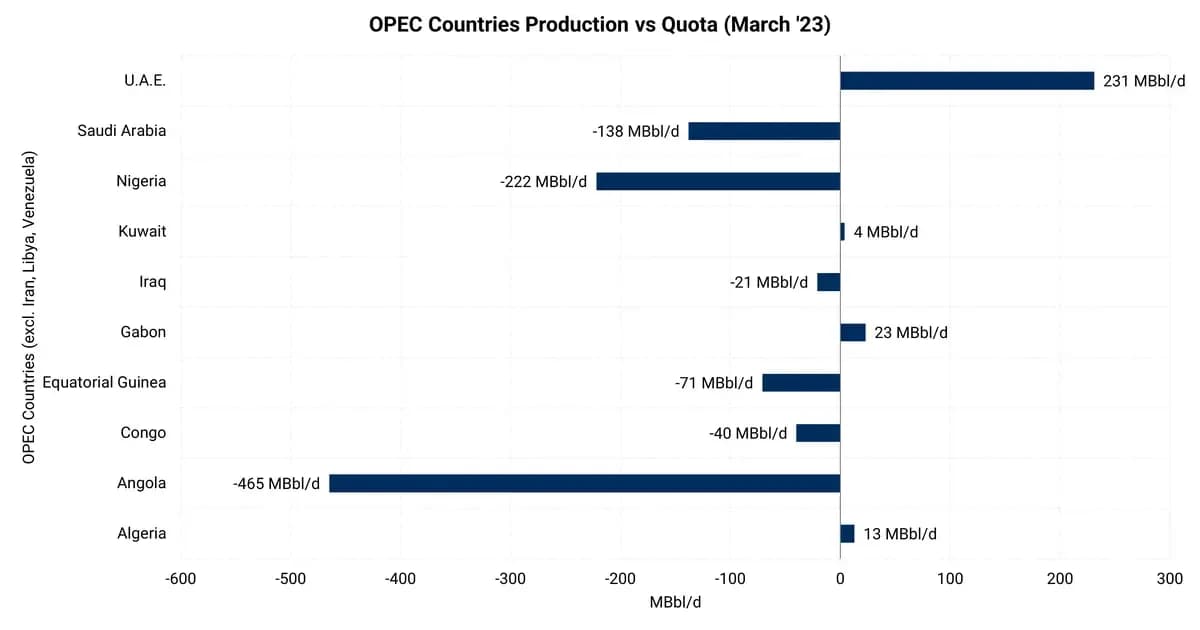
The above chart shows the difference in the production of each OPEC nation with their respective target quotas. The recurring theme is that most of the group's members have consistently underperformed due to various reasons, and the following explains the reasons and constraints faced by some of the key members of the cartel.
Nigeria - Africa's largest producer, has struggled to stabilize its production at around 1.5 MMBbl/d. Internal strife, especially in the Delta region, compounded by rampant theft from its pipelines and years of underinvestment, has pushed Nigeria's production numbers down to around 1.13 MMBbl/d. Nigeria currently pumps about 0.700 MMBbl/d below its OPEC quota.
Angola - Africa's third biggest producer, has also seen output plummet from close to 1.8 million b/d five years ago to 1.17 million b/d in August. Angola's crude output had sharply declined because of technical and operational issues in some fields, further exacerbated by a lack of upstream investment and incentives. Angola's oil production last hit these levels in 2006, when the country's offshore fields' output started ramping up. Angola has a quota of 1.565 MMBbl/d, and the nation produces nearly 0.355 MMBbl/d below its OPEC quota.
Saudi Arabia - Saudi is the leading producer among the selected OPEC nations and has a quota of 11 MMBbl/d. The nation has met this production goal twice in the past four years. While the 11 MMBbl/d production level has been reached in the past, maintaining it is difficult because of operational difficulties, regularly planned maintenance, and the necessity to provide the nation with enough fuel for power generation for summer.
The kingdom can only continue producing at a rate of 11 MMBbl/d or more with infrastructural expansion. The investment and project execution will take time and requires long-term, consistent capital investment. Officially, the country's "maximum sustainable capacity" is 12 MMBbl/d, and the current estimated spare capacity is expected to be about 1.0-1.5 MMBbl/d. Even if Saudi Arabia were eager to increase global supply, it would be challenging due to its limited additional ability to ramp up oil production.
However, Saudi Arabia's Energy Minister Salman said in May that the nation is on track to lift oil production capacity by more than 1 MMBbl/d to over 13 MMBbl/d by the end of 2026 or the start of 2027.
UAE - UAE's current production stands at 3.4 MMBbl/d, up about 13% from February 2022. The nation hit a peak output of 3.7 MMBbl/d In April 2020, when Saudi Arabia and Russia were engaged in a brief price war. Since the pandemic, production has increased by 0.500 MMBbl/d, from 2.85 MMBbl/d to the current 3.4 MMBbl/d. Historical production data indicates that the nation could again reach 3.5–4.0 MMBbl/d and, as a result, add 0.5–1.0 MMBbl/d to the global market – provided this plateau can be maintained. UAE's state-owned ADNOC expects to be able to increase production to 5 MMBbl/d by 2025.
Iraq - Iraq is one of OPEC's top three oil producers, producing more than 4.40 MMBbl/d. The nation's current production is 0.22 MMBbl/d below the agreed quota of 4.651 MMBbl/d. Iraqi production peaked at 4.75 MMBbl/d in early 2019 but fell to 4.61 MMBbl/d in February 2020, just before the COVID-19 pandemic.
Iraqi production usually fluctuates due to political turmoil or security issues in the southern part of the country, where the majority of the country's production is located, and in the Kurdistan region—where pipelines export the pumped oil via Turkey to the Mediterranean.
Although Iraq has enough resources to support larger export volumes, it desperately needs significant capital investment to expand its export facilities and oil storage tanks.
Iran - Iran produced 3.63 MMBbl/d on average under the Joint Comprehensive Plan of Action (JCPOA) or the Iranian nuclear deal, which was in effect from January 2016 until the Donald Trump administration withdrew from the agreement in May 2018. Iran's oil exports were subject to sanctions after the U.S. withdrew from the JCPOA, and production fell to an average of 2.48 MMBbl/d.
According to OPEC data, the current production is 2.52 MMBbl/d. If an agreement is reached on the nuclear deal and the sanctions on oil exports are eased, Iran could boost output by up to 1 MMBbl/d to its full capacity of about 3.7 MMBbl/d.
According to the most recent information, the deal is at an impasse after much back and forth between the U.S. and Iran. There are still reports that negotiations are ongoing, and it is unclear when a deal might be reached.
Note: Libya, Iran, and Venezuela are exempt from a quota under the OPEC+ deal.
For additional information on other nations, please use EIA's, International Page.
Want this in your inbox?
AEGIS market analysts publish research across crude, natural gas, NGLs, refined products, metals, and rates.
We use a few essential cookies to make our site work, including one that counts how many reports you have opened. Analytics cookies are used only with your permission, and you can change your mind at any time. Learn more about cookies in our privacy policy.