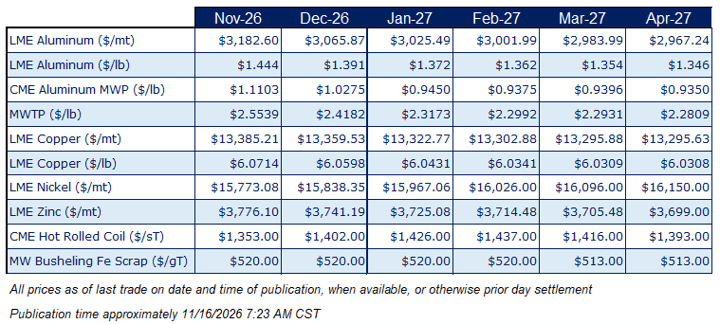
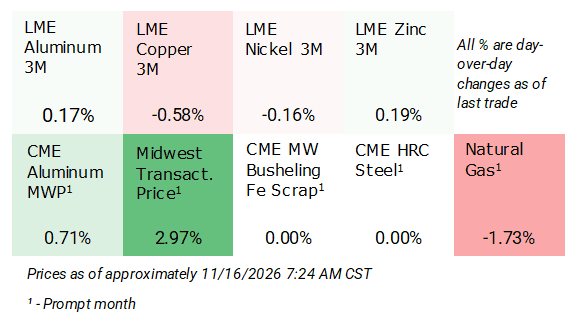
LME Aluminum 3M Select trades $5.25 higher to $3015 at 8:25:58 AM
(Bloomberg) – The London Metal Exchange’s rules to prevent squeezes from wreaking havoc with the market are being given an extreme stress test — this time in aluminum. The LME has created a series of pressure-relief valves in recent years, as it seeks to avoid a repeat of turmoil that gripped its nickel and copper markets earlier this decade. Now, a historic squeeze in the aluminum market — in which trading house Trafigura Group has played a key role — is testing the LME’s rules in several ways. November aluminum contracts, which trade as the LME’s main spot contract on Monday, have surged to as much as $180 a ton above December futures, pushing the market into the biggest backwardation since a notorious squeeze orchestrated by Marc Rich + Co in the late 1980s.
One rule introduced by the LME in recent years forces traders holding dominant long positions in its main monthly contracts to reduce their positions. If a single trader holds a position in the front-month contract equal to 50% or more of the inventory in the LME system, the rule forces them to to lend it to those on the short side of the trade at progressively strict levels. But that cap, which starts at 3% of the spot price of aluminum, was comfortably exceeded on Friday and Monday, indicating that no one trader had a sufficiently large position to put it over the threshold. And yet the most recent LME data, which refers to the situation last Thursday, shows five traders held positions of at least 43,000 tons each in the main November contract — collectively, virtually all of the inventory of aluminum in the LME system.
In the aluminum market, stockpiles on the LME have fallen 57% this year to a 36-year-low of 221,900 tons, which is enough to service global demand for just one day. That creates the potential for another test. Faced with falling inventories across many of its key markets, which helped trigger a record squeeze in copper in 2021, the LME has for several years been introducing rules designed to mitigate disruptions in low-stock environments. One rule allows traders with short positions to pay a set fee to avoid delivery. Another governs the LME’s rules which force traders to lend long positions back via the key one-day “Tom-next” spread — effectively, capping the scale of backwardations.
Last year and this year, the LME has introduced minimum stock thresholds to its lending rules for both large monthly positions and large positions in warrants. The effect is, in very low stock environments, to allow traders to hold larger positions than they otherwise would have before the lending rules are triggered.
In aluminum, the minimum threshold for the front-month lending rules is 160,000 tons of total inventories, meaning that if total LME stocks fell by a further 65,000 tons, the minimum threshold would come into play. And the minimum threshold for the Tom-next lending rules is 56,000 tons of available inventories, so a large request for delivery could potentially bring it into effect.
While outright aluminum prices have been falling amid a broad selloff in metals, the extreme backwardations are causing severe stress for anyone with short positions.
That typically includes manufacturers, which take short positions as a hedge against their inventory, and if they aren’t able to deliver metal into the LME to settle those contracts, the backwardation represents the price they need to pay roll them forward. On the basis of the November-December spread, that represents an annualized cost of more than 60% of the value of their metal.
And with prices trading in backwardation out to 2028, the low level of inventory on the LME presents an ongoing threat. While many analysts and traders are bearish aluminum in the medium term amid expectations of a surge in Indonesian production, so far only one Indonesian aluminum producer’s metal is registered for delivery on the LME.
“We’ve more aluminium coming to the market — on paper,” said Duncan Hobbs, head of research at Concord Resources Ltd. “But of course, that is still a little ways away, and what is coming is largely non-deliverable.”
A similar dynamic was a major factor in the nickel squeeze, and the LME’s post-crisis reforms included measures to expedite the registration of new brands. But there are still some limitations, as new plants need to be in steady operation for at least six months before their metal can be delivered into the exchange.
The LME reiterated that it has a number of arrangement in place to guard against any undue influence of large or dominant positions. “The LME also routinely requests further position management information from market participants and has the power to require positions to be managed as appropriate,” it added.
LME Copper 3M Select trades $-77 lower to $13321 at 8:25:58 AM
CME HRC Steel last traded at $1353 and $1 higher at 11/13/2026