Skip to content
AEGIS Hedging
Market Insights

Metals

China's Inflation on Fire as GDP Data Looms

Chris Stadele3 min read

Since mid 2020, pandemic-related supply constraints have caused a rapid rise in commodity prices, including copper, leading to a surge in China's PPI and...

Since mid 2020, pandemic-related supply constraints have caused a rapid rise in commodity prices, including copper, leading to a surge in China's PPI and CPI. Can their economy handle this surge in inflation?


Summary: The Producer Price Index (PPI) track the prices a producer receives for a basket of goods or services. A positive PPI signals an inflationary environment, a negative PPI signals a deflationary environment. Swings in prices for raw materials such as copper are reflected in this index. To calculate this index, China's National Bureau of Statistics collects data from 50,000 companies, and includes all manufacturing. The Consumer Price Index (CPI) tracks the prices a consumer pays for a basket of goods and services. Similar to PPI, a positive CPI signals an inflationary environment, a negative PPI signals a deflationary environment. In general, a rising PPI will lead to a rising CPI, whether immediate or delayed. China's PPI has surged this year, leading to a corresponding although smaller increase in CPI. This rapid rise in commodity prices has squeezed end users, thereby decreasing profit margins. The Wednesday July 14 release of GDP data will shed light on the health of China's economy, and could provide direction on commodity prices.

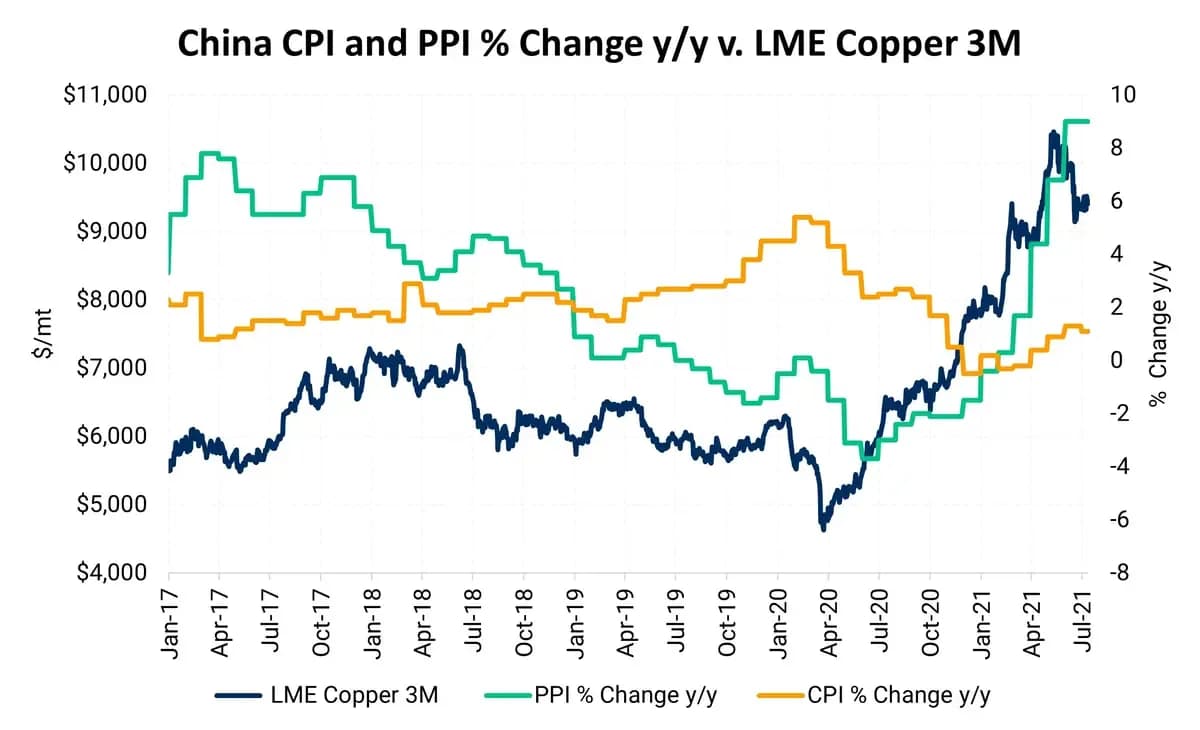
China's Inflation on Fire as GDP Data Looms: chart 1
Source: AEGIS Hedging
  • The Producer Price Index (PPI) track the prices a producer receives for a basket of goods or services. A positive PPI signals an inflationary environment, a negative PPI signals a deflationary environment. Swings in prices for raw materials such as copper are reflected in this index. To calculate this index, China's National Bureau of Statistics collects data from 50,000 companies, and includes all manufacturing.
  • The Consumer Price Index (CPI) tracks the prices a consumer pays for a basket of goods and services. Similar to PPI, a positive CPI signals an inflationary environment, a negative PPI signals a deflationary environment.
  • In general, a rising PPI will lead to a rising CPI, whether immediate or delayed.
  • China's PPI has surged this year, leading to a corresponding although smaller increase in CPI.
  • This rapid rise in commodity prices has squeezed end users, thereby decreasing profit margins.
  • The Wednesday July 14 release of GDP data will shed light on the health of China's economy, and could provide direction on commodity prices.

AEGIS Thoughts & Strategies: As commodities prices have skyrocketed this year, China's PPI and CPI have responded in kind. The PPI surged 8.8% y/y in June, a slight downtick from the 9.0% y/y reading in May. The CPI was up 1.1% y/y in June, a slight drop from 1.3% in May. CNBC recently reported that this rapid in inflation, the largest since 2008 for the PPI, has caused negative profit margins for some companies and others are barely holding their head above water. As we have commented before, data shows that China's economy is slowing, which could cool demand for commodities such as copper. Efforts to jump-start the economy, which we also discussed in a prior post, have both potentially inflationary and deflationary effects on metals prices. AEGIS believes that China's ability to get the economy going again depends ons its ability to rein commodity prices, and thus PPI. China's next important release of economic data, including Q2 GDP, will be 9PM CST on Wednesday, July 14. The forecast (according to investing.com), is for 8.1% y/y increase in GDP. A positive (or negative) read could reflect heavily on market participants view of metals prices, and thus expectations of inflation.

Want this in your inbox?

AEGIS market analysts publish research across crude, natural gas, NGLs, refined products, metals, and rates.

Stay Ahead

Get market insights delivered to your inbox — for free.

We use a few essential cookies to make our site work, including one that counts how many reports you have opened. Analytics cookies are used only with your permission, and you can change your mind at any time. Learn more about cookies in our privacy policy.