- Halliburton reported third quarter 2026 revenue of $5.7 billion, flat from the second quarter.
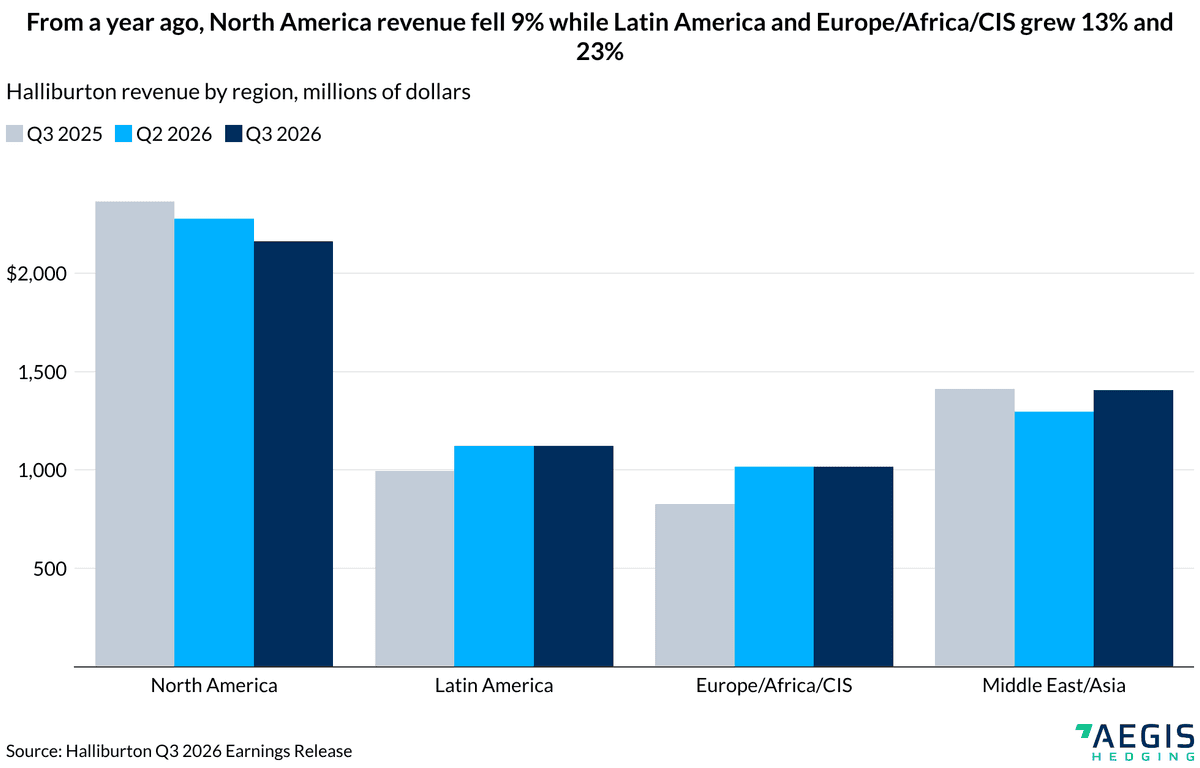
- North America revenue fell 5% sequentially and 9% year over year to $2.2 billion.
- International revenue rose 3% sequentially and 9% year over year to $3.5 billion.
- Halliburton said it moved several North America frac crews to new customers at better pricing in the third quarter and called the market very tight.
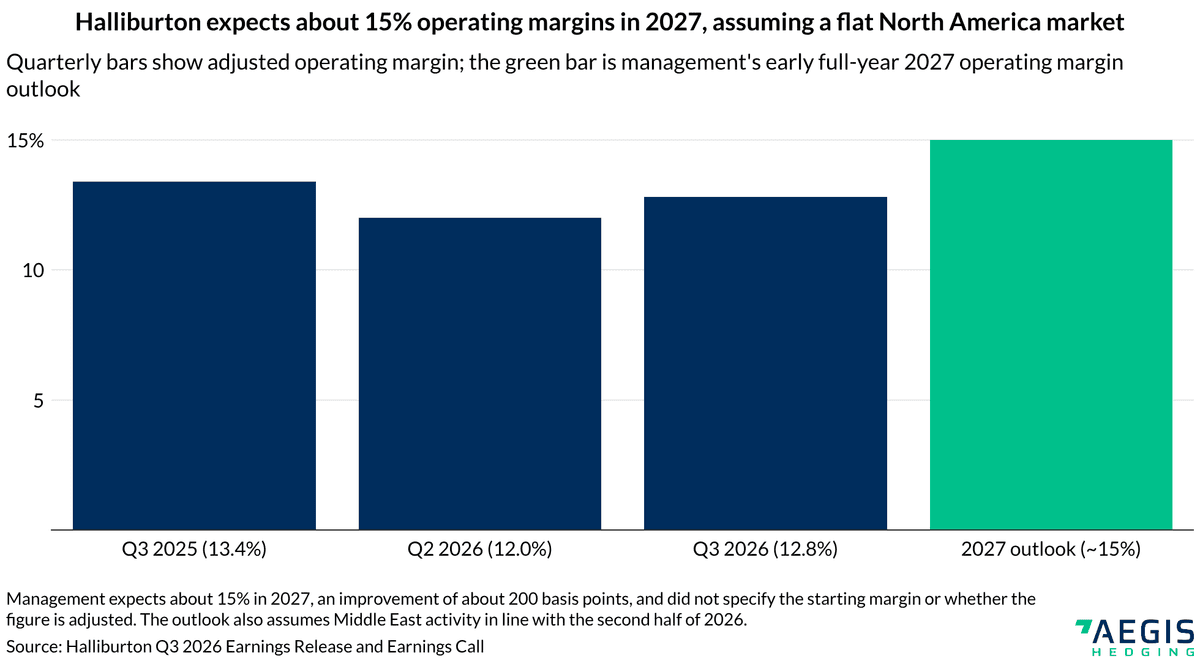
- Halliburton’s early 2027 outlook calls for mid-single-digit revenue growth and operating margins of about 15%, assuming a flat North America market and Middle East activity in line with the second half of 2026.
North America
The third quarter decline in North America had two causes. The frac market did not recover as strongly as Halliburton expected. The company also moved several frac crews to new customers at better pricing, and those moves created more downtime than expected, which weighed on North America results and its Completion and Production division. Halliburton said it runs its North America frac business for returns rather than market share, and that it saw several price increases throughout the quarter. On the call, management cited a large customer tender where only one service company bid, and another customer that extended Halliburton’s electric frac fleet at a higher price and then added a second fleet.
“[W]e do know it is a very tight market. And there’s not a whole lot of capacity out there.” -Shannon Slocum, Executive Vice President and Chief Operating Officer, Halliburton
Management also addressed the gap between drilling and completions. Responding to an analyst’s observation that most new rigs belong to private operators while completion activity has stayed measured, Halliburton said roughly 40 rigs have been added in North America and that private operators are increasing their frac activity. It said the conversations began with privates in late Q2, as operators with hedges saw an opportunity to create value at the prevailing strip, and now include more foundational contracts being considered by operators who believe commodity prices will stay elevated. Halliburton’s North America land drilling services, drill bits and drilling fluids businesses grew 23% year over year in the third quarter, well ahead of the rig count, as wells get longer and more complex.
Market Impact: Rising frac prices and limited spare capacity raise the cost of new L48 wells. Higher completion costs lift the price needed to grow supply, which supports the back end of the WTI and Henry Hub curves.
International
International revenue rose 3% sequentially to $3.5 billion and is up 9% from a year ago. The Middle East improved sequentially despite what Halliburton called inflationary headwinds that it expects to persist for some time. CEO Jeff Miller separately cited higher logistics costs for getting materials to location “with everything going on within the strait,” which the company has built into its 2027 outlook. Halliburton expects Middle East revenue to grow again in the fourth quarter on a full quarter of completions work and a larger share of work in Saudi Arabia, where Halliburton now has a frac fleet running in the Jafurah gas field and sees a runway of more than 30,000 stages to be fracked in the Kingdom next year. Outside the Middle East, the company expects its international business to grow about 12% in 2026.
Halliburton said it has won roughly $14 billion of work so far this year. Recent awards include the Bumerangue appraisal campaign for bp offshore Brazil and the Cronos gas development for Eni offshore Cyprus. It reopened its business in Venezuela, which was a more than $0.5 billion business before Halliburton left the country, and will deliver 12 electric submersible pumps there this quarter. Management said no one in the service sector is overbuilt, that the market is tight, and that in the past month it had to choose among three customers for the same drilling tools.
Market Impact: Halliburton describes a service market that is tight worldwide, with no one overbuilt, which leaves little spare equipment or crews to absorb a rise in US activity. That limits how far L48 completion costs can ease and supports breakevens at the back of the WTI curve. Most of the new international work is gas (Cronos, Jafurah) or long-dated oil development (Iraq, deepwater Brazil), so its supply effect falls mainly on Brent after 2027. Argentina’s Vaca Muerta is the exception, with new frac capacity starting this quarter.
2027 Outlook
“The world has lost an enormous amount of oil supply and the shortfall continues to grow. Current estimates are that nearly 3 billion barrels of supply have been lost since the conflict began and that about 1 billion barrels have been drawn from global inventories.” -Jeff Miller, Chairman, President and Chief Executive Officer, Halliburton
Halliburton expects mid-single digit revenue growth in 2027 and operating margins of about 15%, up roughly 200 basis points. The outlook assumes a flat North America market, Middle East activity in line with the second half of 2026, and steady growth in other regions. CFO Eric Carre said 2026 revenue should finish near $22.5 billion, so the outlook adds a little over $1 billion of revenue and $500-600 million of operating profit. About half of that profit comes from cost savings, roughly $100-150 million from the third quarter cost right-sizing, which included $107 million of severance tied to headcount reductions, and $120-150 million as spending on its SAP system upgrade winds down. The rest assumes 20-30% incremental margins on new revenue. Halliburton said it is not assuming meaningful price increases in 2027, even though it is already seeing pricing firm up.
“[A]s we describe ’27, that’s an assumption that we have made. That is not our view for North America. We’re actually quite excited about North America.” -Jeff Miller, Chairman, President and Chief Executive Officer, Halliburton
For the fourth quarter, Halliburton guided to flat revenue of about $5.7 billion with operating margins up about 70 basis points, and expects steady frac activity in North America land. It also expects full-year 2026 capital spending of about $1.1 billion.
Market Impact: Halliburton’s 2027 plan leaves North America pricing as upside rather than a requirement, so it is positioned to push price. For producers, that points to higher service costs in 2027, which supports the back end of the WTI curve by raising breakevens.
Oilfield Inflation
Halliburton Q3 2026 oilfield inflation signals
Source: Halliburton Q3 2026 Earnings Release and Earnings Call, AEGIS
For E&P operators, the call changes the read from the press release. The release showed falling North America revenue, but part of that decline came from Halliburton moving crews to higher-priced work, not only from softer frac activity. Halliburton, which says it is the largest frac provider in North America, is now raising prices with little spare capacity, international demand is tight enough that it is choosing among customers for drilling tools, and management said it would take only one or two large operators committing to a bigger program to change things for Halliburton. Operators planning to add activity in 2027 should expect to pay more for completions than they did this year, and those that wait may find crews already committed.
Market Impact: Completion cost inflation raises L48 breakevens and slows the supply response to high prices, which supports the back end of the WTI and Henry Hub curves.
Overall, Halliburton’s third quarter call points to a tightening oilfield service market both in the US and abroad. The company built its 2027 plan on a flat North America, which it called an assumption rather than its view, and described a North America frac market where prices are rising, capacity is scarce, and private operators are already adding activity. For producers, the cost of growing supply in 2027 is likely to be higher than in 2026, which makes service cost inflation a real input to 2027 budgets alongside the price they hedge.
Sources: Halliburton Announces Third Quarter 2026 Results, October 20, 2026; Halliburton Q3 2026 Earnings Call transcript (Bloomberg), October 20, 2026.