SM Energy Sees Relief at Waha but Expects Uinta Oil Takeaway Limits Into Early 2027
AEGIS Automation6 min read
SM realized 83% of Henry Hub on its Permian gas as Waha differentials stabilized, while its Uinta oil stays constrained by takeaway until a terminal expansion expected in the first quarter of 2027.
SM Energy produced 433 MBoe/d in the third quarter of 2026, including 230 MBbl/d of oil.
Oil volumes were reduced by about 2 MBbl/d of Permian downtime, which SM says has been addressed, and about 4 MBbl/d of Uinta takeaway constraints it expects to be resolved in early 2027.
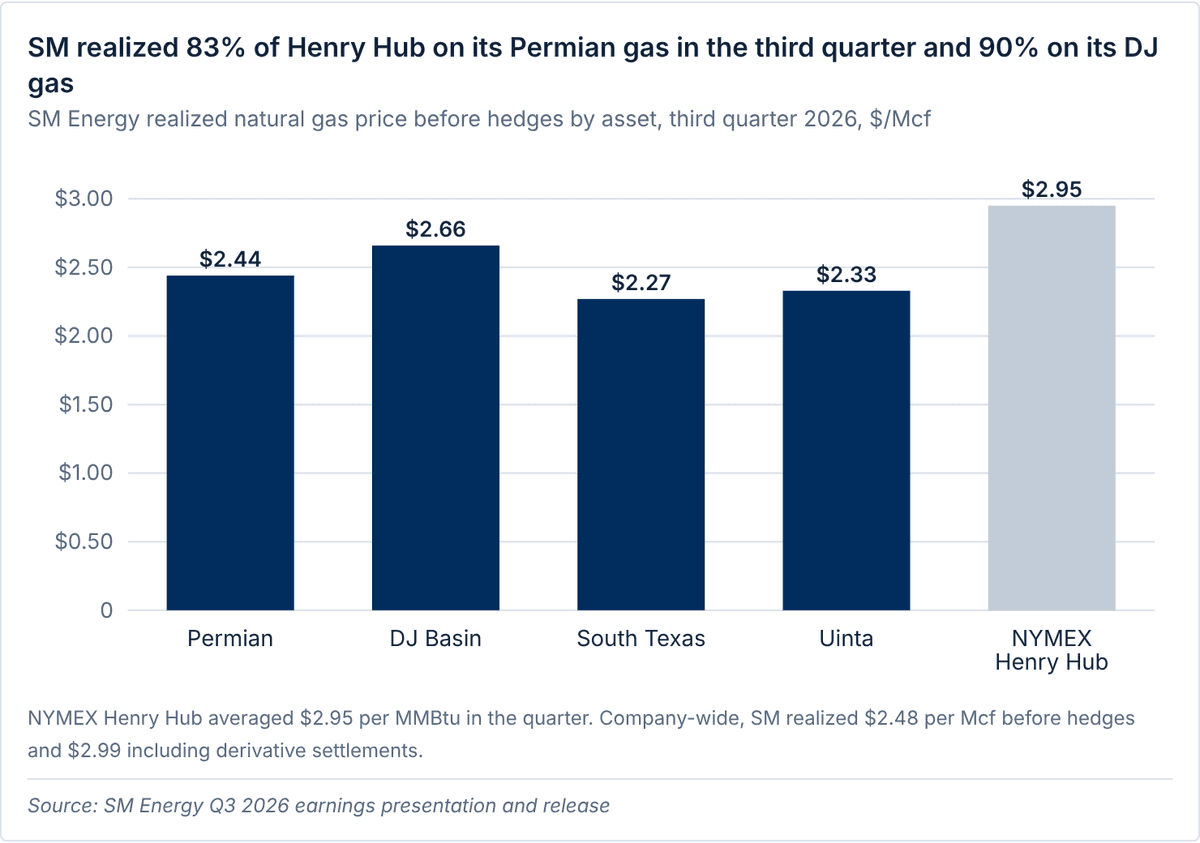
SM realized $2.48 per Mcf for its gas before hedges, 84% of Henry Hub, with its Permian gas at 83% and its DJ Basin gas at 90%.
SM lowered its full-year 2026 oil guidance by 1% to 220-222 MBbl/d, narrowed total production guidance to 420-422 MBoe/d and expects fourth-quarter oil of 229-239 MBbl/d.
Chief Executive Officer Beth McDonald said the second-half run rate SM gave last quarter, 435-440 MBoe/d with about 238 MBbl/d of oil, still holds as a good baseline for 2027, with guidance due in February.
Uinta
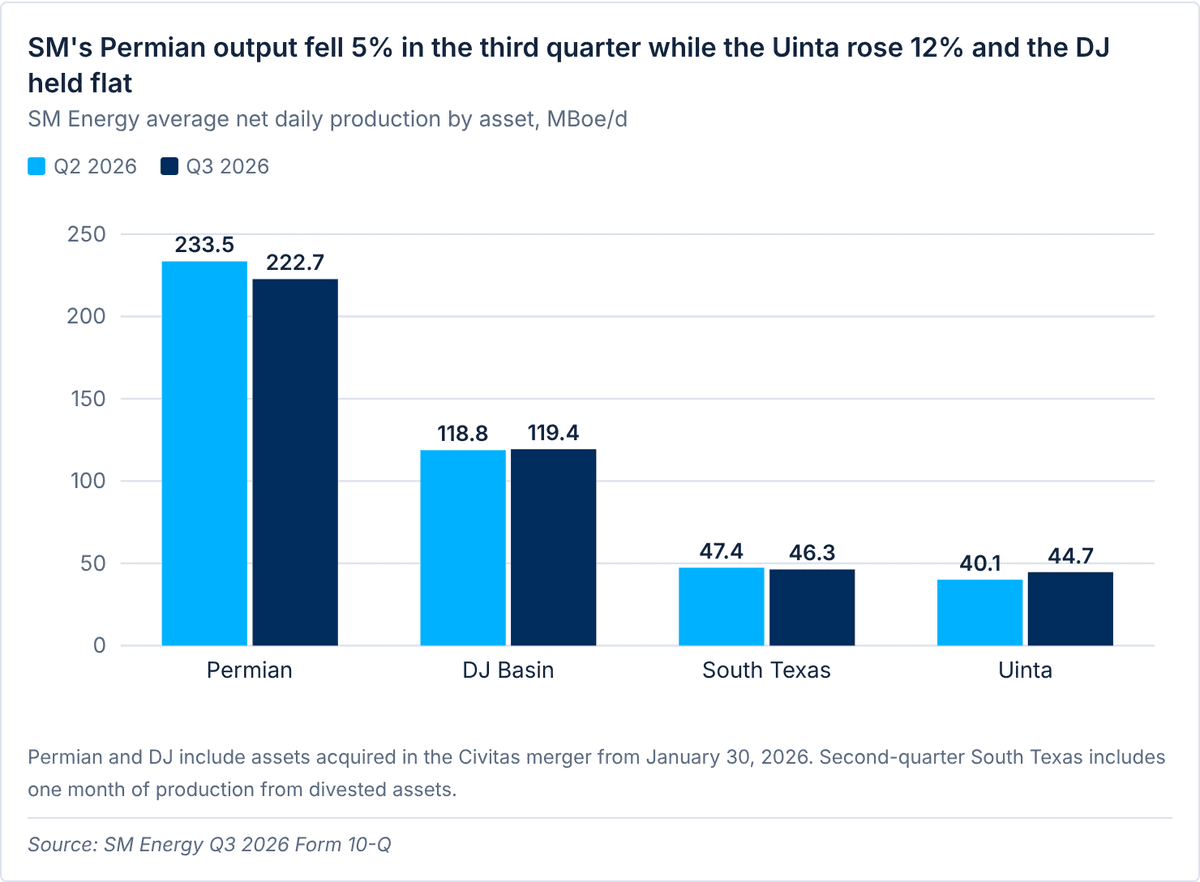
SM's Uinta production rose 12% sequentially to 44.7 MBoe/d in the third quarter, 85% of it oil, but Chief Operating Officer Blake McKenna said the asset was limited by takeaway. An unplanned outage at an in-basin refinery sent incremental barrels to rail when terminal capacity was already fully used ahead of a planned expansion. The refinery is back online, but rail capacity stays constrained until the terminal expansion enters service, currently expected in the first quarter of 2027, and SM's fourth-quarter oil guidance of 229-239 MBbl/d includes that limit.
McDonald said the terminal serves SM and one other operator, and that the planned expansion will more than double its capacity, beyond what either company committed to. She said SM is weighing the Uinta takeaway constraints early in 2027 against temporarily shifting activity to other basins as it builds its 2027 budget. SM ran two rigs and one completion crew in the Uinta in the third quarter and plans an average of three rigs and one crew for the rest of 2026. Its first fully SM-designed pad came online in August on 15,000-foot laterals with the highest normalized 30-day rates SM has delivered in the basin, the next pads in the fourth quarter use 20,000-foot laterals, and its first 4-mile wells turn in line in the fourth quarter. SM's Uinta oil realized 95% of WTI in the quarter.
Market impact: SM expects a terminal expansion in the first quarter of 2027 to relieve the takeaway limit on its Uinta oil. New takeaway is supportive of Uinta crude differentials to WTI.
DJ Basin
SM's DJ Basin production was flat sequentially at 119.4 MBoe/d, including 56.9 MBbl/d of oil and 246.5 MMcf/d of gas, on one rig and one completion crew; SM plans one rig for the rest of 2026 and one crew for part of the fourth quarter. It turned 24 net wells in line, and its presentation calls the DJ its lowest-cost asset per lateral foot. McKenna said SM has invested alongside an operator of a sand mine in the basin, which the presentation says should supply all of SM's DJ sand needs and lower its proppant cost by about 40% against the in-basin market by mid-2027.
SM's 10-Q says regional basis differentials in the Permian and DJ moderated in the third quarter, although regional pricing constraints continue to influence its realized prices. It says CIG Rockies differentials widened in the first half of 2026 on elevated regional storage after a mild winter and lower spring demand, then narrowed through the late second and third quarters as regional demand strengthened. SM realized $2.66 per Mcf for its DJ gas before hedges, 90% of Henry Hub and the highest of its four assets.
Market impact: SM held DJ Basin production flat at 119.4 MBoe/d and plans one rig there for the rest of 2026, neutral for CIG Rockies basis.
Permian
SM's Permian production fell 5% sequentially to 222.7 MBoe/d, including 118.9 MBbl/d of oil and 546.8 MMcf/d of gas. McKenna said downtime ran higher than planned while SM completed compliance work on acquired assets and temporarily shut in production during high-risk simultaneous operations, and that this downtime is now behind it. McDonald said SM's activity came down to a new baseline in July and August, so part of the Permian drop was planned, and that production should be flat to up a little from this quarter. SM ran six rigs and two completion crews in the Permian in the third quarter and plans six rigs and one crew for the rest of 2026.
McKenna said the 21 Delaware Basin wells SM brought on this year are producing about 40% more oil per foot than its 2024 wells and about 24% more than its 2025 wells at six months, and that SM has drilled roughly twice as many Delaware wells as last year. The eight Woodford-Barnett wells online in the Midland Basin are delivering above the area average, and delineation continues. On gas, SM's 10-Q says gathering and takeaway constraints contributed to widening Waha differentials in the first half of 2026, that differentials improved late in the second quarter and stabilized in the third as new pipeline capacity entered service, and that SM expects additional pipeline capacity during the rest of 2026. Asked about gas realizations, McDonald said, "We've seen relief at Waha and more pipes are to come."
Market impact: SM expects more Permian pipeline capacity during the rest of 2026 after Waha differentials stabilized in the third quarter. New takeaway is supportive of Waha basis.
Hedging
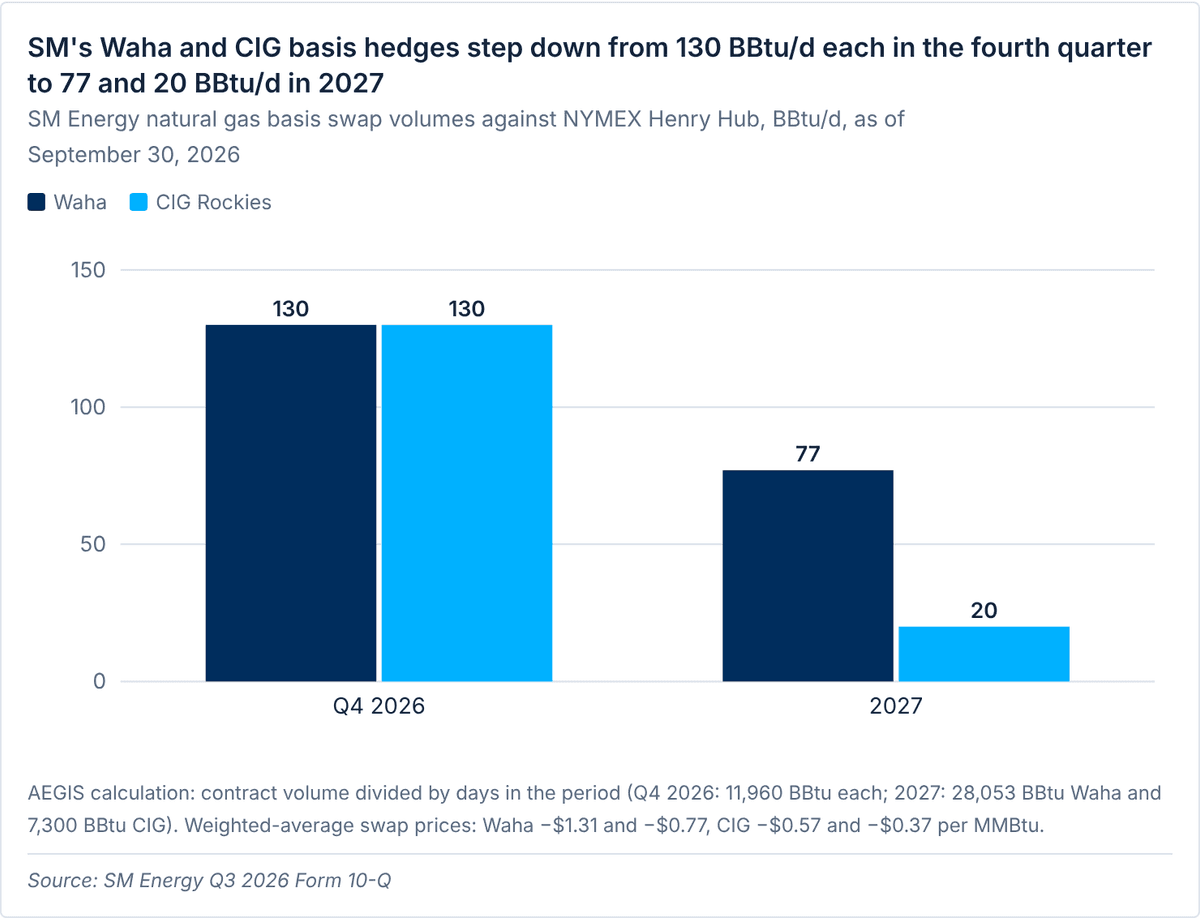
Chief Financial Officer Wade Pursell said SM keeps layering in hedges tied to the balance sheet, and that with a stronger balance sheet its targeted hedge levels a year out are closer to 30%, down from 50% after the merger. SM's presentation shows about 11,000 MBbls of fourth-quarter oil hedged at $60.45 to $62.67 per barrel, about half of its fourth-quarter oil guidance by AEGIS's calculation, and about 42,100 BBtu of fourth-quarter gas hedged at $3.77 to $4.51 per MMBtu. Its 10-Q shows Waha and CIG Rockies basis swaps of 11,960 BBtu each for the fourth quarter, at $1.31 and $0.57 below Henry Hub, or about 130 BBtu/d each, falling in 2027 to about 77 BBtu/d of Waha swaps (28,053 BBtu for the year) at $0.77 below and about 20 BBtu/d of CIG swaps (7,300 BBtu) at $0.37 below, by AEGIS's per-day calculation. It also holds IF Waha fixed-price swaps of 1,067 BBtu for the fourth quarter at $3.13, 4,603 BBtu for 2027 at $3.64 and 7,280 BBtu for 2028 at $1.11 per MMBtu.
Market impact: SM's hedge targets are now closer to 30%, down from 50%. Hedging changes its price exposure, not its supply, neutral for WTI, Henry Hub, Waha and CIG Rockies.
Oilfield Inflation
Signal
Direction
Evidence
Input costs
Up
McKenna cited inflation in diesel unit costs, fuel-related transportation and other consumables, including OCTG.
2026 capital
Flat
Capital narrowed to about $2.75 billion, the midpoint of the prior range, with synergies and efficiencies largely offsetting inflation.
2027 outlook
Could rise (management)
McDonald said it is "not unreasonable to say that inflation could hit this sector at this point," with 2026 capital excluding one-time costs as a starting point for 2027.
McKenna said SM's Uinta completion cost fell from $475 per lateral foot in the first quarter to about $400 in the third, and that simul-frac raised completion speed on the same lateral length and target zone from about 1,000 feet per day to 2,800. In the Permian, third-quarter drilling footage per day was up about 15% and completion footage about 23% from the 2025 average. SM's 10-Q says it is monitoring potential inflation in oilfield services, materials and other inputs tied to the elevated commodity price environment and the conflict in the Middle East.
Market impact: SM reported higher diesel, fuel-transport and OCTG costs, largely offset by synergies and efficiencies, and said inflation could hit the sector. Higher service costs are supportive of deferred WTI.
Overall, SM said its third-quarter oil volumes were held back by about 2 MBbl/d of Permian downtime, now addressed, and about 4 MBbl/d of Uinta takeaway limits that it expects to be resolved when a terminal expansion enters service in the first quarter of 2027. It reported relief at Waha, with more pipeline capacity expected this year, and said the second-half run rate it gave last quarter, 435-440 MBoe/d, still holds as a good baseline for 2027.
Get market insights delivered to your inbox — for free.
This website uses cookies
We use a few essential cookies to make our site work, including one that counts how many reports you have opened. Analytics cookies are used only with your permission, and you can change your mind at any time. Learn more about cookies in our privacy policy.