Permian Resources Restores Curtailed Gas as About 80% of Its Gas Now Prices Away From Waha
AEGIS Automation5 min read
Permian Resources brought back curtailed high-GOR wells and its gas output rose 42% to 787 MMcf/d; it now sells more than 600 MMcf/d downstream of Waha, with about 80% of its gas priced in Gulf Coast and DFW markets.
Permian Resources produced 208.0 MBbls/d of oil and 787.1 MMcf/d of natural gas in the third quarter of 2026, for total production of 457.5 MBoe/d.
Its gas volumes rose 42% from the second quarter after it brought back high-GOR wells it had curtailed when Waha prices were deeply negative.
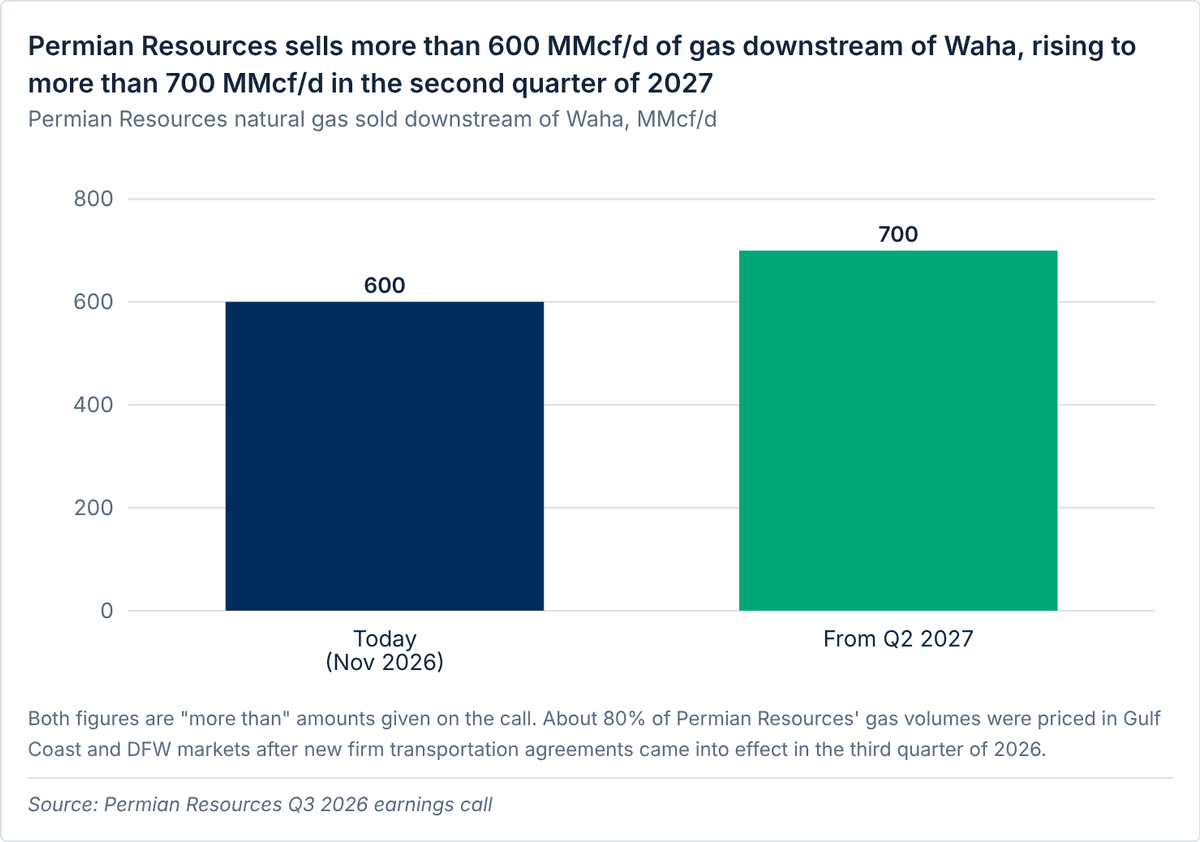
About 80% of its gas volumes are now priced in Gulf Coast and DFW markets, and it sells more than 600 MMcf/d downstream of Waha, rising to more than 700 MMcf/d in the second quarter of 2027.
It completed about 175 acquisitions in the core of the New Mexico Delaware Basin for about $1.15 billion, including Ridge Runner, which closed on October 30.
Permian Resources raised its 2026 oil guidance midpoint to 202.5 MBbls/d and expects more than 210 MBbls/d of oil in the fourth quarter.
Natural Gas Volumes
Co-Chief Executive Officer Will Hickey said Permian Resources curtailed high-GOR wells in the second quarter when Waha prices were deeply negative, then brought them back online as prices improved, lifting natural gas production 42% from the second quarter to about 787 MMcf/d. NGL volumes rose 37% to 118.3 MBbls/d. Hickey said the company's unhedged realized gas price improved by $2.48 per Mcf from the second quarter, and it realized $1.12 per Mcf including hedges. Its natural gas revenue rose by $141 million to $53 million, from negative in the second quarter.
Asked whether stronger gas prices and new takeaway change its development plan, Hickey said its economics are still oil-driven and that better downstream gas prices make every well more economic but do not change capital allocation.
Market impact: Permian Resources brought back high-GOR wells it had curtailed in the second quarter when Waha prices were deeply negative. More supply is bearish for Waha basis.
Gas Marketing and Takeaway
Hickey said Permian Resources began delivering gas on a new pipeline in the third quarter, raising the share of its gas volumes priced in Gulf Coast and DFW markets to about 80%, and that it now sells more than 600 MMcf/d downstream of Waha, rising to more than 700 MMcf/d in the second quarter of 2027. The release attributes the shift to incremental firm transportation agreements that came into effect. Co-Chief Executive Officer James Walter said the company thinks in-basin Waha pricing should improve, but that its goal is to sell most of its molecules further downstream, while its contracts preserve some optionality to shift sales back to Waha.
Walter said the firm takeaway it holds for next year, rising again in 2028, leaves its gas "pretty well covered for the near term," and that if its gas keeps growing it would likely evaluate taking firm capacity on longer-dated pipelines. He called the move away from Waha "pretty close to mission accomplished" and said Permian Resources is now looking at LNG deals, end users and infrastructure investments, with a high bar for returns.
Market impact: Permian Resources sells more than 600 MMcf/d of gas downstream of Waha, rising to more than 700 MMcf/d in the second quarter of 2027. New takeaway is supportive of Waha basis.
Delaware Basin Activity and Acquisitions
Oil production rose by about 10 MBbls/d from the second quarter, including more than 8 MBbls/d of organic growth, which Hickey attributed to record-low downtime from more workovers, over 100 acquisitions of extra working interest in existing units and shorter cycle times; the rest came from its Ward County bolt-on. Permian Resources raised its 2026 oil guidance midpoint to 202.5 MBbls/d, 13.5 MBbls/d above its February guide, and Walter said about 85% of the year-to-date increase came from standalone improvements. It plans about 250 gross wells turned in line in 2026 while keeping its current rig and fleet counts, with cash capital expenditures of $1.975-2.075 billion.
Its roughly 175 acquisitions added about 24,000 net acres, 9,000 net royalty acres and 13,000 BOE per day, mostly offsetting its core Northern Delaware position. Ridge Runner, bought for about $1.025 billion of initial cash plus potential contingent payments tied to future oil prices, was producing about 6 MBbls/d of oil at closing and is expected to add about 4 MBbls/d in the fourth quarter; Walter said the deal excluded Ridge Runner's Woodford and Northwest Shelf assets. Permian Resources expects more than 210 MBbls/d of oil in the fourth quarter with capital spending similar to the third. On 2027, Hickey said the company will "probably keep it close to the vest" and will try to deliver any growth within its existing rig and frac fleet count.
Market impact: Permian Resources grew oil production by more than 8 MBbls/d organically in the third quarter. More supply is bearish for WTI.
Hedging
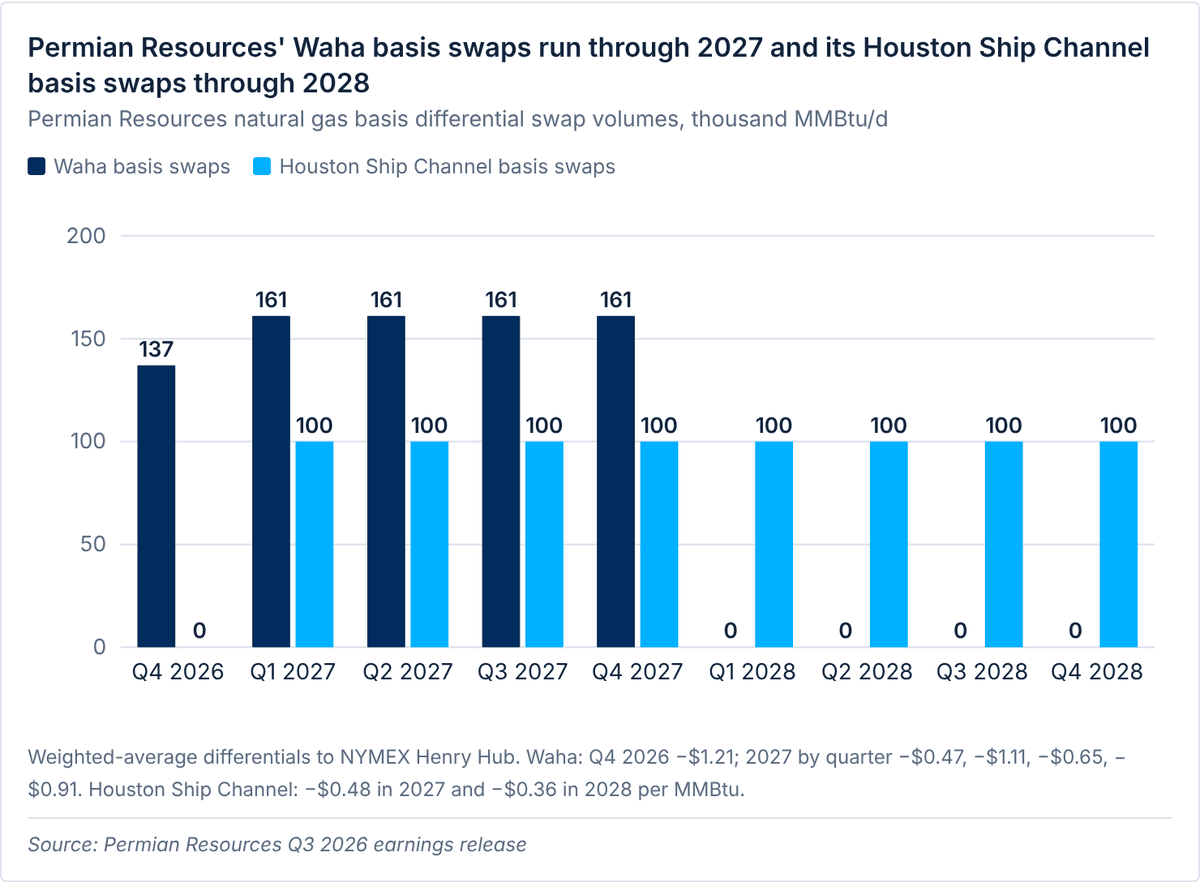
Walter said that with leverage at about 0.5 times and an investment-grade rating, hedging to protect the business "is no longer a need," and that Permian Resources will hedge opportunistically; it has seen some windows to layer on additional hedges. Its release lists Waha basis swaps of 137,000 MMBtu/d for the fourth quarter of 2026 at $1.21 below Henry Hub and 161,000 MMBtu/d in each quarter of 2027 at $0.47 to $1.11 below, plus Houston Ship Channel basis swaps of 100,000 MMBtu/d in each quarter of 2027 at $0.48 below and 2028 at $0.36 below. It also holds Waha fixed-price swaps of 164,620 MMBtu/d for the fourth quarter at $2.73 and 85,000 MMBtu/d for the first quarter of 2027 at $3.57.
Market impact: Permian Resources says it will now hedge opportunistically rather than to protect the business. Hedging changes its price exposure, not its supply, neutral for Waha and Houston Ship Channel basis.
Oilfield Inflation
Signal
Direction
Evidence
Input costs
Up
Walter said diesel and casing are headwinds; Hickey cited inflation in diesel and steel.
Well costs
Down
Hickey said efficiency gains are helping offset that inflation and supporting lower drilling and completion cost per foot year over year.
2027 outlook
Could rise (management)
Walter cited "potential kind of tariff-related casing increases that are projected into '27."
Walter said Permian Resources has weighed how far ahead to buy casing given the run-up in hot-rolled coil prices, is looking at kits that cut diesel use on its rigs, and now has electric frac fleets "on the table." He said service-company efficiencies have brought some deflation in other areas. Hickey said the company has been able to mitigate much of the diesel-related inflation it has seen this year.
Market impact: Permian Resources cited diesel and casing as cost headwinds, with potential tariff-related casing increases projected into 2027. Higher service costs are supportive of deferred WTI.
Overall, Permian Resources brought back the high-GOR gas it had curtailed in the second quarter, lifting gas production 42% to 787 MMcf/d, while about 80% of its gas now prices in Gulf Coast and DFW markets. It added about 175 Delaware Basin acquisitions, including Ridge Runner, raised its 2026 oil guidance midpoint to 202.5 MBbls/d, and expects fourth-quarter oil above 210 MBbls/d.
Get market insights delivered to your inbox — for free.
This website uses cookies
We use a few essential cookies to make our site work, including one that counts how many reports you have opened. Analytics cookies are used only with your permission, and you can change your mind at any time. Learn more about cookies in our privacy policy.