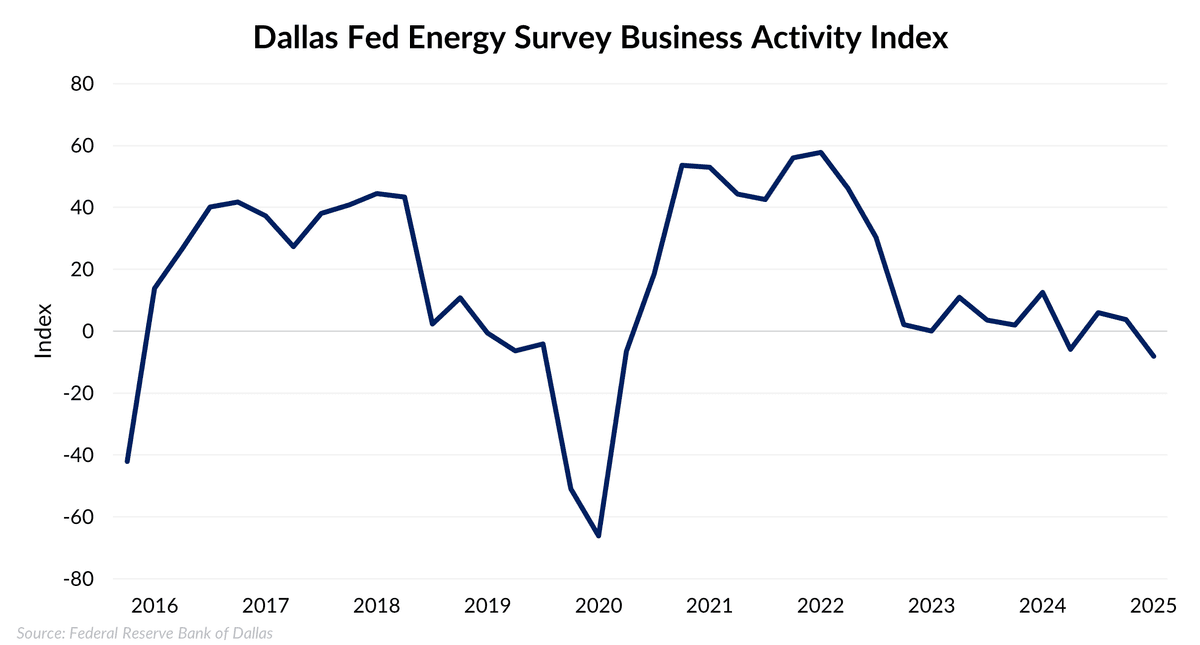
Oil and gas business activity across Texas, northern Louisiana, and southern New Mexico declined in the second quarter of 2025, as uncertainty rose and commodity prices weakened.
The Dallas Fed Energy Survey’s Business Activity Index (for the Fed’s 11th District) fell to -8.1 from 3.8 in Q1, signaling a modest contraction. Outlook sentiment also dipped, with the company outlook index at -6.4, while uncertainty rose sharply to 47.1.
The survey was conducted from June 18 to June 26, 2025, with responses from 136 energy firms, including 91 E&P companies and 45 oilfield services providers.
Production and Cost Trends E&P firms reported a decline in both oil and natural gas production, with the oil production index falling to -8.9 from 5.6 and the natural gas index slipping to -4.5. (These indices reflect the net share of firms reporting increases versus decreases, so negative values indicate that more firms saw declines than gains.) Cost inflation was mixed across segments:
- Oilfield services firms reported higher input costs (index rose to 40.0), but also noted margin compression, as the margin index plunged to -33.4.
- E&P firms saw slower increases in finding and development and lease operating costs.
Price Expectations Spot prices during the survey period averaged $69.81 for WTI and $3.30 for Henry Hub. Executives nonetheless forecast modest price increases in the medium to long term:
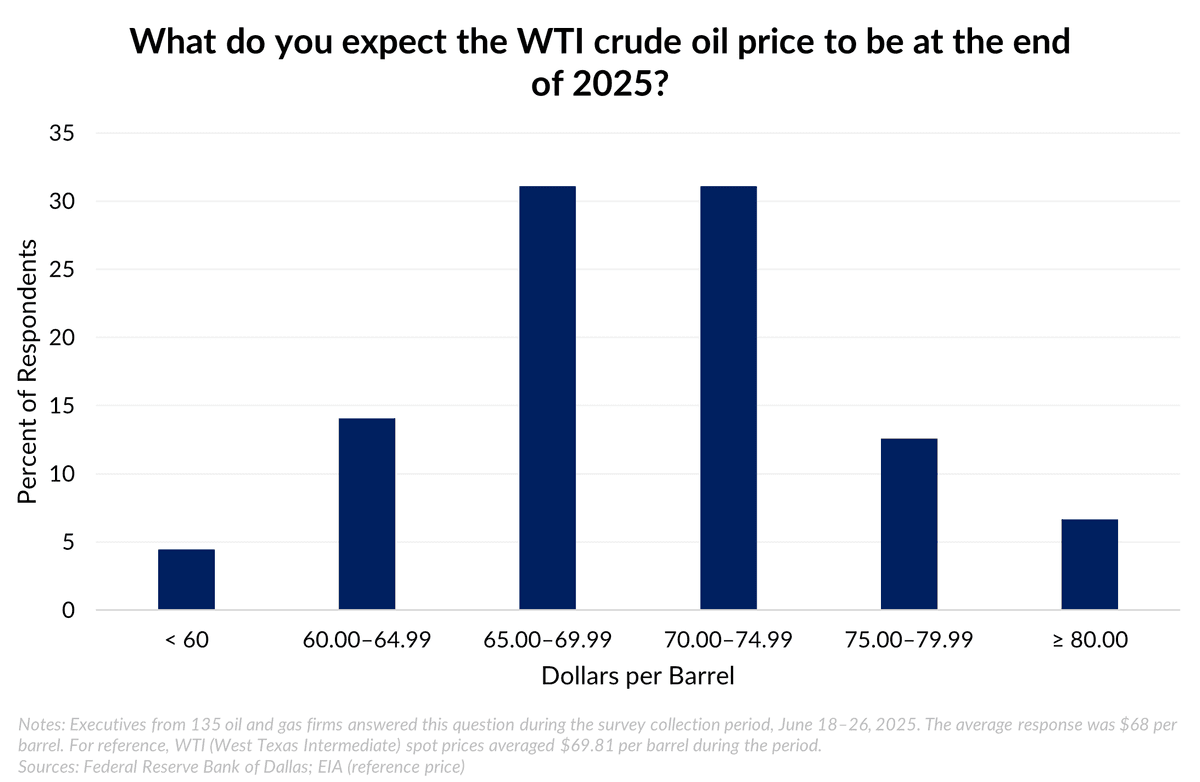
- WTI oil is expected to average $68/Bbl by year-end, rising to $72 in two years and $77 in five years.
- Henry Hub natural gas is expected to end 2025 at $3.66/MMBtu, reach $4.12 in two years before climbing to $4.50 by 2030.
Most firms expect WTI to stay between $65–$75/Bbl at year-end 2025, while natural gas prices are forecast to stay between $3.50–$4.49/MMBtu.
Drilling and Investment Outlook Drilling plans have been tempered:
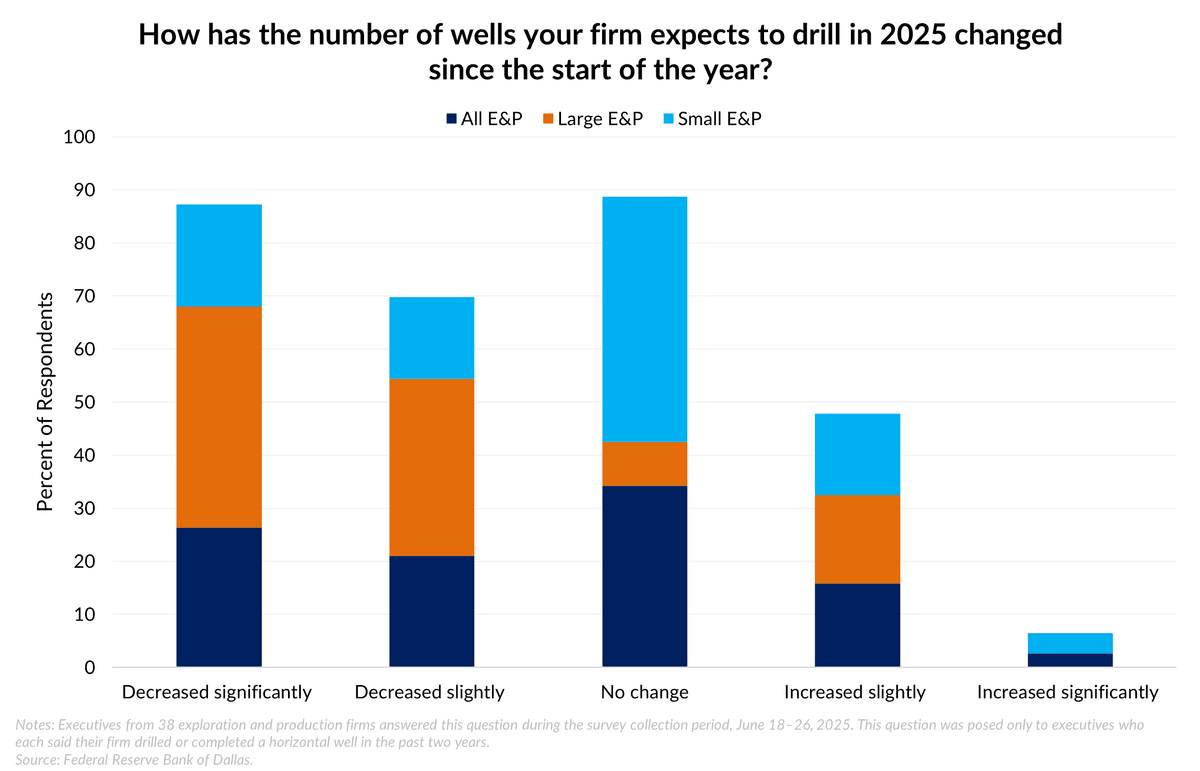
- 47% of E&P executives anticipate drilling fewer wells in 2025 than planned at the start of the year.
- The recent official increase in steel import tariffs from 25% to 50%, enacted by presidential proclamation on June 3, 2025, is expected to weigh on drilling activity in the second half of the year, with 32% of E&P executives reporting plans to drill fewer wells as a result.
Price Sensitivity and Risk Low oil prices threaten upstream viability:
- At $60/Bbl, 61% of E&P executives said production would decline slightly.
- At $50/Bbl, 88% expect production declines, 46% significantly.
Service firms also showed vulnerability. If oil averages $50/Bbl, 58% expect significant price cuts for their primary service offerings.
Long-Term Structural Constraints Produced water management is emerging as a long-term constraint in the Permian Basin:
- 74% of respondents expect produced water disposal issues to constrain activity over the next five years.
- Comments highlighted aging infrastructure, regulatory risks, and environmental hazards from shallow zone injections and overpressurized disposal zones.
Conclusion The outlook for the U.S. oil and gas sector remains fragile. According to those surveyed, near-term prices are expected to remain in a tight range, and investment is retreating as cost pressures mount. Persistent structural issues, from tariffs to water management, are shaping a cautious tone across both operators and service providers.