Kinetik Sees Localized Waha Egress Constraints Easing After Its New Mexico Plants Ran Full for Much of the Quarter
AEGIS Automation5 min read
Kinetik processed a record 1.94 Bcf/d in the third quarter and 2.14 Bcf/d in October, said localized Waha egress constraints have begun to ease, and expects more than 13 Bcf/d of new residue gas takeaway from 2028 through 2030.
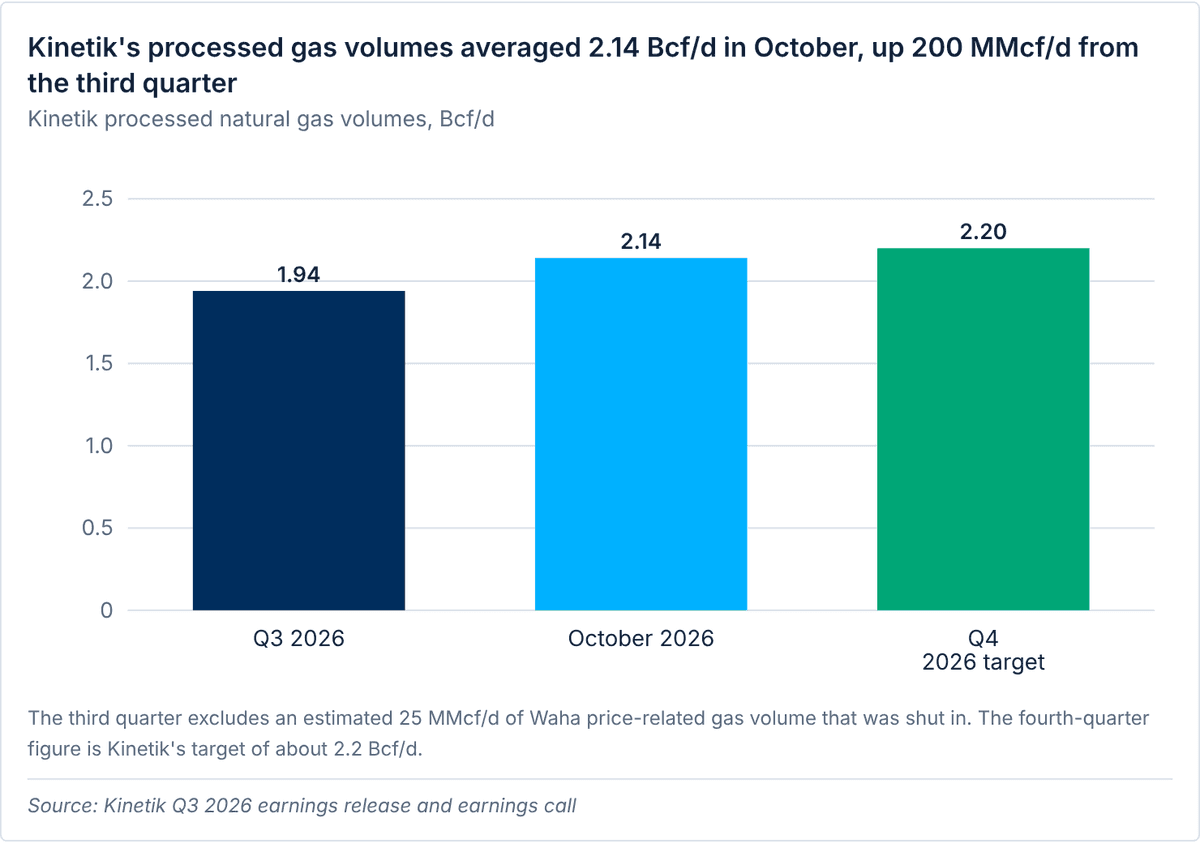
Kinetik processed a record 1.94 Bcf/d of natural gas in the third quarter of 2026, with an estimated 25 MMcf/d more shut in because of Waha prices.
Its processed volumes averaged 2.14 Bcf/d in October, and Kinetik said it is tracking toward its fourth-quarter target of about 2.2 Bcf/d.
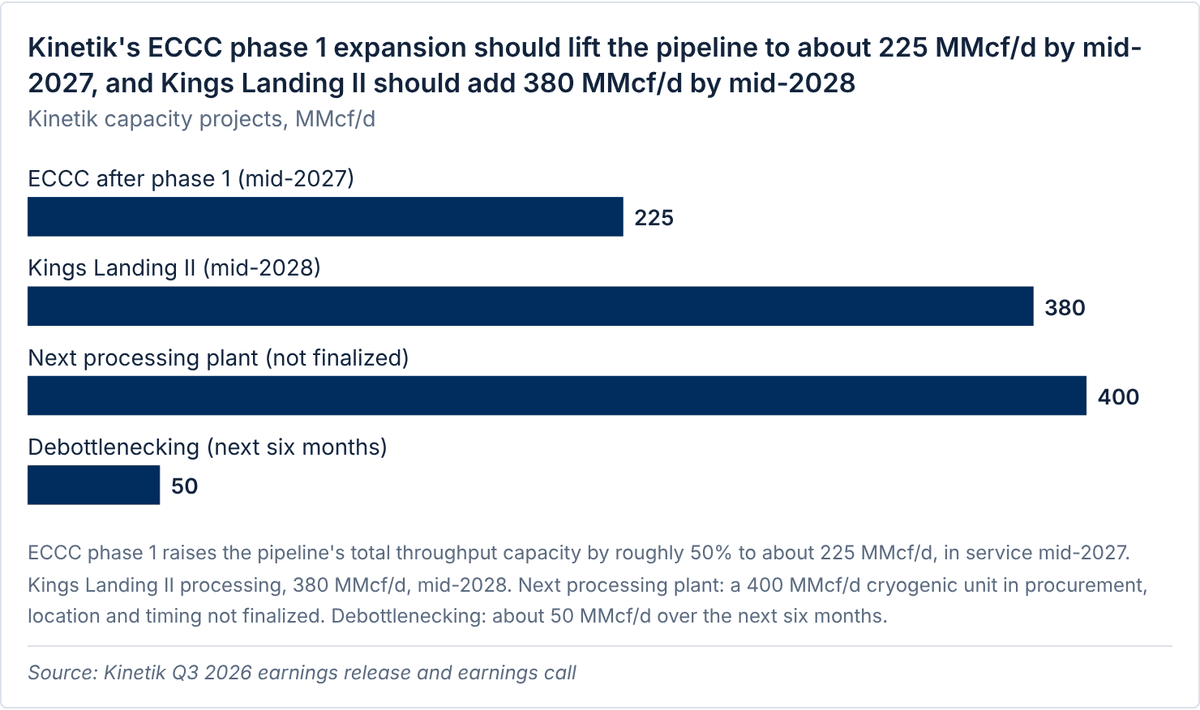
Kinetik upsized its Kings Landing II plant by more than 25% to 380 MMcf/d with no change to its expected cost of about $260 million, and the plant remains on track for mid-2028.
It reached a final investment decision on phase 1 of the ECCC Pipeline expansion, which should raise throughput capacity to about 225 MMcf/d by mid-2027.
Kinetik said localized Waha egress constraints have begun to ease and expects more than 13 Bcf/d of incremental residue gas takeaway capacity to come online from 2028 through 2030.
Delaware Basin Volumes
Kinetik's processed gas volumes rose to a record 1.94 Bcf/d in the third quarter, with an estimated 25 MMcf/d of Waha price-related shut-ins on average during the quarter. Its Kings Landing I complex and other New Mexico processing plants ran at full capacity for much of the quarter, so the ECCC Pipeline moved surplus volumes south to its Delaware South system. President and Chief Executive Officer Jamie Welch said October volumes averaged 2.14 Bcf/d, 200 MMcf/d above the third-quarter average, and the release says volumes are tracking toward the fourth-quarter target of about 2.2 Bcf/d. Kinetik expects to reach full utilization across its integrated systems by the end of 2027, and Welch said about 50 MMcf/d of debottlenecking capacity remains to be added over the next six months.
The release says producers are delineating new benches, which tend to have higher gas-to-oil ratios, making the Woodford, Avalon, First Bone Spring and Penn Shale more expansive across the Delaware Basin. Senior Vice President and Chief Financial Officer Trevor Howard said gas-to-oil ratios have compounded at about 5% to 6% per year and that Kinetik expects that to continue, with the potential to accelerate as deeper benches are unlocked. Asked how producers would respond to a quick drop in crude, Welch said New Mexico development for 2027 is largely set, calling it "a baked cake," and that he does not see much change in producer behavior going into 2027.
Market impact: Kinetik expects its processed volumes to rise to about 2.2 Bcf/d in the fourth quarter from 1.94 Bcf/d in the third. More supply is bearish for Waha basis.
Processing and Pipeline Expansions
In September, Kinetik raised the planned capacity of Kings Landing II by more than 25% to 380 MMcf/d, keeping the expected cost at about $260 million, and Howard said the plant will add about 15% to Kinetik's total processing capacity when it enters service in mid-2028. Kinetik also took a final investment decision on phase 1 of the ECCC Pipeline expansion, which should raise throughput by roughly 50% to about 225 MMcf/d, with construction expected to start in early 2027 and in-service anticipated mid-2027. Kinetik calls the expansion a bridge that lets it move more volume south to Texas until Kings Landing II starts up, after which Howard expects some volumes to flow back north.
For its next plant beyond Kings Landing II, Kinetik has ordered long-lead residue compression and is procuring front-end amine treating and a 400 MMcf/d cryogenic unit, with the location in Texas or New Mexico not yet finalized. Welch said Kinetik now expects to add a 400 MMcf/d plant every 18 to 24 months, against 200 MMcf/d plants it once planned around, so its "volume growth expectations have doubled." Since the beginning of August, more than 30,000 gross acres in New Mexico and Texas have been dedicated to Kinetik, some of them prospective for the Woodford, with first flow anticipated in the second and third quarters of 2027; one agreement carries a firm minimum volume commitment. Rising CO2 in Loving and Lea Counties is also driving an expansion of amine treating at its Pecos Bend facility.
Market impact: New and amended gathering and processing agreements adding more than 30,000 gross dedicated acres are expected to start flowing on Kinetik's system in the second and third quarters of 2027. More supply is bearish for Waha basis.
Waha Takeaway and Gulf Coast Access
Welch said localized Waha egress constraints have begun to ease, that more than 7 Bcf/d of new Permian pipeline egress capacity has been announced in the last three months, and that Kinetik expects more than 13 Bcf/d of incremental residue gas takeaway capacity to come online from 2028 through 2030. The release says that capacity should "substantially improve residue gas egress, and reduce Waha price volatility." Howard said Kinetik's Gulf Coast marketing margin declined in the third quarter, as expected, with Waha gas prices turning positive.
Kinetik committed to additional transport capacity on a new long-haul residue gas pipeline from the Waha Hub to the Gulf Coast, expected to start in 2029, and secured firm access to additional Gulf Coast residue gas pricing starting in 2027. It said it believes more residue gas takeaway will be needed to support long-term Permian production growth.
"Come the 2030s, the single largest gas basin in this country will be the Permian."
-Jamie Welch, President and Chief Executive Officer, Kinetik
Market impact: Kinetik expects more than 13 Bcf/d of new residue gas takeaway out of the Permian from 2028 through 2030. New takeaway is supportive of Waha basis.
2027 Outlook and Hedging
Howard said Kinetik expects a constructive commodity environment to support gross margin in 2027, partly offset by lower residue gas marketing contributions. As its legacy Lone Star NGL contracts in Texas and New Mexico begin expiring, with the first on October 31 and more at year-end and in September 2027, Kinetik now forecasts larger margin contributions from system optimization in 2027 than it expected before. Welch said 2027 will be as much about higher unit margins as about volume growth. Howard also said Kinetik runs a ratable hedging program that looks out up to 24 months and has been "pretty active on the hedging front" for 2027 and 2028.
Market impact: Kinetik has been adding hedges for 2027 and 2028. Hedging changes its price exposure, not its supply, neutral for Waha basis.
Overall, Kinetik's New Mexico plants ran at full capacity for much of the third quarter as processed volumes reached a record 1.94 Bcf/d, and October averaged 2.14 Bcf/d. It upsized Kings Landing II to 380 MMcf/d, sanctioned phase 1 of the ECCC expansion to about 225 MMcf/d, and is procuring a 400 MMcf/d cryogenic unit for its next plant, while saying localized Waha egress constraints have begun to ease and that it expects more than 13 Bcf/d of new takeaway from 2028 through 2030.
Get market insights delivered to your inbox — for free.
This website uses cookies
We use a few essential cookies to make our site work, including one that counts how many reports you have opened. Analytics cookies are used only with your permission, and you can change your mind at any time. Learn more about cookies in our privacy policy.