Kinder Morgan Commits to Two Large Gas Pipelines as Power Demand Pulls on Permian and Appalachian Supply
AEGIS Automation5 min read
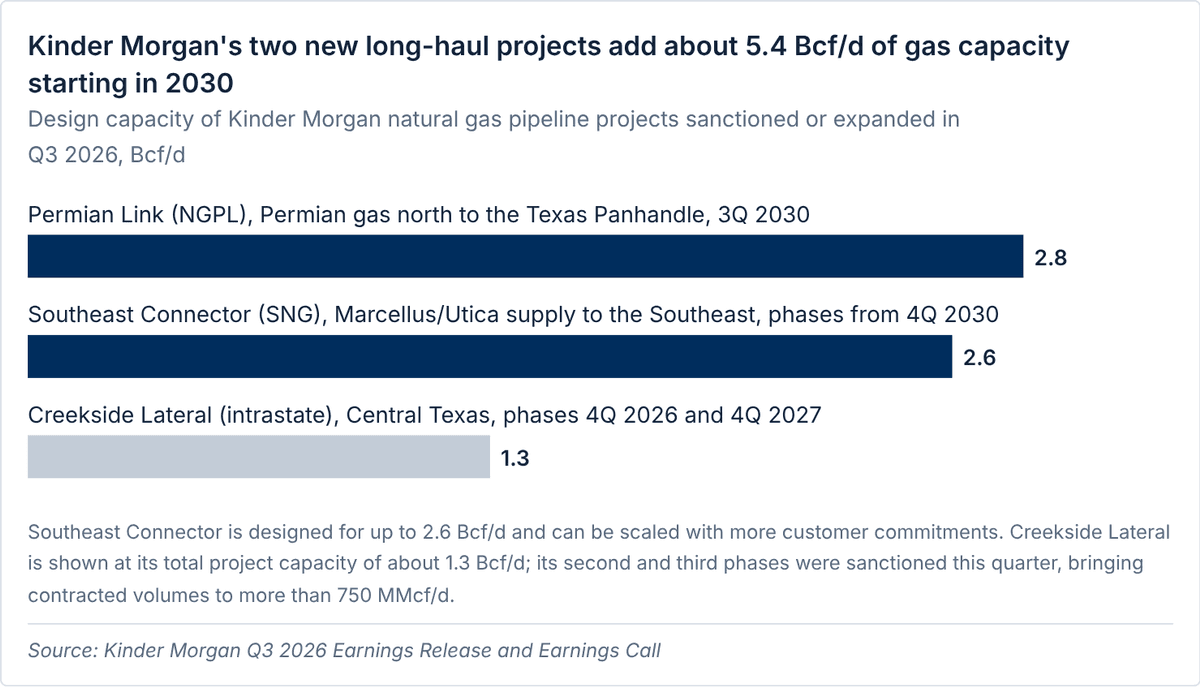
Kinder Morgan sanctioned Permian Link and the Southeast Connector, about 5.4 Bcf/d of new gas capacity starting in 2030, contracted by a hyperscaler and utilities rather than producers.
Kinder Morgan reported third quarter 2026 adjusted EBITDA of $2.18 billion, up 9% from a year ago.
Its project backlog rose to $14.4 billion, including $13.2 billion of natural gas projects, after $5.4 billion of additions this quarter.
NGPL's Permian Link (about 2.8 Bcf/d, in service 3Q 2030) and SNG's Southeast Connector (up to 2.6 Bcf/d, phases from 4Q 2030) both reached final investment decisions.
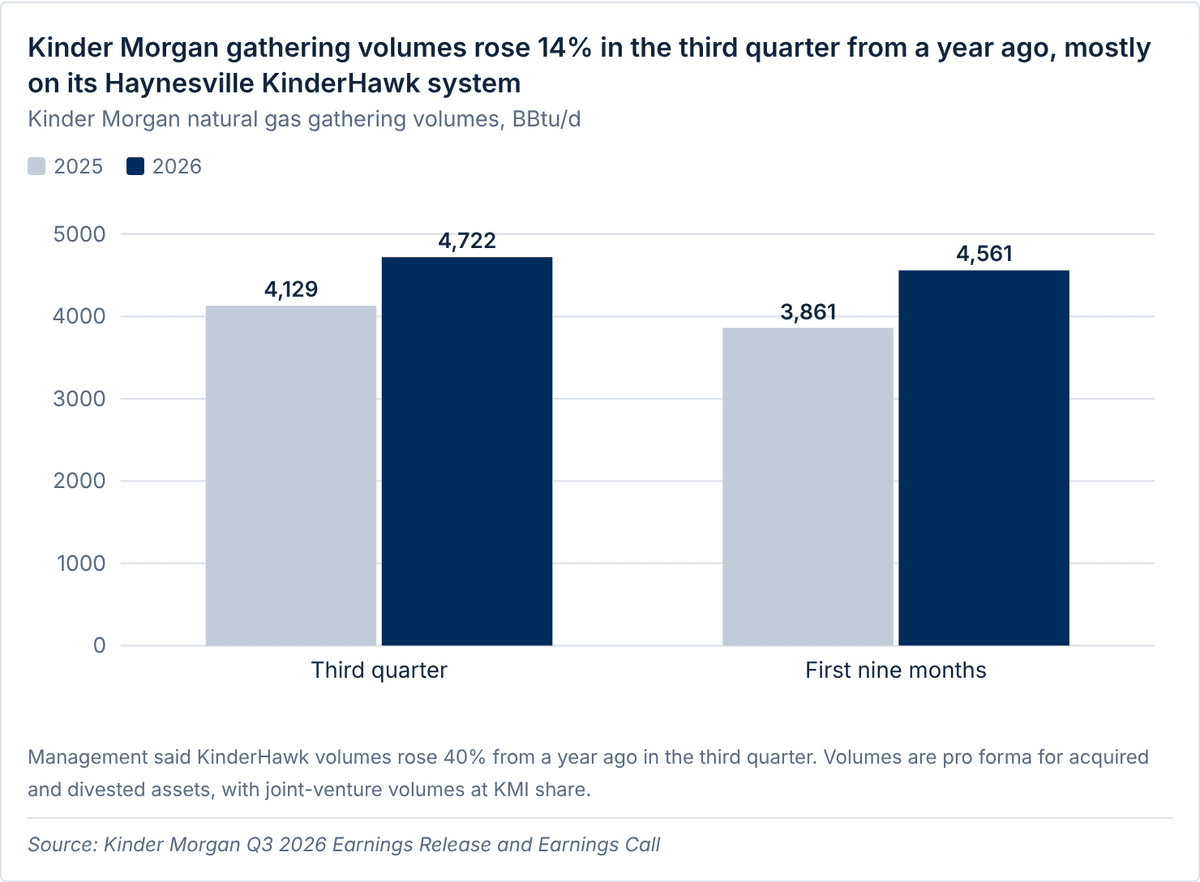
Natural gas transport volumes rose 3% and gathering volumes rose 14% from a year ago.
Kinder Morgan expects 2026 adjusted EBITDA to beat its budget by more than 6%.
Permian
Natural Gas Pipeline Company of America (NGPL) reached a final investment decision on Permian Link, an approximately $4.2 billion project (Kinder Morgan's share about $1.6 billion) with about 2.8 Bcf/d of capacity on roughly 434 miles of new pipeline. CEO Kim Dang said the project will move Permian gas north to meet growing power demand in the Texas Panhandle. It is contracted with an A-rated hyperscaler under long-term take-or-pay agreements, which Dang said run at least 20 years, and is expected in service in the third quarter of 2030. Management said the project can be upsized by adding compression, that it is talking with other potential shippers, and that its link to Kinder Morgan's storage is a selling point for power customers who need reliability.
Responding to an analyst's question about the risk of overbuilding Permian takeaway, Natural Gas Pipelines President Sital Mody said Kinder Morgan's existing Permian Highway and Gulf Coast Express pipelines sit near demand that is still developing, including a power demand corridor forming along Permian Highway and incremental LNG demand that Gulf Coast Express can serve. CFO David Michels also listed an unusually favorable Waha to Houston Ship Channel spread among the items that helped 2026 results and may not recur.
Market impact: Permian Link adds about 2.8 Bcf/d of Permian takeaway from the third quarter of 2030, supportive of Waha basis from then but not before.
Appalachia and the Southeast
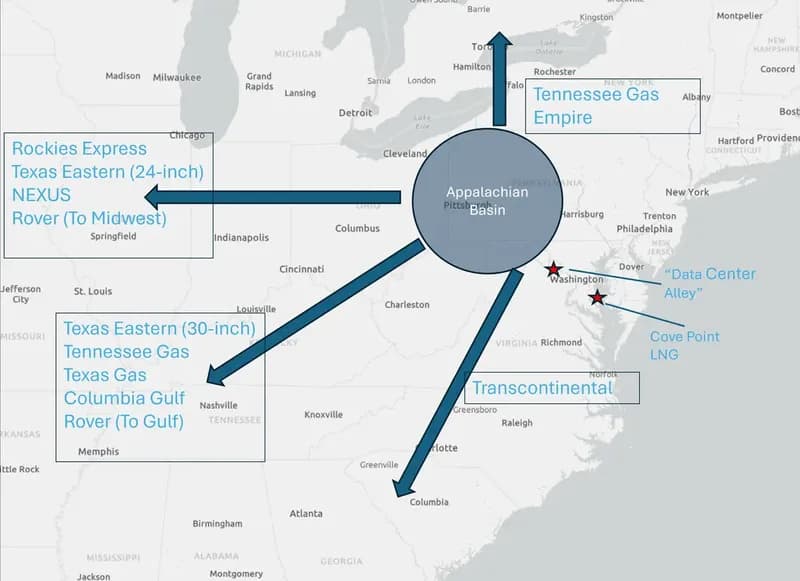
Southern Natural Gas (SNG) reached a final investment decision on the Southeast Connector, designed to move up to 2.6 Bcf/d on about 470 miles of new pipeline plus new and expanded compression. Kinder Morgan's share of the cost is expected to be $3.1 billion, and the project is expected to enter service in phases in 2030, 2031 and 2032. Dang said it will deliver Marcellus/Utica supply to the Southeast and is contracted with strong investment-grade utilities. She said large-load interconnection requests across the Southeast now exceed 200 gigawatts, which could mean roughly 8 Bcf/d of gas demand if all of it were built and served by gas-fired generation, though she said it likely will not all happen. Mody said scaling the project to 3.5 Bcf/d is plausible with more commitments.
Supply for the Southeast Connector does not have to come only from Appalachia. Dang said gas can reach its takeoff point from the Gulf Coast through the major trunk pipelines, including Tennessee Gas Pipeline (TGP), as well as from the Marcellus and Southwest Utica. Separately, TGP's 219 South project drew more than 2 Bcf/d of interest in a non-binding open season, and Mody described a growing power demand corridor across Ohio, Kentucky, West Virginia and Tennessee. Dang cited Wood Mackenzie estimates, which she said are close to Kinder Morgan's own, of about 13 Bcf/d of Marcellus growth by 2035.
Market impact: The Southeast Connector adds up to 2.6 Bcf/d of capacity in phases from 2030 through 2032. To the extent Marcellus/Utica gas fills it, it is supportive of Eastern Gas South (Dominion South) basis.
Haynesville and the Gulf Coast
Gathering volumes rose 14% from a year ago to 4,722 BBtu/d, and President Dax Sanders said most of the increase came from the KinderHawk system in the Haynesville, where volumes were up 40%. The Plantation North expansion on KinderHawk, backed by life-of-lease acreage dedications, is expected to be complete by year-end 2026 to support projected Haynesville production growth and increasing LNG demand along the Gulf Coast. Transport volumes rose 3%, mainly on LNG feed gas deliveries on TGP and higher demand on the Texas Intrastate system.
Dang said the Trident pipeline is on time and on budget for delivery in February 2027, although only 30% of its contracted EBITDA comes on in 2027. Mody said Trident, together with Kinder Morgan's Texas and Kinder Morgan Louisiana Pipeline (KMLP) headers and the KMLP expansions, positions the company to serve power, industrial and LNG demand along the Texas and Louisiana Gulf Coast. Asked how Permian and Haynesville supply will compete for Gulf Coast demand, Mody said it will take all of the above, and Dang cited Wood Mackenzie estimates of about 13 Bcf/d of Haynesville growth and a little over 10 Bcf/d of Permian growth by 2035.
Market impact: Haynesville volumes on KinderHawk rose 40% from a year ago, and the Plantation North expansion supports further Haynesville growth, a bearish factor for Henry Hub.
Outlook and Costs
Adjusted EBITDA rose 9% to $2.18 billion in the third quarter, and Kinder Morgan now expects 2026 adjusted EBITDA to beat its budget of $8.6 billion by more than 6%. CFO David Michels said about $225 million of that outperformance came from items that may not recur, including Winter Storm Fern, extended cold in the Northeast, a terminals contract buyout, a favorable FERC rate true-up and the Waha to Houston Ship Channel spread, and that commodity prices added about $175 million against a budget that assumed $60 WTI.
"At the same time, tightness continues across our US infrastructure, and that provides opportunities for us to capture additional margin when disruptions occur. We expect those conditions will persist."
-David Michels, Vice President and Chief Financial Officer, Kinder Morgan
Dang said capital spending will likely run around $4 billion a year for the next few years, and that the $14.4 billion backlog, at a 5.7 times multiple, implies about $2.5 billion of added cash flow once built.
Dang said the cost per mile of new pipe has risen with steel and pipe prices and higher compression costs, but that Kinder Morgan has not seen customer pushback and has not changed its return thresholds. The projects being sanctioned are contracted by utilities and a hyperscaler rather than by producers. Responding to an analyst who described a fight for gas, a Kinder Morgan executive said none of its projects are contingent on shippers signing supply agreements, and that customers understand they need to secure the molecules themselves.
Market impact: Utilities and a hyperscaler are contracting new firm pipeline capacity into the Southeast and Texas, which adds firm gas demand from 2030, supportive of deferred Henry Hub.
Overall, Kinder Morgan's next round of gas pipeline construction is contracted by utilities and a hyperscaler, not by producers. Permian Link and the Southeast Connector together add about 5.4 Bcf/d of capacity, but neither starts before the second half of 2030.
Get market insights delivered to your inbox — for free.
This website uses cookies
We use a few essential cookies to make our site work, including one that counts how many reports you have opened. Analytics cookies are used only with your permission, and you can change your mind at any time. Learn more about cookies in our privacy policy.