ExxonMobil Holds the Permian Near 1.8 MMboe/d, Plans 2.5 by 2030, as Its U.S. Gas Realization Recovers
AEGIS Automation6 min read
ExxonMobil held Permian output just above 1.8 MMboe/d with about 2.5 MMboe/d planned for 2030, and its U.S. gas realization recovered to $2.43 from $0.52, consistent with a stronger third-quarter Waha basis.
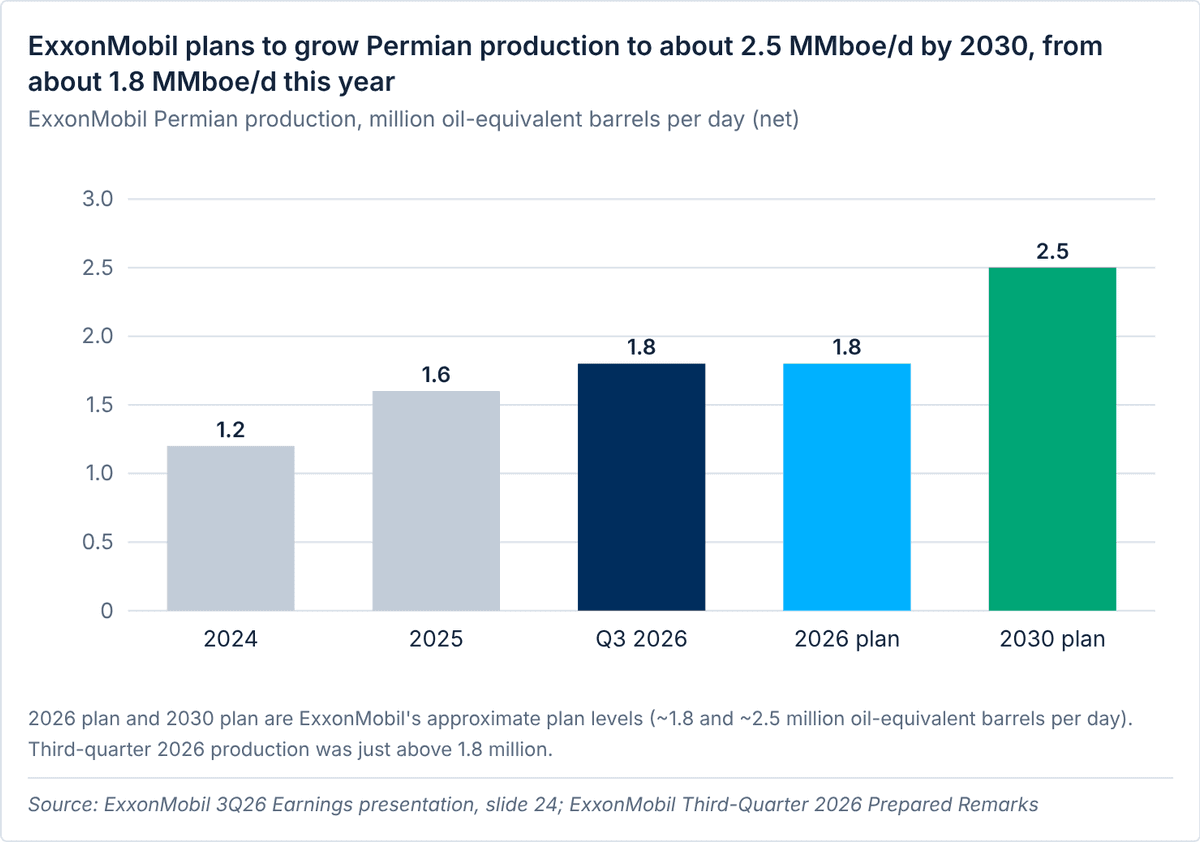
ExxonMobil's Permian production stayed just above 1.8 million oil-equivalent barrels per day (MMboe/d) in the third quarter of 2026, in line with its 2026 guidance, and it expects full-year Permian production of roughly 1.8 MMboe/d.
ExxonMobil's plan puts Permian production at about 2.5 MMboe/d in 2030, up from 1.6 MMboe/d in 2025 and 1.2 MMboe/d in 2024.
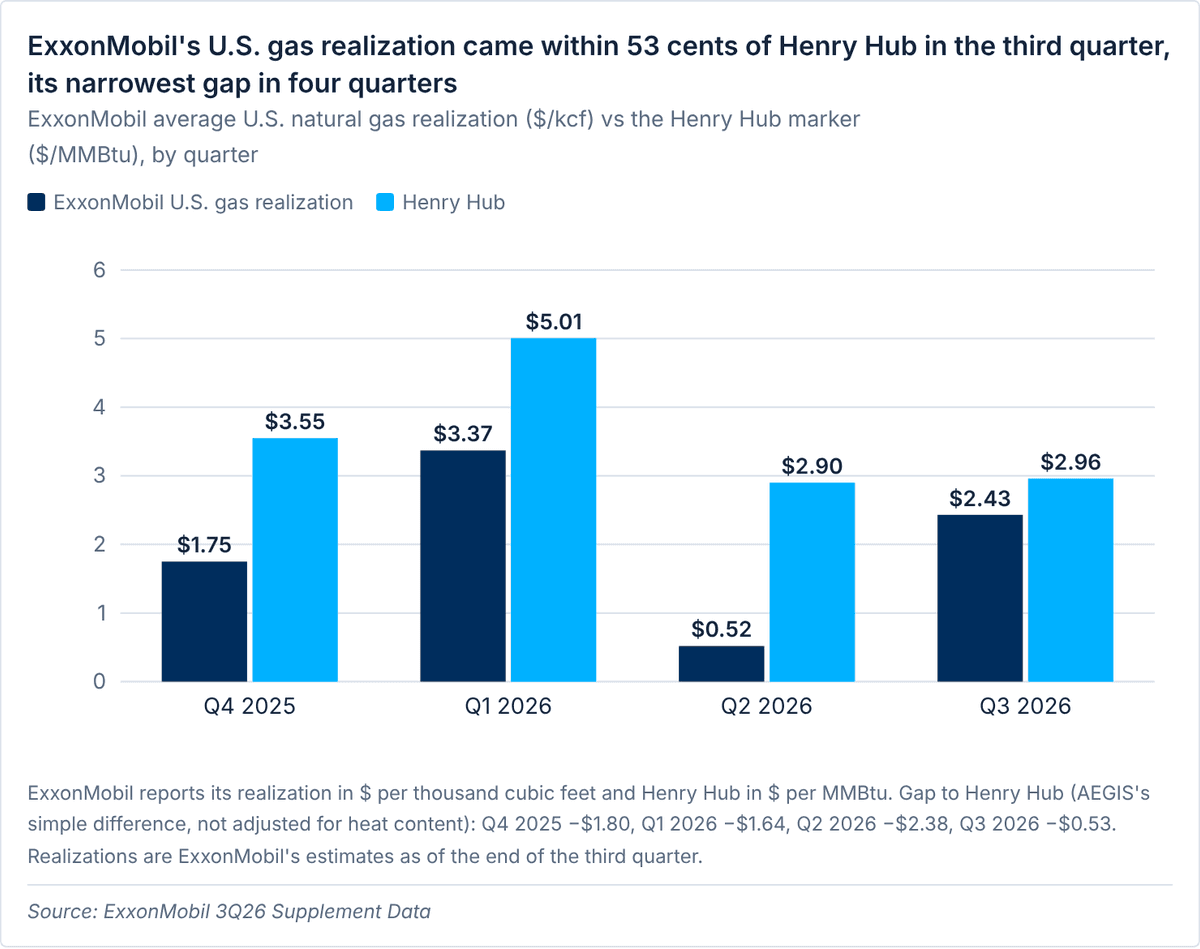
ExxonMobil's average U.S. natural gas realization rose to $2.43 per thousand cubic feet in the third quarter from $0.52 in the second, against Henry Hub marker prices of $2.96 and $2.90 per MMBtu.
ExxonMobil's U.S. natural gas production available for sale averaged 3,866 MMcf/d in the third quarter and 3,766 MMcf/d in the first nine months of 2026, up from 3,340 MMcf/d in the first nine months of 2025.
Chairman and CEO Darren Woods said Golden Pass LNG Train 2 should be substantially complete by December, with mechanical completion of Train 3 expected in mid-2027.
Permian Production
ExxonMobil said its Permian production remained just above 1.8 MMboe/d in the third quarter, in line with its 2026 guidance, and that growth in the Permian and Guyana this year has helped offset disruptions in the Middle East. It expects full-year Permian production of roughly 1.8 MMboe/d. Its presentation attributed lower advantaged volumes in the third quarter, compared with the second, to an accelerated Guyana entitlement effect and to Permian non-operated impacts. ExxonMobil's U.S. upstream cash capex rose to $3.9 billion in the third quarter from $3.4 billion in the second, and totaled $10.8 billion in the first nine months of 2026, against $12.2 billion a year earlier. ExxonMobil's U.S. liquids production averaged 1,627 thousand barrels per day in the third quarter, against 1,653 in the second, and its U.S. crude realization averaged $84.82 per barrel, against a WTI marker of $86.19.
Responding to an analyst who said ExxonMobil hit its Permian guidance number earlier in the year, Woods said ExxonMobil has always said production comes on "a bit lumpy," and that it reached its year-end number a little ahead of schedule. He said ExxonMobil is not really focused on the volume target as such, but on executing efficiently, deploying capital efficiently and using its technology work to maximize the value of the development.
"We're not real focused, as you know, on necessarily the volume target."
-Darren Woods, Chairman and Chief Executive Officer, ExxonMobil
Jim Chapman, Vice President, Corporate Finance and Treasurer, said ExxonMobil does not plan to hold a formal corporate plan update event in December this year. Instead, after its Board approves this year's plan, it will reaffirm key 2027 planning metrics in a press release later this quarter and expects to give more color on its fourth-quarter earnings call in late January.
Woods said ExxonMobil is the only operator currently using automated drilling rigs in the Permian. It has three in operation today and expects to expand them to about 25% of its Permian fleet next year (2027) and approximately half by 2028, which he said will help it continue to grow U.S. production safely and at a lower cost. He also said a lightweight proppant, developed by ExxonMobil's refining technologists from their work on coke morphology, is now deployed throughout the Permian. On the goal he set several years ago of doubling Permian recovery, Woods said ExxonMobil thinks there is "a line of sight" to it, but that the technology takes time to show up given the size of the development. Asked about secondary recovery, he said it will be an important part of reaching that goal, and that it will probably show up much more materially in the years beyond 2030. Senior Vice President and Chief Financial Officer Neil Hansen said ExxonMobil has doubled the synergies from its Pioneer acquisition to $4 billion a year, from $2 billion.
Market impact: ExxonMobil's Permian output holding near 1.8 MMboe/d through year-end 2026 adds little new supply, neutral for Waha basis near term. Its plan for about 2.5 MMboe/d in 2030 adds associated gas later in the decade, bearish for deferred Waha basis unless egress keeps pace.
U.S. Gas Realizations
ExxonMobil's average U.S. natural gas realization rose to $2.43 per thousand cubic feet in the third quarter, from $0.52 in the second, while the Henry Hub marker ExxonMobil reports rose to $2.96 per MMBtu from $2.90. On a simple, unconverted difference (an AEGIS calculation), the gap to Henry Hub narrowed to $0.53, from $2.38 in the second quarter, $1.64 in the first quarter and $1.80 in the fourth quarter of 2025, the narrowest of the four quarters shown in ExxonMobil's supplement data. Its U.S. gas production available for sale averaged 3,866 MMcf/d in the third quarter, against 3,840 MMcf/d in the second, and 3,766 MMcf/d in the first nine months of 2026, about 13% above (an AEGIS calculation) the 3,340 MMcf/d of a year earlier. ExxonMobil estimates that each $0.10 per MMBtu increase in Henry Hub adds about $90 million to its annual upstream earnings, based on expected 2026 volumes.
ExxonMobil does not break out its U.S. realization by basin. By AEGIS's calculation, the Permian, at just above 1.8 MMboe/d, is roughly 80% of ExxonMobil's U.S. oil-equivalent output (1,627 thousand barrels per day of liquids plus 3,866 MMcf/d of gas, or 644 thousand oil-equivalent barrels per day at six thousand cubic feet per barrel, for 2,271 thousand in total; 1.8 million divided by 2.271 million is about 79%), though ExxonMobil does not say what share of its U.S. gas comes from the Permian.
Market impact: On a simple, unconverted difference (an AEGIS calculation), ExxonMobil's U.S. gas realization was $0.53 below the Henry Hub marker in the third quarter, against $2.38 below in the second. The figure is a backward-looking, U.S.-wide average, neutral for forward Henry Hub.
LNG and Global Gas
Responding to an analyst who said third-party data suggests Golden Pass Train 1 is approaching nameplate capacity, Woods said ExxonMobil has made good progress on Train 1 after taking over work from a contractor that went bankrupt, and that he thinks what it learned has been embedded in its work on Trains 2 and 3. He said ExxonMobil expects Train 2 to be substantially complete by December, then to start facilities commissioning, and expects mechanical completion of Train 3 in mid-2027. ExxonMobil named Golden Pass LNG, with Guyana and the Permian, as a source of advantaged volume growth that raised its upstream earnings in the first nine months of 2026.
ExxonMobil said international natural gas prices increased in the third quarter as the Middle East conflict affected LNG supply. The TTF marker it reports averaged $18.20 per MMBtu, against $16.45 in the second quarter. Its Middle East production was about 550,000 oil-equivalent barrels per day in the third quarter, including 250,000 in Qatar, and it assumes about 350,000 oil-equivalent barrels per day remain offline in the fourth quarter if the current level of supply disruption continues. Woods said the volume impact is concentrated in Qatar, in the loss of LNG trains there and in the inability to flow and transport LNG at the rates ExxonMobil did before the conflict. ExxonMobil's worldwide gas production averaged 7,301 MMcf/d in the third quarter, against 6,849 MMcf/d in the second.
Market impact: Golden Pass Train 2, expected to be substantially complete by December, and Train 3, with mechanical completion expected in mid-2027, add Gulf Coast LNG feedgas demand, supportive of Henry Hub in 2027.
Overall, ExxonMobil held its Permian production just above 1.8 MMboe/d, shows a plan for about 2.5 MMboe/d in 2030, and saw its U.S. gas realization recover to $2.43 per thousand cubic feet from a second-quarter trough of $0.52, against a Henry Hub marker of $2.96. It expects Golden Pass Train 2 to be substantially complete by December and Train 3 to reach mechanical completion in mid-2027.
Get market insights delivered to your inbox — for free.
This website uses cookies
We use a few essential cookies to make our site work, including one that counts how many reports you have opened. Analytics cookies are used only with your permission, and you can change your mind at any time. Learn more about cookies in our privacy policy.