Enterprise Raises Its Permian Gas Outlook as Gas-Oil Ratios Climb and Processing Volumes Hit a Record
AEGIS Automation7 min read
Enterprise processed a record 4.6 Bcf/d at its Permian plants and raised its 2030 Permian dry gas forecast by 2.5 Bcf/d on rising gas-oil ratios, more associated gas that is a bearish factor for deferred Henry Hub.
Enterprise reported third quarter 2026 adjusted EBITDA of $2.8 billion, up 16% from a year ago.
Inlet volumes at Enterprise's Permian processing plants rose 12% from a year ago to a record 4.6 Bcf/d, and its total processing inlet volumes reached a record 8.5 Bcf/d.
Co-CEO Randy Fowler said Enterprise now forecasts Permian wet gas and NGL production growing 34% from 2025 to 2030, up from the 23% it forecast in April, while its crude oil forecast changed only modestly.
Enterprise's 300 MMcf/d Athena processing plant in the Midland Basin and a 300,000 b/d LPG export expansion at its Houston Ship Channel terminal are due in the fourth quarter of 2026.
Fowler said Enterprise currently expects 2027 growth capital spending in the $3 billion area, with an update due next quarter, and that 2027 EBITDA growth may be more modest than 2026's.
Permian Processing
Inlet volumes at Enterprise's Permian processing plants rose 12% from a year ago to a record 4.6 Bcf/d in the third quarter, and Co-CEO Randy Fowler said Enterprise's three-year compound annual growth rate in Permian inlet volumes is 19%. Fee-based processing volumes at its Delaware Basin plants rose 359 MMcf/d from a year ago and at its Midland Basin plants 280 MMcf/d. Justin Kleiderer, Senior Vice President, Pipelines and Terminals, said inlet volumes rose 13% from the second quarter in the Delaware and just over 10% in the Midland. He said Enterprise saw probably about 200 MMcf/d of economic shut-ins in the second quarter because of volatile Waha pricing, and that the third-quarter growth combined that production coming back with new acreage completed and brought online behind its system.
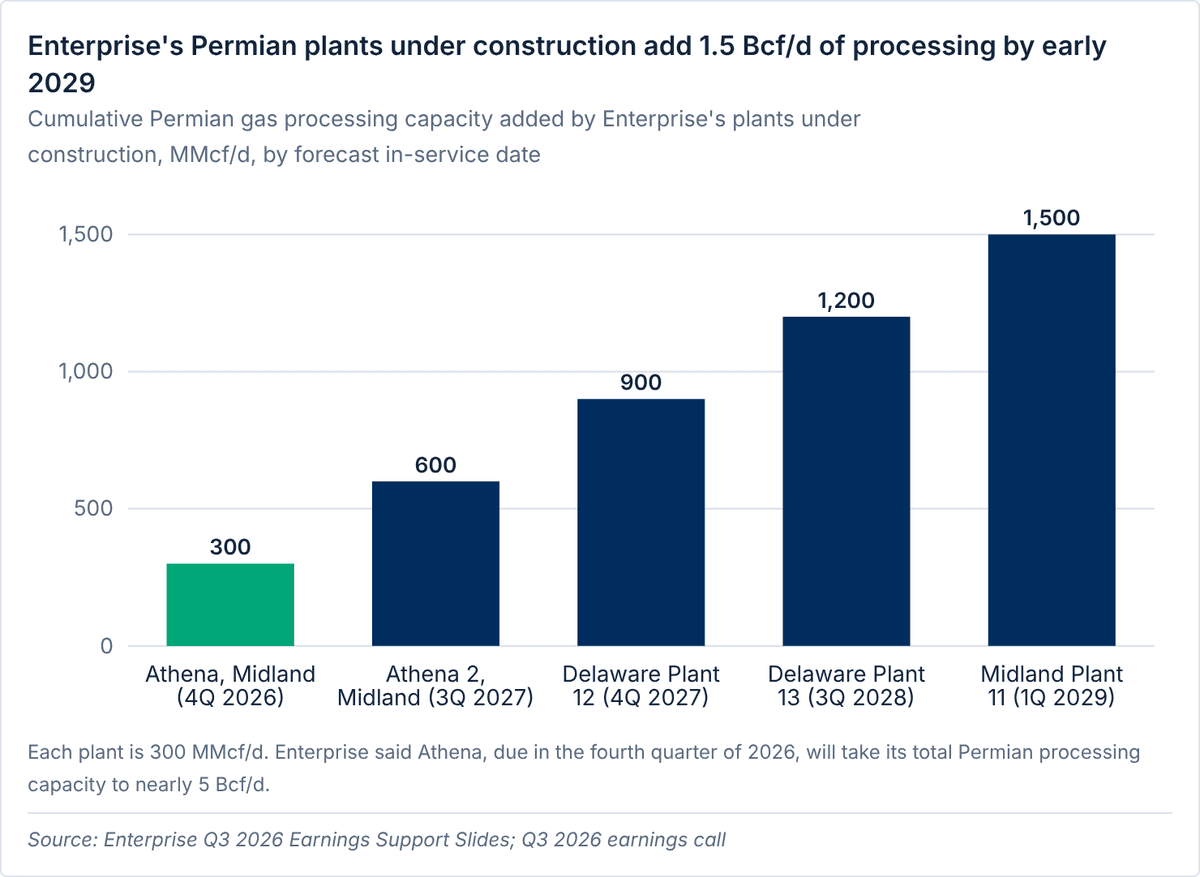
Enterprise's next plant, the 300 MMcf/d Athena plant in the Midland Basin, is due in the fourth quarter and will extract up to 40,000 b/d of NGLs. Fowler said Athena, Enterprise's 20th Permian processing plant, will take its total processing capacity in the basin to nearly 5 Bcf/d. Four more 300 MMcf/d Permian plants are under construction, Athena 2 in the third quarter of 2027, Delaware Plant 12 in the fourth quarter of 2027, Delaware Plant 13 in the third quarter of 2028 and Midland Plant 11 in the first quarter of 2029. Kleiderer said Enterprise has previously talked about one to two plants a year, but that with the higher growth curve it feels more confident it will be closer to two a year, noting that processing capacity growth and production growth have historically matched each other about one to one.
Market impact: Athena and the four 300 MMcf/d Permian plants under construction add 1.5 Bcf/d of processing by early 2029 (an AEGIS sum), which means more residue gas needing takeaway, a bearish factor for Waha basis if pipelines lag.
Permian Gas Outlook
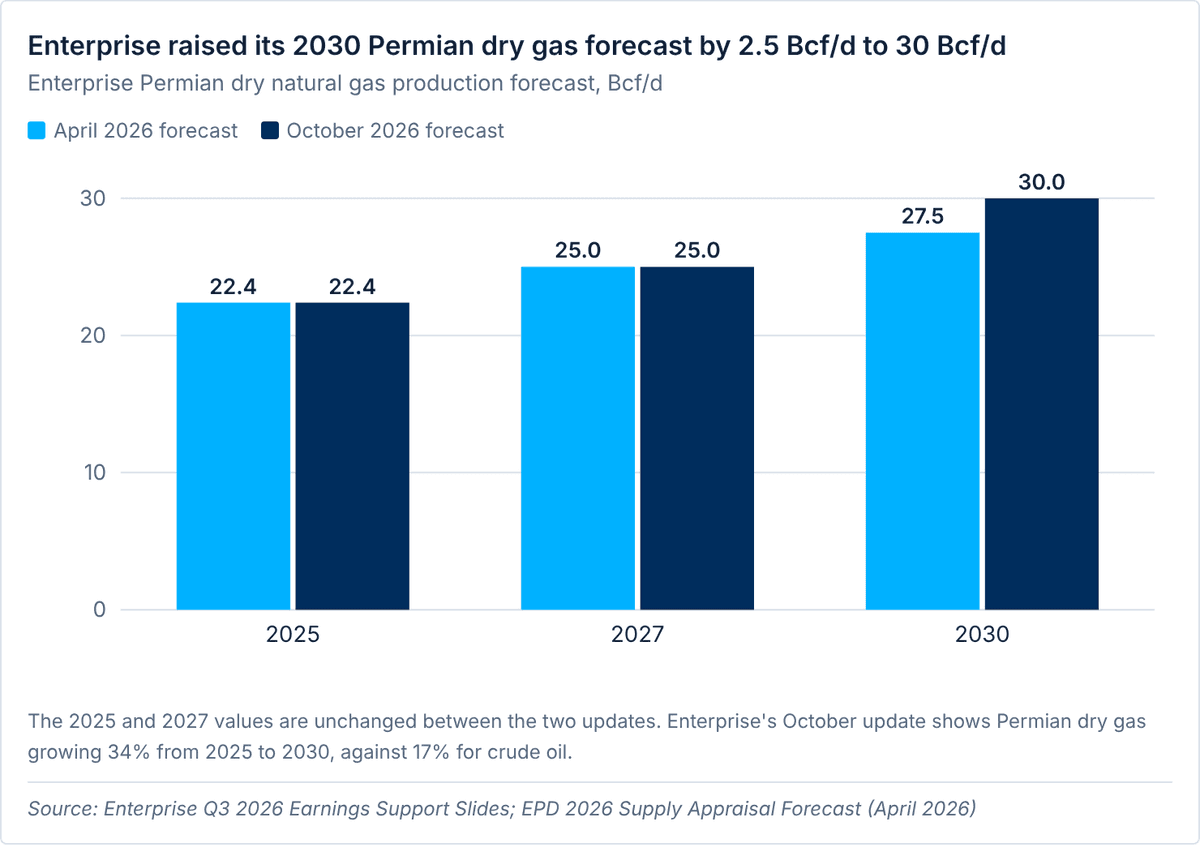
Enterprise updated its Permian production forecast through 2030. Its October forecast puts Permian dry gas production at 30.0 Bcf/d in 2030, up from 27.5 Bcf/d in its April forecast and 22.4 Bcf/d in 2025, and total gas at 38.6 Bcf/d in 2030, up from 35.4 Bcf/d. Its crude oil forecast for 2030 rose only 0.1 million b/d, to 7.6 million b/d. Fowler said Enterprise now expects wet gas and NGL production to grow 34% from 2025 to 2030, against the 23% it forecast in April, because of higher gas-oil ratios in the Permian.
Corey Johnson, Senior Vice President, Fundamentals and Commodity Risk Assessment, agreed with an analyst that two factors drove the higher gas-oil ratios, and added a third. Decline curves on natural gas have been shallowing, so existing wells produce more gas relative to crude over time. Producers are also moving to different locations, including a little more growth activity in the Delaware Basin, and are hitting new benches with high gas-oil ratios, with some Woodford and Barnett wells reaching gas-oil ratios as high as 8-9 on initial production against about 2 for a Wolfcamp well. He also cited technology and higher total recoveries, saying the last few percent recovered from the rock tend to be lighter molecules. He said he thinks the forecast has some conservative variables, that some of the new formations are new to Enterprise and that "there could be more gas." He also said the update did not change the expected cadence of drilling or completions, only what Enterprise sees coming out of the rock.
An analyst said he thinks new Permian dry gas egress coming between 2025 and 2030 is now up to 20 Bcf/d; Enterprise's slides show dry gas growth of 7.6 Bcf/d over that period. Johnson said Enterprise builds its forecast from the bottom up, from the rock and from talking to producers, and that the takeaway outlook will be a factor when it recalibrates for its 2027 forecast, which it expects to release around March or April.
"I think this is probably the clearest runway we've had in years for producers to look out and see that there is plenty of takeaway capacity for them to grow into."
Market impact: Enterprise raised its 2030 Permian dry gas forecast to 30.0 Bcf/d from 27.5 Bcf/d on higher gas-oil ratios, which means more associated gas supply, bearish for deferred Henry Hub.
NGLs and Exports
Enterprise's 300,000 b/d LPG expansion at its Enterprise Hydrocarbons Terminal on the Houston Ship Channel will raise Enterprise's total LPG loading capacity on the Houston Ship Channel to about 1.1 million b/d. Tyler Cott, Senior Vice President, Hydrocarbon Marketing, said the expansion is fully contracted, is in the early stages of commissioning and should be commissioned before year-end, and that Enterprise is about 90% contracted on the LPG side through the end of the decade. Enterprise said the extension of its Bahia NGL pipeline into the Delaware Basin will be in service in the fourth quarter of 2027, and that the 400,000 b/d expansion taking Bahia to 1 million b/d will start in the fourth quarter of 2027 and continue through mid-2028, with permanent power the critical path. Its 150,000 b/d Fractionator 15 at Mont Belvieu is due in the first quarter of 2028; Zachary Strait, Senior Vice President, Unregulated NGLs, said lead times have extended by probably about six months and that Enterprise will probably build more fractionation.
On NGL prices, Cott said ethane and propane prices have risen a little, mostly at the front of the curve, and that he thinks a new Gulf Coast ethane cracker reportedly starting up, some new export capacity and fractionation waiting to come online are part of the reason. Tug Hanley, Senior Vice President, Hydrocarbon Marketing, said ethane production keeps growing.
"We still continue to expect ethane to be long here in the U.S."
Market impact: Enterprise expects US ethane to stay long. Ethane left in the gas stream adds gas supply at the margin, modestly bearish for Henry Hub.
Haynesville and Appalachia
Fowler cited higher natural gas pipeline volumes in the Haynesville as one driver of the quarter, and Enterprise said gross operating margin from its Acadian Gas System and Haynesville Gathering System rose from the second quarter on lower operating costs and higher average transportation fees. In Appalachia, an analyst asked whether upstream consolidation, including the EQT-Range combination, changes the recontracting outlook for Enterprise's ATEX ethane pipeline. Fowler said ATEX is less than 3% of Enterprise's EBITDA, and Carrie Weaver, Vice President of Commercial, Pipelines and Terminals, said Enterprise does not view the recent announcements as materially changing how it looks at ATEX. She said there could be some optimization as customers look at their portfolios, that Enterprise expects the next generation of contracts to reflect today's market rather than the economics when ATEX was originally contracted, and that its conversations with current and potential new shippers are still dynamic as it evaluates the most economic use of the pipe, which it still considers very strategic given growing Gulf Coast ethane demand.
Market impact: Enterprise expects new ATEX contracts to reflect today's market and still views the pipe as very strategic, neutral for Eastern Gas-South basis for now.
2027 Outlook
Fowler said Enterprise's EBITDA is up 15% so far in 2026, after it had said it was looking at modest growth in 2026 and could see up to 10% growth in 2027, and that 2027 may be more modest compared with what it reports for 2026. He said that depends on geopolitical conflicts, which created some nice spreads across Enterprise's system this year. He said growth capital spending in 2027 should still be in the $3 billion area, but that Enterprise will update that next quarter after completing its budget cycle and reviewing producer plans, given the expected natural gas and NGL volume growth in the Permian. This was Jim Teague's final quarterly earnings call as Co-CEO; Fowler becomes sole CEO in January.
Market impact: Enterprise expects natural gas and NGL volume growth in the Permian, which adds associated gas supply in 2027, bearish for 2027 Henry Hub.
Overall, Enterprise reported record inlet volumes at its Permian plants, raised its 2030 Permian dry gas forecast 2.5 Bcf/d above April's on rising gas-oil ratios, and now forecasts 34% gas growth from 2025 to 2030 against 17% for crude, and Kleiderer said it feels more confident it will build closer to two processing plants a year.
Get market insights delivered to your inbox — for free.
This website uses cookies
We use a few essential cookies to make our site work, including one that counts how many reports you have opened. Analytics cookies are used only with your permission, and you can change your mind at any time. Learn more about cookies in our privacy policy.