Diamondback Says Permian Gas Has Moved From Supply Push to Demand Pull as Its Gas Price Turns Positive Again
AEGIS Automation7 min read
Diamondback's realized gas price turned positive again at $1.12 per Mcf, it took a 7.5% stake in the 4.5 Bcf/d Solitude pipeline for 2H 2029, and its 2027 basis hedges shift from Waha toward Houston Ship Channel.
Diamondback's oil production averaged 525 MBO/d in the third quarter of 2026, flat with the second quarter, and total production averaged 1,034 MBOE/d, up 2%.
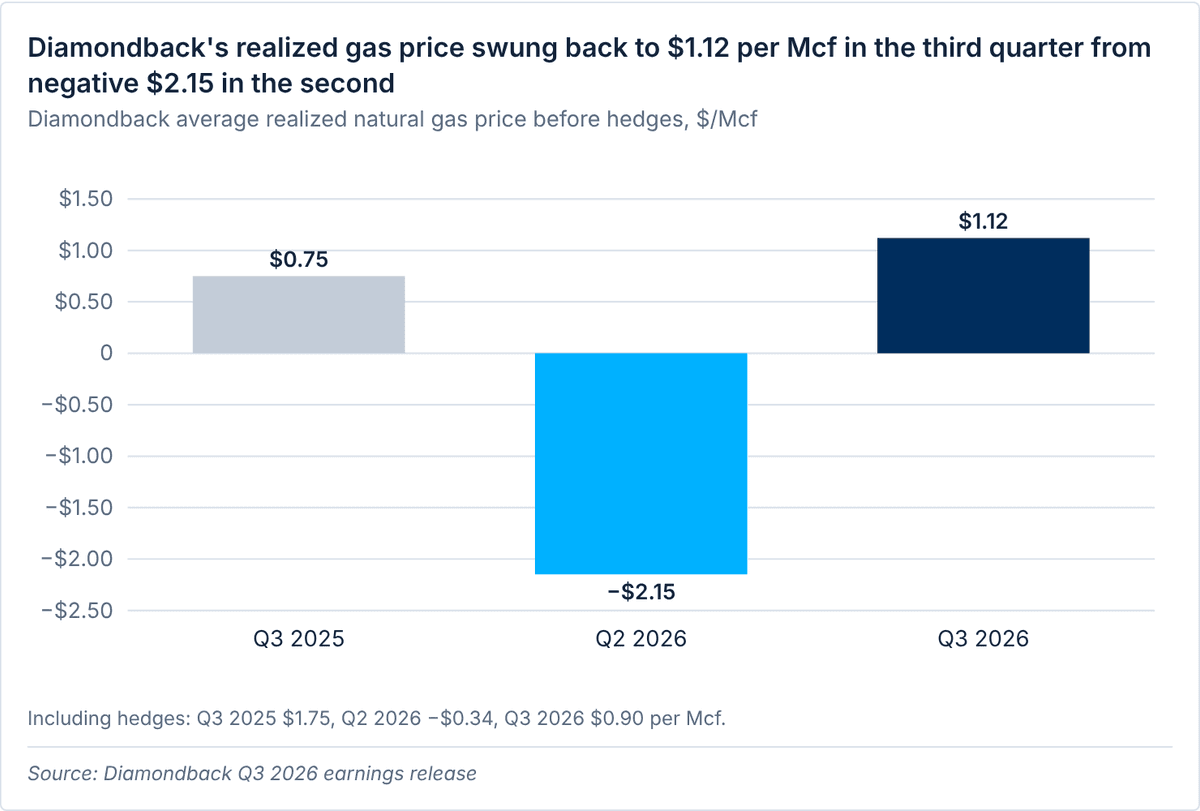
Diamondback's average realized natural gas price was $1.12 per Mcf before hedges in the third quarter, up from negative $2.15 in the second quarter.
Diamondback raised its 2026 production guidance to about 1,015 MBOE/d, including about 524 MBO/d of oil, and guided fourth-quarter oil production to 518 to 528 MBO/d.
Diamondback acquired a 7.5% equity interest in the Solitude Pipeline System, two 48-inch lines able to move 4.5 Bcf/d from the Permian to Katy and Gulf Coast markets, set to enter service in the second half of 2029.
Diamondback has Waha and Houston Ship Channel basis protection on about 50% of its estimated fourth-quarter 2026 gas production and says about 60% of its estimated 2027 production receives non-Waha pricing.
Permian Gas: From Supply Push to Demand Pull
In his letter to stockholders, CEO Kaes Van't Hof named gas production growth and monetization through LNG and power demand as one of three mega-themes Diamondback sees for the Permian. "As we have said many times, the Permian Basin has not tried to produce gas yet," the letter said, adding that Diamondback expects the Permian to be the largest natural gas play as well as the largest oil play in the United States in the 2030s. It said gas-oil ratios will naturally continue to expand, that secondary zones in both the Midland and Delaware basins are gassier than what operators have targeted to date, and that there are gas-weighted exploratory zones that have not been tested because of the basin's egress problems. Diamondback's goal is to control more of its gas further downstream, primarily feeding the Gulf Coast LNG complex, and to build relationships with LNG players who are long offtake and short physical molecules.
"At the highest level, the gas theme in the Permian Basin has moved from supply-push to demand-pull, which should be beneficial to the owners of the molecule long-term and therefore Diamondback stockholders."
-Letter to stockholders, Kaes Van't Hof, Chief Executive Officer, Diamondback
On the call, Van't Hof said Diamondback is "obviously very long molecules, and I think likely to be longer gas molecules over the next 5 years, 10 years," and that it has taken out a lot of pipeline space to get closer to end markets. He said a lot of LNG players have taken out space even on some of the pipelines Diamondback is on without having the gas supply. Asked about the time horizon, he said "I don't think it's next month," but that if the Northeast cannot build south and the Haynesville cannot meet 10, 20 or 25 Bcf/d of new demand, "It's got to come from the Permian," and that he thinks there will be periods over the next decade when Permian gas increases in value. Asked whether higher gas prices could bring undrilled acreage into its program, he said Diamondback has that in its inventory but has not had to or tried to drill it, and that he thinks the basin will see a lot higher gas cuts in certain zones. Asked separately about drilling for gas, he said, "I think we're probably still a long way from drilling for gas specifically. I think it's naturally just going to happen." By AEGIS's calculation from its production data, Diamondback's gas production averaged about 1.47 Bcf/d in the third quarter, up 4% from the second quarter and 17% from a year earlier.
Market impact: Diamondback expects Permian gas to keep growing as gas-oil ratios rise, without gas-directed drilling, which adds associated gas at Waha, bearish for Waha basis until new egress, including Solitude in the second half of 2029, enters service.
Gas Realizations, Takeaway and Hedges
Diamondback's realized gas price before hedges was $1.12 per Mcf in the third quarter, against negative $2.15 in the second quarter and $0.75 a year earlier. Including hedges, it realized $0.90, against negative $0.34 and $1.75. Diamondback cut its 2026 gathering, processing and transportation cost guidance to $1.30 to $1.50 per BOE, from $1.40 to $1.60, and Van't Hof said that cost is a mix of gas realizations and how much gas Diamondback takes in kind.
Diamondback is part of the WhiteWater-led consortium that reached FID on Solitude in the third quarter, and it acquired a 7.5% equity interest in the pipeline. Solitude consists of two 48-inch lines able to move 4.5 Bcf/d out of the Permian to Katy and Gulf Coast markets, with potential to expand to 7.5 Bcf/d, and is set to enter service in the second half of 2029. Van't Hof said Diamondback committed a good amount of production to Solitude, and that the project got off the ground and was funded within a couple of months, which he said kind of just shows that the supply is going to be there and that those taking out space on the other side of these pipes are looking for supply too. He said he thinks the investment is going to roll through equity affiliates, outside the traditional capex budget.
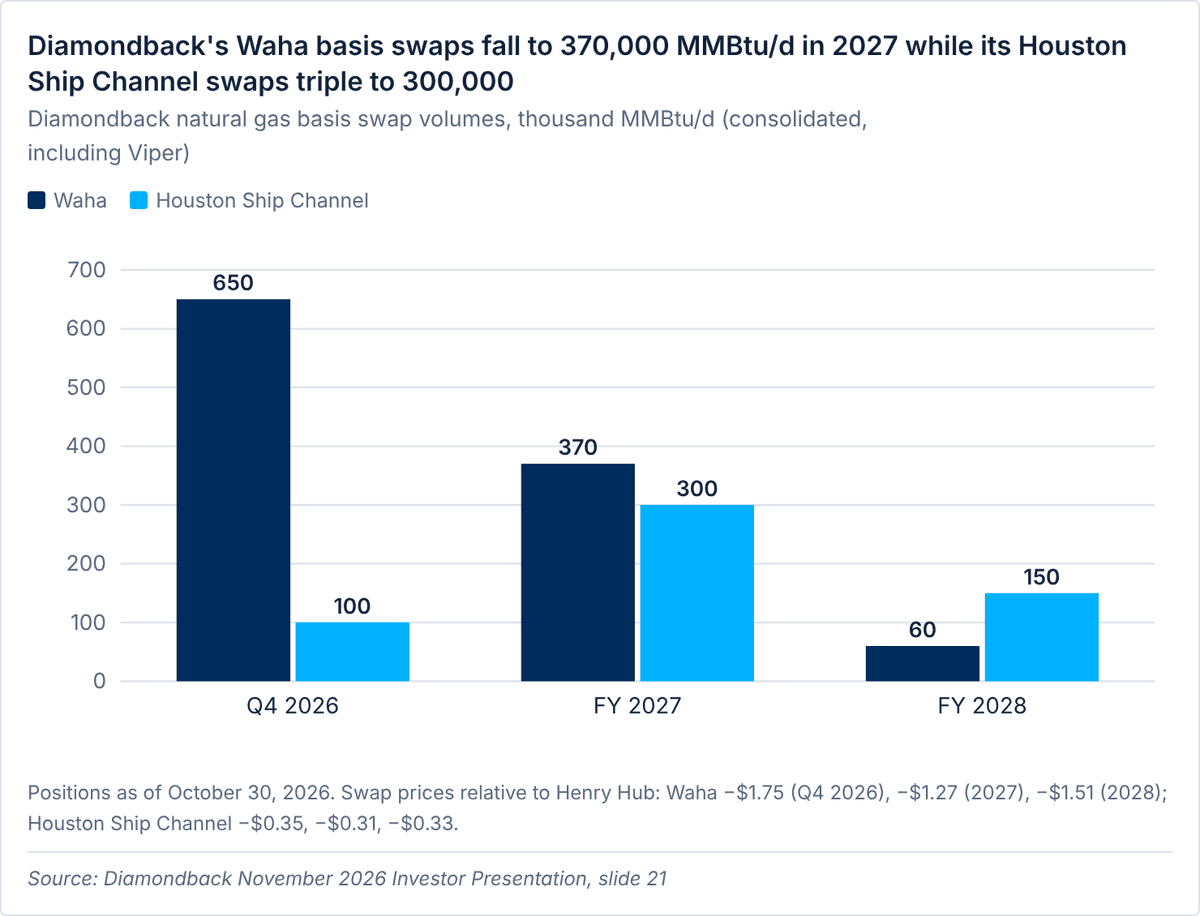
For the fourth quarter of 2026, Diamondback has Henry Hub costless collars on 840,000 MMBtu/d with a $2.87 floor and $6.35 ceiling, Waha basis swaps on 650,000 MMBtu/d at $1.75 below Henry Hub and Houston Ship Channel basis swaps on 100,000 MMBtu/d at $0.35 below. For 2027 it has collars on 720,000 MMBtu/d, Waha swaps on 370,000 MMBtu/d at $1.27 below and Houston Ship Channel swaps on 300,000 MMBtu/d at $0.31 below. Diamondback says more than 60% of its estimated fourth-quarter gas production is protected on outright price and about 50% on Waha/Houston Ship Channel basis.
Market impact: Diamondback's 2027 Waha swaps at $1.27 below Henry Hub are 48 cents narrower than its fourth-quarter swaps (an AEGIS calculation), and about 60% of its estimated 2027 production receives non-Waha pricing. That limits Diamondback's own Waha exposure in 2027 but does not change its supply, neutral for Waha basis.
Activity and the Barnett
Diamondback drilled 105 gross wells and completed 135 in the third quarter, all in the Midland Basin, with average completed lateral length up about 13% from the second quarter to 13,584 feet. Its letter said deeper Barnett and Wolfcamp D targets now make up roughly a fifth of the wells it drills, and that its Barnett position has grown to 224,000 net acres, up 12% since February, as it moves to full-field development. Van't Hof said he thinks Diamondback has four or five full-section Barnett developments coming on over the next three or four months.
Van't Hof said he thinks the base case is to run 19 to 20 rigs and five frac crews consistently, a level-loaded program that should produce some organic growth, and the letter said Diamondback expects to run five electric simulfrac fleets in 2027. Asked how much footage five crews and about 19 rigs would complete in 2027 relative to this year, he said "relatively flat to this year." He said Diamondback thinks it can probably hold oil production flat at the higher end of its fourth-quarter capital spending range, fighting off some inflation with efficiencies, but would have to spend a little more than that range to grow next year, which is "still very much TBD based on the macro." The letter said Diamondback's blended cost per lateral foot rose in the quarter as the program shifted toward deeper Barnett and Wolfcamp D targets, and that inflation could build if oil prices stay in the triple digits and the Permian rig count keeps rising. Diamondback plans to give its formal 2027 plan in February.
Market impact: Diamondback's base case of 19 to 20 rigs and five crews, which it said should produce some organic growth, is neutral for WTI; whether it grows next year is still to be decided.
West Texas Power
Executive Vice President and Chief Financial Officer Jere Thompson said Diamondback's Bryan Ranch power project is shovel-ready: it has remediated the land, secured the equipment, and has water and gas keyed up, and is dotting the i's and crossing the t's on final agreements. Van't Hof said he thinks projects in the basin have kind of moved to mobile power to get power as quickly as possible. The letter said Diamondback believes incremental large-scale data center development in the United States should go through West Texas, and that it controls significant natural gas reserves and owns surface land such projects need; its presentation puts its surface acreage at about 67,000 acres.
Market impact: Bryan Ranch, with gas keyed up, would add in-basin gas demand if final agreements are signed and it is built, supportive of Waha basis; until then it is not a firm load.
Overall, Diamondback held oil production flat at 525 MBO/d, saw its realized gas price return to $1.12 per Mcf from negative $2.15, and laid out a view that Permian gas will keep growing as gas-oil ratios rise, with Solitude set to add 4.5 Bcf/d of egress in the second half of 2029. About 60% of its estimated 2027 production receives non-Waha pricing, and it is finalizing agreements for its Bryan Ranch power project.
Get market insights delivered to your inbox — for free.
This website uses cookies
We use a few essential cookies to make our site work, including one that counts how many reports you have opened. Analytics cookies are used only with your permission, and you can change your mind at any time. Learn more about cookies in our privacy policy.