CNX Stays in Maintenance Mode as Weak Appalachian Basis Widens Its Discount to NYMEX
AEGIS Automation6 min read
CNX's gas sold 85 cents below NYMEX in the third quarter and it widened its 2026 differential guidance to 71 cents, while it holds production steady behind heavy hedges, keeping near-term Eastern Gas-South basis weak.
CNX produced an average 1,699 MMcfe/d in the third quarter of 2026, up 2% from the second quarter and down 3% from a year ago.
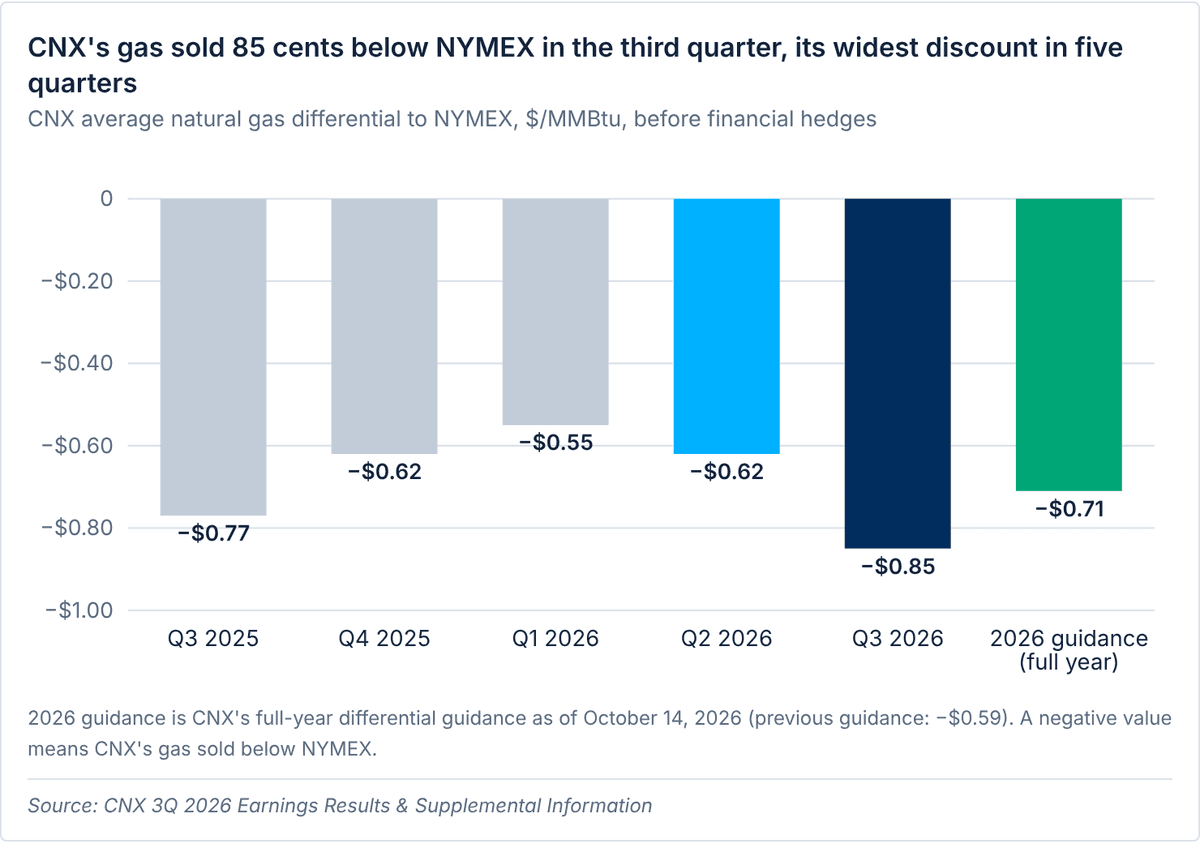
CNX's natural gas sold an average $0.85 per MMBtu below NYMEX before financial hedges, compared with $0.62 below in the second quarter and $0.77 below a year ago.
CNX narrowed its 2026 production guidance to 612.5-617.5 Bcfe, from 605-620 Bcfe, raising the midpoint, and widened its 2026 gas differential guidance to $0.71 below NYMEX, from $0.59.
CNX has 82% of its 2026 natural gas production hedged and 409.4 Bcf of 2027 gas hedged.
CEO Alan Shepard said that, right now, CNX looks set to stay in maintenance production mode into 2027, and that it will bring incremental volumes to market when the longer-term strip rises enough to call on its gas.
Appalachian Basis
CNX produced 156.3 Bcfe in the third quarter, an average 1,699 MMcfe/d, including 132.8 Bcf of shale gas and 9.4 Bcf of coalbed methane. Its gas sold an average $0.85 per MMBtu below NYMEX before financial hedges, against a NYMEX average of $2.95, the widest discount in the five quarters CNX shows in its supplemental data. Shepard said about two-thirds of CNX's portfolio is exposed to in-basin pricing and that conditions in the basin have been challenging with the weather and the softness. CNX has several sales points, he said, but a lot of its volumes stayed in the basin because it was not economic to send them to Michigan or other places.
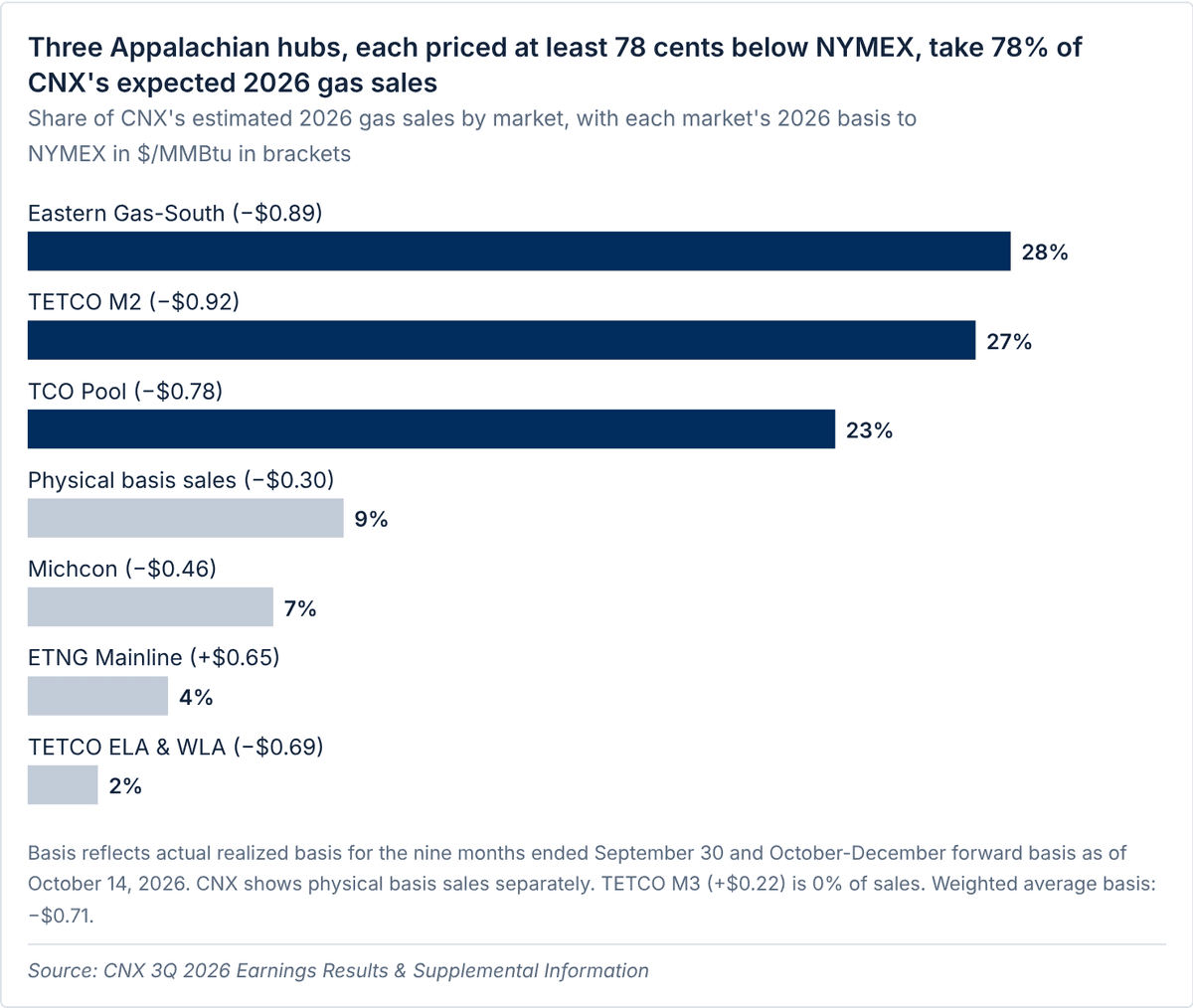
CNX widened its full-year 2026 differential guidance to $0.71 below NYMEX, from $0.59, in line with the weighted-average basis in its 2026 market mix, which uses actual basis for the first nine months and forward prices as of October 14 for the rest of the year. CNX's fourth-quarter basis marks as of October 14 were $1.10 below NYMEX at Eastern Gas-South, $1.05 below at TETCO M2 and $0.94 below at TCO Pool. Those three markets carry 78% of CNX's expected 2026 gas sales, and their 2026 basis averages $0.78 to $0.92 below NYMEX.
Responding to an analyst's question about curtailments, Shepard said there have been periods over the last couple of months when in-basin gas dropped below $1. Because CNX hedges, it has little need to shut in production, but it curtailed volumes during a couple of stretches, probably less than 1 Bcf for the whole quarter. He said that when in-basin gas falls to $0.50 to $0.60, there is no reason for an unhedged producer to produce at that level.
Market impact: CNX's fourth-quarter basis marks of $1.10 below NYMEX at Eastern Gas-South and $1.05 below at TETCO M2 point to weak near-term Appalachian basis.
Hedging
CNX has 82% of its 2026 natural gas production hedged, up from 81% last quarter. For 2027 it has 409.4 Bcf hedged at an average $3.30 per Mcf including basis, made up of 265.8 Bcf of NYMEX hedges at a NYMEX price of $4.16 per Mcf, before basis, and 143.6 Bcf of physical fixed-price sales and index hedges at $3.30 per Mcf. Its 2027 NYMEX hedges average $3.90 per MMBtu, against an average 2027 forward price of $3.26 on October 14. CNX also has 233.1 Bcf hedged for 2028 and 38.2 Bcf for 2029.
"We're pretty hedged going into '27. So, we're in a little bit different shape than most folks."
-Alan Shepard, Chief Executive Officer and President, CNX
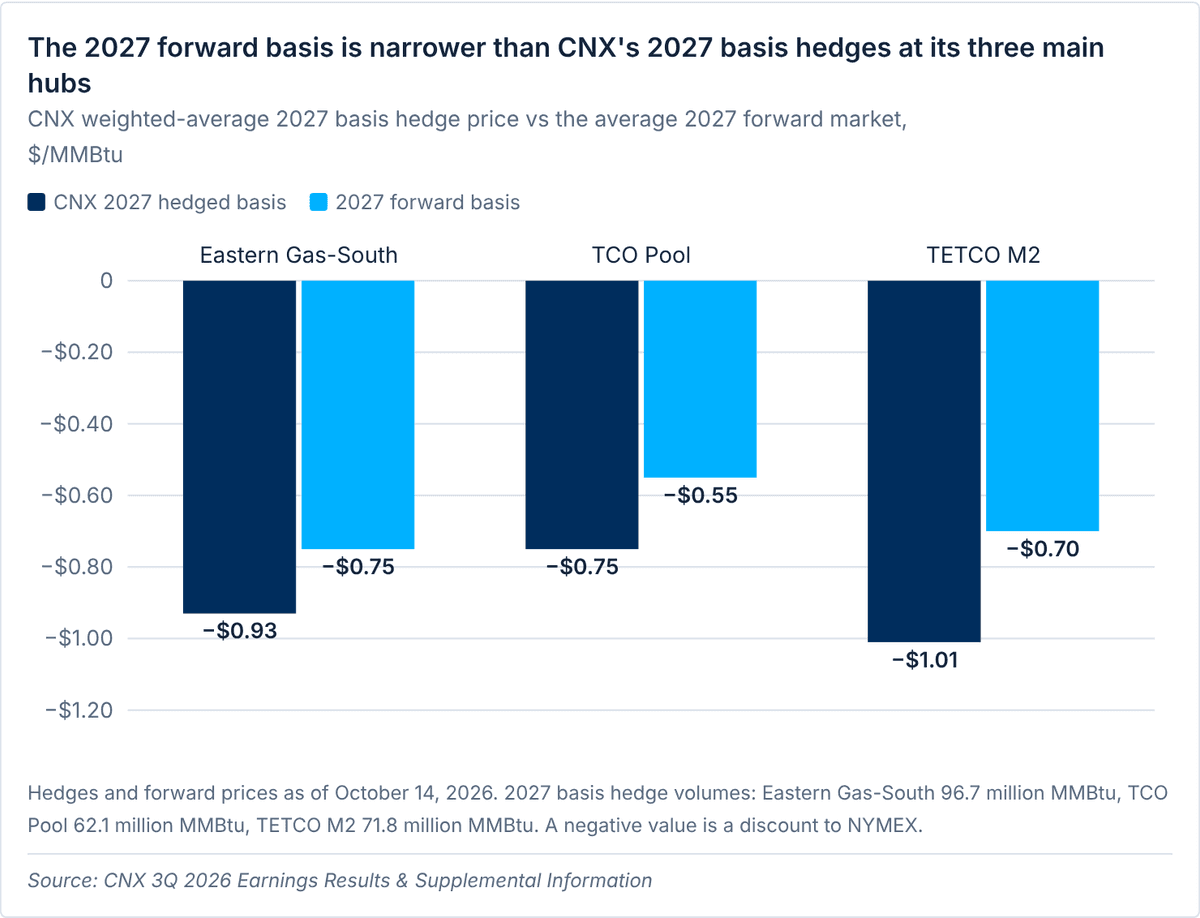
At its three main hubs, which hold about 95% of its 2027 basis hedge volume, CNX's 2027 basis hedges are wider than the October 14 forward market. It has 96.7 million MMBtu of 2027 Eastern Gas-South basis hedged at $0.93 below NYMEX, 62.1 million MMBtu at TCO Pool at $0.75 below and 71.8 million MMBtu at TETCO M2 at $1.01 below. On October 14, the 2027 forward market at those hubs was $0.18, $0.20 and $0.31 narrower.
Market impact: CNX said its hedges leave little need to shut in production, and its 2027 NYMEX hedges average $3.90 against a $3.26 forward price, which makes a 2027 volume cut less likely, a modest bearish factor for 2027 Eastern Gas-South basis.
Activity and Costs
CNX continued its maintenance-of-production program of about 1.5 rigs and a partial-year frac crew. In the third quarter it drilled two Central Pennsylvania (CPA) Utica wells and fracked and turned in line 12 Southwest Pennsylvania (SWPA) Marcellus wells. It plans 34 turn-in-lines in 2026, 27 Marcellus and seven deep Utica, and said it does not expect material changes to the 2026 program under current market conditions, though it will respond to material changes in gas prices. Shepard said CNX is not giving 2027 guidance, but that without something that incentivizes producers to bring on more gas it looks set to stay at steady state, and it would make adjustments if conditions degrade. He said he thinks the 2027 mix of wells will look like 2026's, without giving well counts, blending deep Utica with the remaining SWPA Marcellus.
Shepard said CNX expects to finish developing its remaining SWPA Marcellus over the next four or five years, exiting around the end of the decade, before shifting predominantly to CPA Utica with CPA Marcellus and later returning to SWPA for the Utica and other horizons. Chief Operating Officer Navneet Behl said infrastructure spending for the CPA development should oscillate around $25 million a year, plus or minus, with no major spikes. On inflation, Behl said CNX is seeing cost increases in diesel and steel but that the overall impact is less than 1% of its capital, and Shepard said CNX has driven most diesel out of its system and runs electric frac fleets. CNX raised the midpoint of its 2026 base capital guidance to $563 million, from $555 million.
Market impact: A 2027 maintenance program, which CNX said looks likely right now, adds little new supply, neutral for Eastern Gas-South basis.
Demand and Contracting
Responding to an analyst's question about robust gas demand forecasts, Shepard said CNX is extremely bullish on long-term demand in the basin, though whether that is "2 B's or 20 B's, time will tell," given uncertainty about end users such as AI. He said pricing will still be constrained by the supply curve, and that CNX will bring incremental volumes to market when the longer-term strip rises enough to call on its gas.
"But what's clear is natural gas, every drop of it here in Appalachia is going to get developed."
-Alan Shepard
Asked about direct sales to customers, Shepard said CNX is in the mix with everyone else in the basin on some of these discussions, but that the challenge has been the incentive to lock into long-term contracts without enough of a premium for fixed delivery. He gave no timeline, saying CNX will participate if buyers come to market for gas for projects coming online over the next five years. Asked about the large Appalachian merger announced that week, Shepard declined to comment on another company's M&A but said CNX will watch what the combined company does with production levels.
Market impact: CNX expects pricing to stay constrained by the supply curve and will add volumes once the longer-term strip rises, which limits how far deferred Eastern Gas-South basis can tighten as in-basin demand grows.
Overall, CNX's gas sold 85 cents below NYMEX in the third quarter, it widened its 2026 differential guidance to 71 cents, and Shepard said in-basin gas dropped below $1 at times over the last couple of months. CNX is holding production steady behind a hedge book that covers 82% of 2026 gas and 409 Bcf of 2027 gas, with its 2027 NYMEX hedges well above the strip, and Shepard said it looks set to stay in maintenance mode into 2027.
Get market insights delivered to your inbox — for free.
This website uses cookies
We use a few essential cookies to make our site work, including one that counts how many reports you have opened. Analytics cookies are used only with your permission, and you can change your mind at any time. Learn more about cookies in our privacy policy.