Chevron Holds Its Permian Plateau With Less Capital and a Gas-to-Oil Ratio It Calls Relatively Stable
AEGIS Automation6 min read
Chevron held the Permian above 1 MMboe/d for a sixth quarter with a gas-to-oil ratio it calls relatively stable through the decade, so it adds little associated gas to Waha, while its West Texas Kilby power project targets first power in 2028.
Chevron's Permian production was above 1 million barrels of oil equivalent per day (MMboe/d) for a sixth consecutive quarter in the third quarter of 2026.
Vice Chairman Mark Nelson said Chevron's Permian production may move up or down 3% but that Chevron will sustain it above 1 MMboe/d, and that its Permian gas-to-oil ratio is relatively stable through the end of this decade.
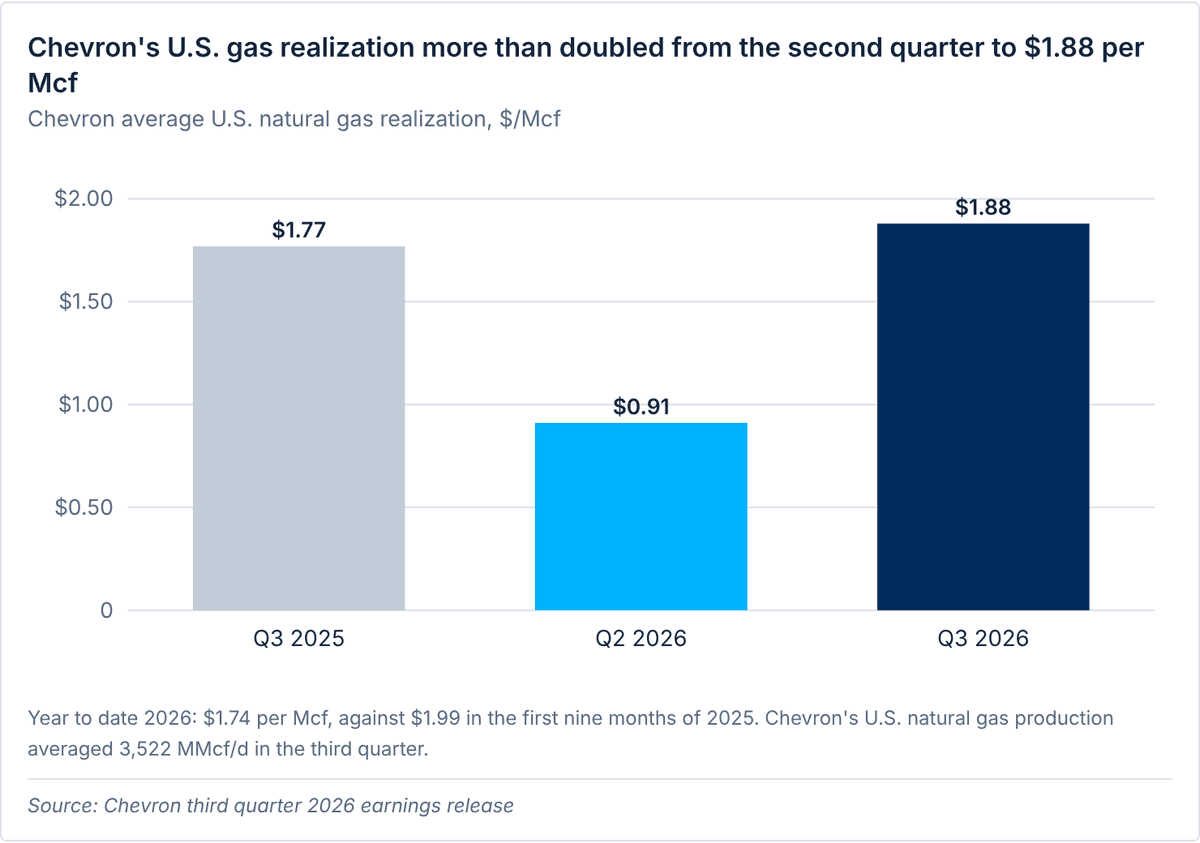
Chevron's average U.S. natural gas realization was $1.88 per Mcf in the third quarter, up from $0.91 in the second quarter, on U.S. gas production of 3,522 MMcf/d.
Chevron signed agreements expected to cut its Bakken midstream costs by about 50%, subject to the closing of its Hess Midstream transaction, and Nelson said it will move from three rigs to two in the Bakken at year-end while sustaining 180,000 barrels of oil equivalent per day.
Chief Financial Officer Eimear Bonner said Project Kilby, a 2.67-gigawatt behind-the-meter power project in West Texas with a 20-year power purchase agreement with Microsoft, is on track for first power in 2028 as Chevron works toward a final investment decision.
Permian Plateau
Chevron said the Permian recorded its sixth consecutive quarter above 1 MMboe/d in the third quarter. An analyst said Permian production was "off a little bit" while still above the 1 MMboe/d target, and asked whether that was normal quarter-to-quarter volatility or the kind of non-operated disruption a peer had mentioned. Nelson said Chevron has the inventory depth to grow above 1 MMboe/d but framed the Permian around maximizing free cash flow, and said that after six quarters at that level the number could go up 3% or down 3%, while Chevron sustains it above 1 MMboe/d. He said activity in Chevron's non-operated joint ventures has remained fairly stable this year, with possibly a small uptick in workover rigs that is not material.
Chairman and Chief Executive Officer Mike Wirth said the plateau Chevron has been managing since it passed 1 MMboe/d will last not only to the end of this decade but to the end of the next, and that he expects it to last well beyond that as Chevron applies more technology to the resource. He said technologies in drilling, reservoir stimulation and fracturing can extend the economic life of the plateau, make it economic to grow to a higher level and make currently subeconomic benches economic, and that, while he would not speculate on what might take Chevron back into growth mode, it is building the capability to do that economically if and when it chooses to.
"Our gas-to-oil ratio is relatively stable through the end of this decade. And so we can maybe take advantage of some other parties' challenges in this regard."
-Mark Nelson, Vice Chairman, Chevron, responding to an analyst's question about rising gas-oil ratios at peers
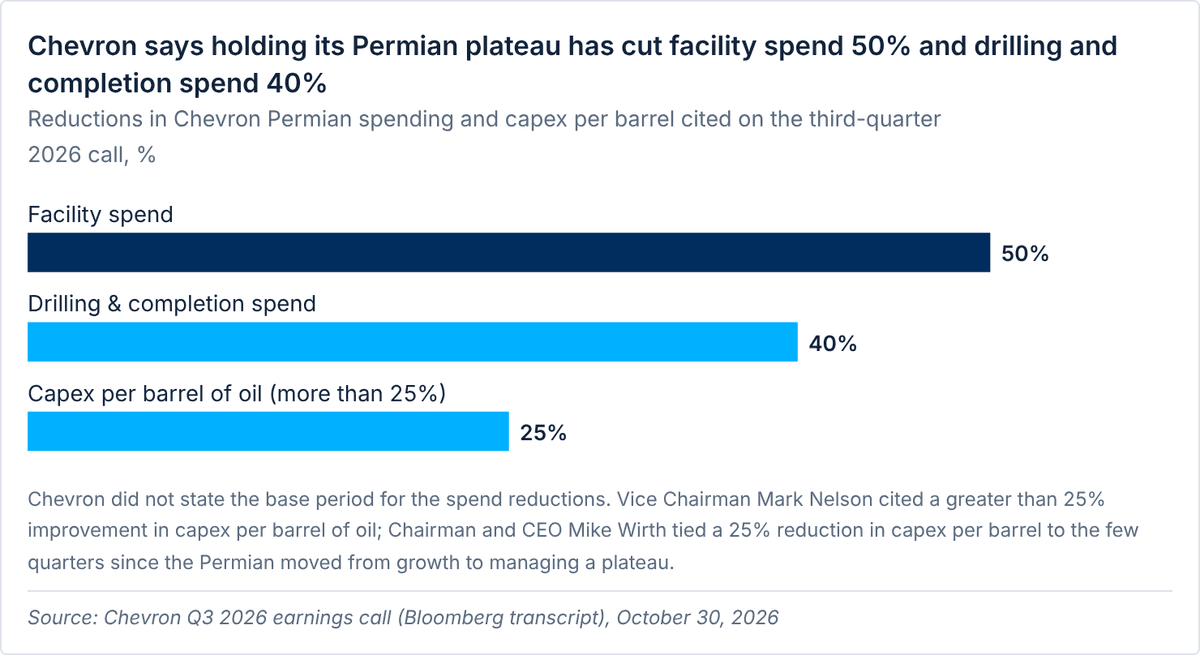
Wirth said that in the few quarters since the Permian moved from growth to managing the plateau, Chevron has seen a 25% reduction in capex per barrel, along with lower operating costs and fewer downtime events. Nelson put the improvement in capex per barrel of oil at greater than 25%, and said Chevron's Permian drilling and completion spend is down 40% and its facility spend down 50% because it is staying in that band. Chevron's U.S. upstream capex was $1.7 billion in the third quarter, against $2.4 billion a year earlier, and Chevron said its total third-quarter capex was lower than last year largely because of lower spend in the Permian Basin.
Nelson said advanced chemicals continue to deliver strong results in the Permian, increasing cumulative oil-equivalent production by up to 23% in the first 12 months. Wirth said a next generation of that chemistry is moving into field pilots, which Chevron is optimistic may prove even more successful in improving production outcomes.
Market impact: Chevron plans to hold the Permian above 1 MMboe/d, moving up or down about 3%, with a gas-to-oil ratio it calls relatively stable through the end of the decade, so it adds little new associated gas, neutral for Waha basis.
U.S. Production and Gas Realizations
Chevron's average U.S. natural gas realization was $1.88 per Mcf in the third quarter, up from $0.91 in the second quarter and $1.77 a year earlier. Its first-nine-months 2026 average was $1.74, against $1.99 a year earlier. Chevron's U.S. gas production averaged 3,522 MMcf/d in the third quarter, against 3,520 MMcf/d in the second quarter and 3,265 MMcf/d a year earlier, while its U.S. liquids realization fell to $62.72 per barrel from $70.80. Chevron's U.S. net production fell to 2,043,000 barrels of oil equivalent per day from 2,077,000 in the second quarter, with liquids down to 1,456,000 barrels per day from 1,491,000. For the fourth quarter, Chevron expects company-wide upstream turnarounds and downtime of 175,000 to 225,000 barrels of oil equivalent per day, including a major turnaround at Wheatstone LNG, curtailment at the Partitioned Zone and October downtime due to Hurricane Isaias in the Gulf of America.
Chevron does not break out its U.S. realization by basin or say what share of its U.S. gas comes from the Permian. By AEGIS's calculation, the Permian, at above 1 MMboe/d, is about half of Chevron's 2,043,000 barrels of oil equivalent per day of U.S. production (1,000 divided by 2,043 is about 49%).
Market impact: Chevron's U.S. gas output held at about 3.5 Bcf/d in the second and third quarters, through a second-quarter realization of $0.91 per Mcf, adding no new supply, neutral for Henry Hub.
West Texas Power Demand
Asked whether already permitted behind-the-meter sites such as Kilby carry more value, and how large Kilby could get, Bonner said Project Kilby is 2.67 gigawatts of power in West Texas with strong partners and a 20-year power purchase agreement with Microsoft. She said it is a behind-the-meter project that won't put pressure on the grid in the short term or raise prices, and that it uses non-potable water, which is why Governor Abbott announced on August 6 that it complies with the standards. Chevron could expand the project from single-cycle to combined-cycle, she said, depending on additional permits. Bonner said Chevron is working toward a final investment decision, is finalizing its engineering, procurement and construction contract, is working through the permit process and has to secure financing, and is on track for first power in 2028 and, per the call transcript, energization in 2031.
Market impact: Project Kilby has not reached a final investment decision, so it adds no firm West Texas demand yet, neutral for Waha basis for now.
DJ Basin and Bakken
In the DJ Basin, Nelson said Chevron achieved first-quartile reliability in the third quarter (on third-party industry benchmarking data, per Chevron's slides) by applying AI to anticipate and minimize downtime and by scaling learnings from the Permian, which reduced lost production events by 50%.
In the Bakken, Chevron signed agreements with Hess Midstream that it expects to reduce its Bakken midstream costs by about 50%, subject to the transaction closing, which Bonner said is on track for the end of the fourth quarter. Nelson said the lower tariff improves upstream returns, expands economic inventory and increases operational flexibility. Chevron will move from three rigs to two at year-end while sustaining 180,000 barrels of oil equivalent per day, he said, and will go from 60% long laterals this year to over 85% in 2027 while beginning to lean into advanced chemicals there. Chevron said its U.S. production rose 3,000 barrels of oil equivalent per day from a year earlier, mainly on higher Gulf of America production, partly offset by lower production in the Bakken.
Market impact: Fewer lost production events steady Chevron's DJ Basin supply, neutral for CIG Rockies basis; holding Bakken output at about 180,000 boe/d on two rigs is neutral for WTI.
Overall, Chevron held its Permian above 1 MMboe/d for a sixth consecutive quarter, said its Permian drilling and completion spend is down 40% and its facility spend down 50% as it manages that plateau, and said its Permian gas-to-oil ratio is relatively stable through the end of the decade. Its U.S. gas output was up about 8% from a year earlier (an AEGIS calculation), and Project Kilby is on track for first power in 2028 as Chevron works toward a final investment decision.
Get market insights delivered to your inbox — for free.
This website uses cookies
We use a few essential cookies to make our site work, including one that counts how many reports you have opened. Analytics cookies are used only with your permission, and you can change your mind at any time. Learn more about cookies in our privacy policy.