APA Restores Alpine High Gas and Says New Pipelines Are Strengthening Waha
AEGIS Automation5 min read
APA's U.S. gas output rose 29% from the second quarter to 521 MMcf/d, its U.S. oil beat guidance at 128,000 b/d, and it plans to add two Permian rigs around the turn of the year.
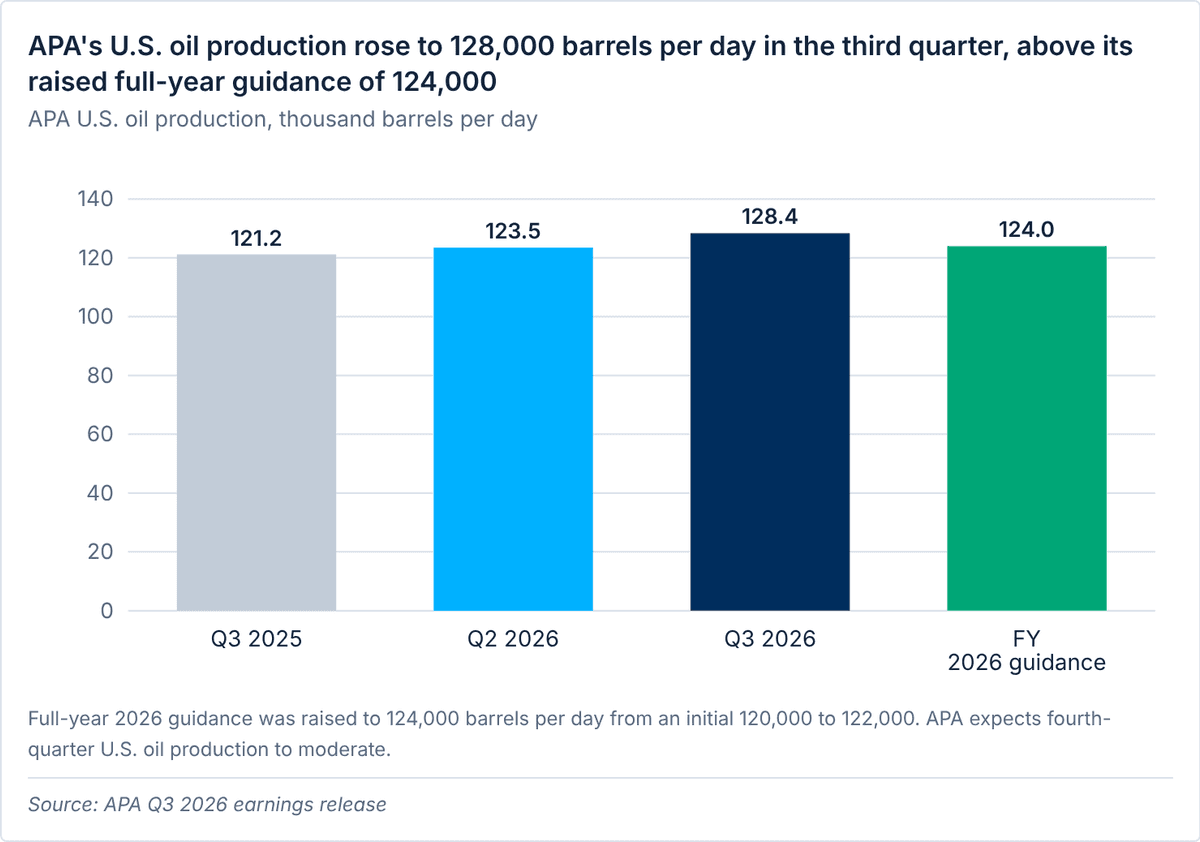
APA's U.S. oil production averaged 128,000 barrels per day in the third quarter of 2026, 4,000 barrels per day above guidance.
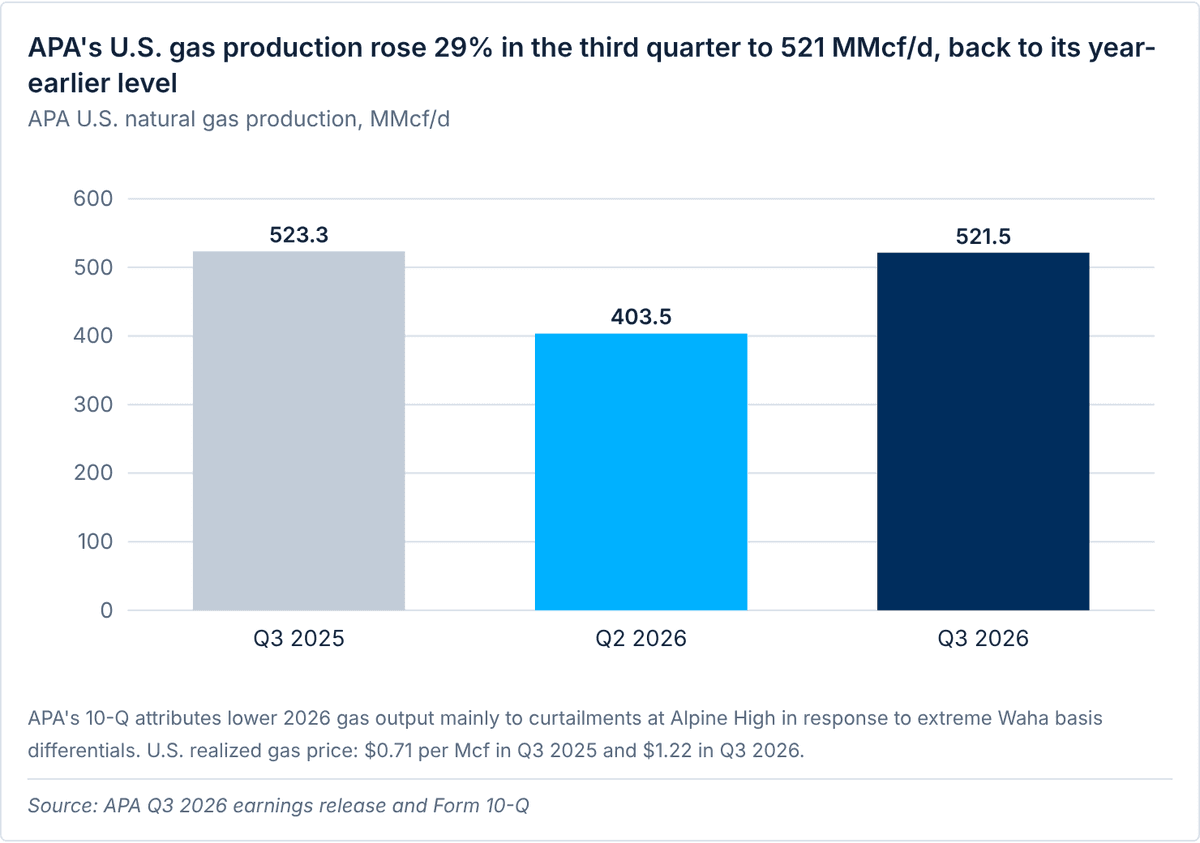
Its U.S. natural gas production rose 29% from the second quarter to 521 MMcf/d, level with a year earlier; its 10-Q cites lower Alpine High curtailments than a year earlier as wells shut in for uneconomic or negative pricing tied to extreme Waha basis differentials resumed production.
APA raised its full-year U.S. oil guidance to 124,000 barrels per day, above its initial range of 120,000 to 122,000.
Its preliminary 2027 upstream capital budget is about $2.5 billion, with two rigs added in the Permian around the turn of the year and similar U.S. and Egypt production expected.
Chief Financial Officer Ben Rodgers said new Permian pipelines coming on this year and into early next year mean "you're seeing Waha strengthen."
Permian Gas and Waha
APA's U.S. natural gas production averaged 521 MMcf/d in the third quarter, up 29% from 403 MMcf/d in the second quarter and level with a year earlier, and its U.S. NGL production rose 9% sequentially to 79,000 barrels per day. APA's 10-Q attributes its lower gas output in the first nine months of 2026 mainly to increased curtailments at Alpine High in response to extreme Waha basis differentials, including periods of negative pricing, and, comparing the third quarter with a year earlier, cites lower Alpine High curtailments as production resumed from wells previously shut in for uneconomic or negative pricing. APA realized $1.22 per Mcf for its U.S. gas in the third quarter, against $0.71 a year earlier and negative $0.52 for the first nine months of 2026.
Market impact: APA's 10-Q says production resumed from Alpine High wells that had been shut in for negative Waha pricing. More supply is bearish for Waha basis.
Firm Transport and Gas Trading
APA's 10-Q says it holds about 750,000 MMBtu/d of firm capacity on Permian Basin pipelines, and that at the end of September it had basis swaps buying Waha and selling Henry Hub on about one-third of that capacity for 2026, locking in part of the cash flow from its gas trading. The 10-Q lists those swaps at 22.5 million MMBtu for the fourth quarter at $1.96 below Henry Hub and 25.6 million MMBtu for 2027 at $1.52 below; after the quarter APA added another 29.2 million MMBtu for 2027 at $1.64 below, or about 80,000 MMBtu/d by AEGIS's calculation.
Rodgers said the gas trading portfolio should generate about $950 million of pre-tax cash flow in 2027 at strip prices set the week before the call, probably in the mid to high $800 millions at current prices, after about $1.1 billion this year. He said the Permian firm transport portion has shrunk as expected.
"You've seen a lot of new pipelines not only be FID'd recently, but also coming on this year, and that's going to continue into early next year. So you're seeing Waha strengthen."
-Ben C. Rodgers, Executive Vice President and Chief Financial Officer, APA
Rodgers added that Gulf Coast prices are still low compared with global LNG prices and that he expects that to continue next year.
Market impact: APA said new Permian pipelines coming on this year and into early next year are strengthening Waha. New takeaway is supportive of Waha basis.
Permian Oil and 2027 Activity
APA's U.S. oil production rose 4% sequentially to 128,000 barrels per day, which the release attributes to high uptime, earlier turn-in-lines and strong new well performance in the Permian Basin. Faster drilling cycle times let APA pull some completion activity into the fourth quarter, adding $30 million to 2026 Permian capital, and it raised full-year U.S. oil guidance to 124,000 barrels per day; it expects fourth-quarter U.S. oil to moderate with the timing of turn-in-lines and seasonal weather.
President Stephen Riney said APA runs three rigs in the Midland Basin and one in the Delaware and will add two rigs around the turn of the year. Chief Executive Officer John Christmann said its activity split this year was about 85% Midland and 15% Delaware, likely moving to about two-thirds and one-third, and over time to the 60/40 mix of its inventory. APA's preliminary 2027 upstream capital budget of about $2.5 billion includes more Permian activity, and Christmann said the program should deliver similar U.S. and Egypt production year over year.
Market impact: APA raised its full-year U.S. oil guidance to 124,000 barrels per day, above its initial 120,000 to 122,000. More supply is bearish for WTI.
Egypt and Suriname
In Egypt, gross production was about flat sequentially at 206,000 BOE per day, gross gas production rose to 542 MMcf/d, above guidance, and gas realizations increased to $4.34 per Mcf from $4.23. APA expects Egypt gross production to rise slightly in the fourth quarter. In Suriname, Christmann said the GranMorgu development remains on budget and on schedule for first oil in mid-2028, with two exploration wells planned with its partner in 2027; exploration and GranMorgu account for about 60% of APA's planned capital increase in 2027.
Market impact: GranMorgu remains on schedule for first oil in mid-2028. More supply is bearish for deferred Brent.
Oilfield Inflation
Signal
Direction
Evidence
2027 Permian costs
Up
Rodgers said the preliminary 2027 Permian outlook already incorporates mid-single-digit cost inflation.
Fuel
Up
Savings across APA's assets absorbed $40 million of higher diesel costs in Egypt this year.
Efficiencies
Offsetting
APA is pursuing Delaware Basin efficiencies that could offset inflation; they are not reflected in its outlook.
Rodgers said APA's focus in 2027 is sustaining its cost savings and driving further reductions "as we navigate industry-wide inflationary pressures," and Christmann said the remainder of the 2027 capital increase, beyond exploration and GranMorgu, comes from Permian activity and modest inflation. APA is expanding power projects in Egypt to cut diesel use.
Market impact: APA built mid-single-digit cost inflation into its 2027 Permian outlook. Higher service costs are supportive of deferred WTI.
Overall, APA's U.S. gas production rose 29% from the second quarter to 521 MMcf/d, level with a year earlier, and its 10-Q cites lower Alpine High curtailments than a year earlier; its CFO said new pipelines are strengthening Waha. U.S. oil beat guidance at 128,000 barrels per day, full-year U.S. oil guidance rose to 124,000, and APA plans to add two Permian rigs around the turn of the year while expecting similar U.S. production in 2027.
Get market insights delivered to your inbox — for free.
This website uses cookies
We use a few essential cookies to make our site work, including one that counts how many reports you have opened. Analytics cookies are used only with your permission, and you can change your mind at any time. Learn more about cookies in our privacy policy.