Prompt month natural gas prices traded sharply higher this week following a pipeline outage in the Northeast. The October contract gained 23c to settle at $3.15/MMBtu but traded as high as $3.30/MMBtu. The Winter ‘26/’27 strip finished the week at $3.39/MMBtu but traded up to $3.53/MMBtu during the week. The Summer ’27 strip was relatively unchanged and continues to trade just above $3/MMBtu.
Gas prices moved higher throughout the week, starting on Tuesday with a 15c gain. However, this move was dwarfed by a 26c gain on Thursday. On Thursday morning, Columbia Gas Transmission (TCO) declared force majeure after a mechanical issue was detected on the Mountaineer Express Pipeline. Flows were reduced to zero, stranding 1.8 Bcf/d in the Northeast, and reducing southbound flows out of Appalachia. A timeline for when the pipe would be returned to service was not given, leading to a sizeable move across the next several contracts. While the Winter ‘26/’27 strip gained 10c on the week, it was initially up about 15c. Prices pulled back somewhat on Friday, but the date on which service will return to normal remains unknown. According to data from S&P, Lower-48 gas production fell to 107.5 Bcf/d, compared to 112 Bcf/d last week. Supply had already been moving lower this week, but the outage exacerbated it.
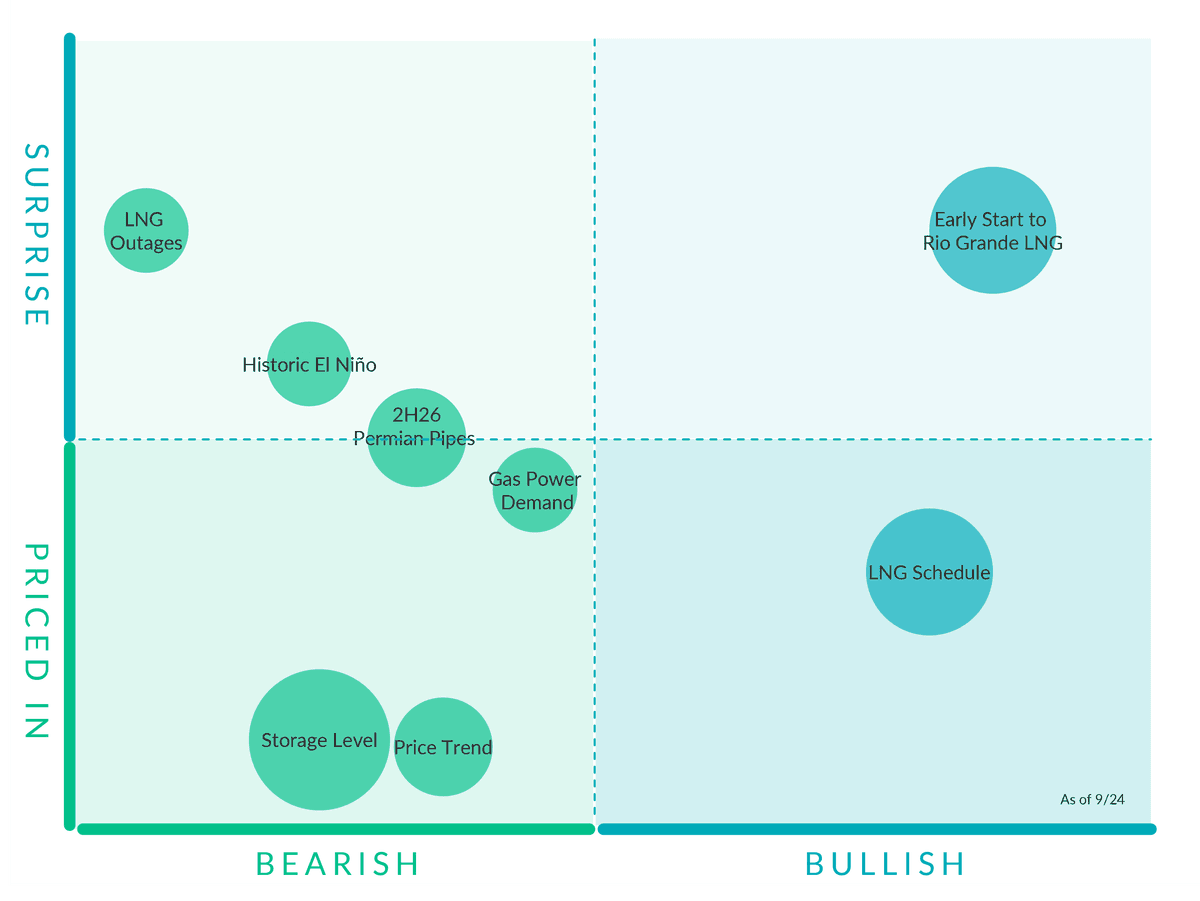
The substantial price move may have also been somewhat driven by short covering, as speculators have built large short positions in NYMEX Henry Hub. According to data from the CFTC, non-commercial traders held the largest net-short position since 2020. As the TCO outage sent prices higher, some traders likely had to cover short positions and this may be what resulted in materially higher winter prices, despite the likelihood that the outage is resolved by then. Market participants will be awaiting new information from TCO on the outage as they attempt to price in the full impact. If the outage were to continue longer than a few days, the reduced supply will begin to result in smaller storage builds.
Basis pricing was also impacted. With 1.8 Bcf/d of gas now stranded in the Appalachian basin, Northeast basis weakened, while downstream points strengthened. This drop in takeaway capacity has come at the same time that Cove Point LNG has gone into its yearly maintenance. These factors combined, may result in production curtailments in the Northeast, until demand and pipeline takeaway normalizes.